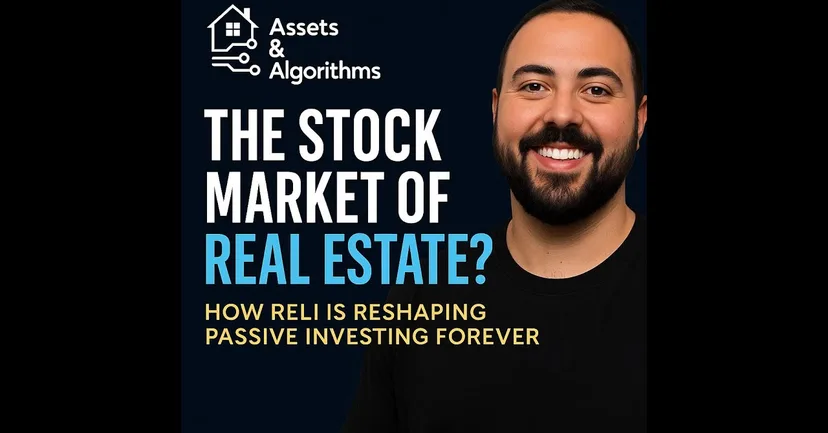
Relli co-founder and CEO Mor Milo joined Derek Moore on Assets & Algorithms, a show about real estate and technology, to talk about how Relli got started and how it works with sponsors and passive investors. They cover Mor's path from watching his parents' rentals to building Relli, how Relli reviews sponsors before they list, the hardest parts of building a two-sided real estate marketplace, and where Relli is headed. The episode, "How Reli Is Reshaping Passive Investing With The Stock Market of Real Estate," was released July 1, 2025 and runs 27 minutes.
Editor's note: first published July 2025, so some details have changed. Today Relli is a marketplace where investors review offerings from reviewed sponsors, express interest and talk to each sponsor directly, and each offering page shows its own minimum. Target returns are projections, not guarantees.
Watch on YouTube.
Key takeaways
- Relli is Mor and Ross Iannarelli's fourth startup together. Mor grew up watching his immigrant parents build a small rental portfolio, and wanted the benefits of real estate without the work of being a landlord.
- Relli is a marketplace where accredited investors find passive real estate offerings from sponsors across the country.
- Relli sits in the middle and does not invest in the deals it lists. Before a sponsor can list, Relli reviews their documents, experience and track record. As Mor puts it, no one can guarantee anything, and every investment has risk.
- Relli also works with partners and service providers, such as PM Real Estate Services, so sponsors and investors can find the professionals they need in one place.
- The hardest part for many sponsors is building a brand and following up consistently. A qualified lead may take months, and a few deals, before they trust a sponsor enough to invest.
Full transcript
Lightly edited for clarity. Section times match the YouTube video.
Welcome (0:00)
Derek Moore: All right. Welcome to Assets & Algorithms, the show where we explore the intersection of real estate and technology. Today I have my guest with me, Mor Milo, the founder of Relli. Thanks for joining me. I'm excited about this conversation, because you guys are described as the stock market of real estate, right? And you're aiming to democratize access to real estate investments. So I'd love for you to elaborate on your background, how you founded the company, a little bit about how the model works, and all of that good stuff.
How did Mor's background lead to Relli? (0:37)
Mor Milo: More than happy to. First of all, Derek, thanks for having me on. I think it all goes back to my parents coming to this country from the Middle East when I was four months old, living very humble beginnings, and slowly but surely building a small portfolio of real estate that helped them build some form of foundation in this country as immigrants. I watched them create this small portfolio of single-family houses and apartment homes, and I watched them go through the heartache and headache of dealing with tenants. But I also saw them really help themselves by investing in the asset and holding on to it long term, being frugal and consistent, doing things in a simple manner, putting tenants in the buildings and making sure they paid consistently. It really intrigued me. I loved the idea of getting into real estate, but I didn't want to deal with the headache.
At my pinnacle moment, I guess you could say, I had a fork in the road when I was about 24 years old. I had an opportunity to purchase a one-bedroom apartment for about $90,000 in a very affluent community in Southern California. It was a great opportunity to buy a piece of property at a very low entry point in a really great community, and today, after eight or so years, that property has probably tripled in value. When that opportunity was presented, I had a choice: either follow in the footsteps of my parents, start investing in real estate, keep working a corporate job and feed the real estate portfolio, or learn how to build a tech startup with my friends.
I chose to build a tech startup with my friends, and I learned a lot. But unfortunately, three failed businesses later, I looked back on my decision at that fork in the road and said to myself, "Wow, I'm really dumb. I should have bought that piece of real estate, because now it's worth about 400 grand and I could have bought it for 90." That's a really simple way to multiply your money. I turned to my business partner of five years at the time, eight years now, and said, "Dude, I know that all the rich people put their money together, half a million dollars, a million dollars at a time, and go buy assets. I want to do the same thing, but I want to do it with five grand." I wanted to get back into the real estate game, or at least take my first stab at it. But I didn't want to be active. I wanted to be passive. I wanted to learn underneath somebody who had a track record of success. But as a non-accredited person, and we'll get into what that means in a minute, as someone who wasn't a high net worth individual, I didn't have access to those real estate syndications and funds.
So we went on this journey to figure out how we could get an average Joe like me to invest $100 or $1,000 or $5,000 into a piece of real estate, because we wanted to be investors in that. We wanted to create that for ourselves. We had stocks, we had crypto, we had mutual funds, we had bonds, but we didn't have real estate, because the barrier to entry was really high and we didn't know what we didn't know. That set us off on the journey to build Relli, which is our fourth startup together. Over the last three years or so, we've slowly but surely chugged along building our first product and getting it to market. We just launched our first product in April of 2025, which is very exciting, and we're already starting to see some results, which is also very exciting.
How does Relli work today? (4:07)
Mor Milo: Unfortunately, we're not going to the retail consumer like me, who could invest $100 or $1,000 into a deal. We had to start by meeting our customers where they were, and our customers are real estate development firms that are raising capital. Their ideal investor is what's called an accredited investor, which is a higher net worth individual. The way the SEC defines it is someone who makes over $200,000 a year as an individual, or over $300,000 with a spouse, or someone who has a million dollars in assets outside of their own home. So somebody who qualifies with $200,000 in individual income, $300,000 in joint income, or a million dollars in assets outside of their home can come on our online platform and find real estate deals across the country that they can passively invest in, that are available to them today, and that maybe they didn't know about yesterday.
So we're really excited to bring that to the market, help the market in the way it currently operates, and then slowly but surely start to trickle in some of those more friendly opportunities for an average Joe like myself to invest $100 or $1,000 or $10,000.
Derek Moore: Listen, that's an awesome story. I love that you have that experience of seeing the difference real estate can make in someone's life as an investor. I think that really is an amazing idea, and as I've told you, I think this is where real estate is going, right? Being able to digitize it, transact, and meet, work with and invest with people from all over who have the same interests. So congratulations on your launch, congratulations on the results you've been seeing, and thank you for that wonderful explanation of your journey.
How do Relli's partners fit into the ecosystem? (5:56)
Derek Moore: I want to talk a little bit about some of your recent partnerships. You have a partnership with PM Real Estate Services and LandCare LLC. Talk to me about how these collaborations enhance the value proposition for investors and sponsors on Relli.
Mor Milo: Well, the beauty of what we're doing is that we're trying to create an ecosystem for everything commercial real estate. The main two functions are dedicated to active real estate developers who are looking to raise capital, and passive real estate investors who want to deploy their money without having to put their hands in the actual work. What we learned through this process was that real estate developers and passive investors are consistently looking for great partners to work with, because there are a lot of moving parts in building real estate. You have architects, auditors, inspectors, lawyers, accountants, you name it. And to really create that ecosystem, we couldn't forget to include the strategic partners who can help these real estate developers build property and help our passive investors properly position themselves to grow their wealth, because everybody needs help. It doesn't matter who you are. In order to grow, you need help.
So we created the platform with that in mind, knowing we would have lots of different professionals and experts who could help other people grow their wealth, grow their businesses and scale. At the end of the day, all boats rise with the tide. If we can bring everybody together in one place, then we can help everybody together, and we're really excited about that. We like to think of anybody on our platform as a partner. If you're an accredited investor deploying your capital completely passively, we're here to partner with you as the concierge that connects you with those real estate developers. If you're a real estate developer, we want to partner with you to provide an awesome marketing and technology experience so you can enhance your business and grow. And finally, we partner with the strategic partners and experts on our platform who can deliver the value our investors need on a day-to-day basis. So we really wanted to bring that ecosystem together, kind of like what you're doing with your platform here, right? You're trying to bring together all the nuance of what's happening in the digital world and real estate. So I'd be curious to know how you're doing it on a daily basis as well.
How is proptech changing? (8:18)
Derek Moore: Well, for me, it is a balancing act. You have to understand what someone's mission is, and at the same time understand how impactful it can be and how it relates to the industry. There are a lot of surprises out there, things I wasn't aware of, and it's a discovery process for me as well, having these conversations. So I'd say it's exciting. Proptech hasn't really been a topic for very long, so it's all new. And like you said, the rising tide raises all boats, right? I think we're at a really exciting time where we're watching the tide rise in real time, and we're seeing which boats really get going.
Mor Milo: I agree with that statement entirely. And I'll tell you, it's been really interesting to be involved in the proptech world over the last three years, because I was such a stranger to it beforehand, right? I'd never spent any time in commercial real estate. I'd never been in the real estate tech space specifically. So when I walked into it, it was really interesting to see how much people want to work together today and help one another out, but also how little diversity there is in the backgrounds of the people building in proptech. What I think makes us kind of special is that my business partner and I are actually not real estate guys. We're corporate guys, business administration guys, marketing and sales guys who are tech builders. So it's really interesting to walk into this industry with a completely different bias and have to learn everything in real time, and we think that positions us to really deliver value in the space.
I think more people are seeing opportunity in real estate because it's an antiquated industry that needs to be freshened up and brought into the 21st century. The majority of the decision makers in the industry, the real estate developers, sponsors, fund managers, lenders and so on, are on the older side of the spectrum and are slowly but surely starting to phase out. And we're starting to see a trickle of newer professionals coming into the space, not only requesting better technology, but needing better technology to compete with businesses that have been around for a longer time. So it's a very interesting space. I think you brought up a very good point that the proptech world is evolving right now.
Derek Moore: Absolutely. And I think that is a great point. We're getting a lot of new talent coming into this space, a lot of younger talent, and they are craving that technology. Because real estate is so antiquated, it's not there yet, but it's being built in real time. At the same time, they're also asking for things like transparency and accessibility to information and data in real estate and real estate investing.
How does Relli keep its marketplace transparent? (11:14)
Derek Moore: I'd love for you to talk about how Relli makes sure transparency and accessibility, as principles, are upheld on your platform.
Mor Milo: That's a great question. I think it's really important to know something special about our platform, which is that we're not an asset manager, and we're not involved in the deals directly. Relli sits as an intermediary. We don't have a dog in the race. I don't have special interests with certain real estate developers. We have an online platform that markets these offerings in a way that gives passive investors a little bit of education and a bit more of a handholding experience, and gives them the space to learn what options they have, so they can take educated steps toward making those investments in different deals across the country. So one thing that really ensures our ability to be unbiased is that we don't participate in any given asset.
For us as an organization, it's really important that we have systems in place to take in the documentation delivered by these real estate investment opportunities and properly underwrite and assess them, so we know the sponsor has gone through the proper steps to legally and compliantly offer this investment opportunity, from a financial perspective, from a securities perspective, from a legal perspective and from an operational standpoint. So we do our due diligence. We cross our T's and dot our I's and collect all sorts of documentation from the sponsors to make sure they're of a high quality. Obviously, we can't guarantee anything. Any investment you participate in has risk. Our job is not necessarily to go through their business with a fine-tooth comb and examine every single deal. Our job is to make sure this person is qualified in their previous experience, in their results and in their track record of success. Then, should they qualify and have enough weight under their belt, I guess you could say, we'll offer them a space to advertise their offerings on our platform.
As we continue to evolve this business, we plan on integrating more of the financial components into it, so that an investor like myself or like you could invest $100, $1,000, $10,000 and manage every dollar they've invested in a consolidated portfolio, just like they invest on Fidelity or E-Trade or Robinhood or Binance, so you have that investment experience in one place. With that additional consolidation also comes additional due diligence. We would then be taking on more responsibility as a registered entity with FINRA or the SEC, to make sure the securities offered to average consumers and accredited investors have gone through the right steps to be properly vetted before they can be offered. It's a very highly regulated industry. There are a lot of steps between approaching a sponsor to raise their deal on the platform and actually putting it on the platform, and we like to make sure we only have really high-quality deals there, only deals we would want to invest in personally.
Derek Moore: I love that. It sounds like you take it extremely seriously, which is very important, to make sure everybody is protected as much as possible, while also navigating the nuance that this is investing. There are risks you should be aware of, and you have to have a vetting process of your own before making an investment. I love that, man. It sounds like the proper way to digitize the entire transaction and really create the stock market of real estate.
What's working, and what's hard? (14:49)
Derek Moore: I'd love to jump into what's working well for you guys, and maybe some of the challenges of building that two-sided marketplace for real estate. Talk to me a little bit about the satisfactions and the disappointments.
Mor Milo: There's no doubt there are many, many challenges. It's also safe to say that many previous competitors have fallen in their attempt to create something along the lines of what we're creating. So we know this is an uphill battle. What we're very excited about, however, is that the strategic position of being the middle ground and not being involved in the deal lets us scale with as little risk as possible, so we can provide really clear value to our customers, our real estate sponsors, by advertising their deals in a very attractive way. So number one, we're very excited about what the platform looks like. In our opinion, it's by far the most attractive way to view a real estate syndication on the market. Not being involved in the deals also gives us an advantage in the way we advertise, because we come across as a third party that wants to give the investors, the limited partners or passive investors, a concierge-style service where we don't have a bias on where they invest. That gives us a better relationship with the limited partner, so they feel confident that we're here to support them, and we don't have a dog in the race in regards to where their money goes. Some of our competitors don't exactly have the same scenario.
We're also extremely excited about the venture capital investors we have coming on board. All of our angels, for the most part, are directly active in real estate in one way or another. They are either previous founders from companies like RealtyMogul, founders of real estate funds with hundreds of millions of dollars in assets under management, or they're in some way, shape or form aligned with the real estate world. Either they personally invest in real estate out of their own portfolio, or they're a subcontractor or contractor directly in the real estate construction world. So all the people coming around our community are partners, strategic investors or active real estate developers, which is all we could ask for, because we get the best feedback from the people directly and actively participating in the market. It's real time, it's detailed, it's significant and it's consistent, which is exactly what we want as an early-stage startup: consistent, high-quality feedback we can iterate on at a high frequency. So great stuff there, lots to celebrate.
Let's dig into challenges, because I feel like challenges are sometimes under-advertised. They're not talked about. This business has had its fair share of challenges. We've had to keep the same North Star, but shift and pivot our execution strategies many times to get to a place where we now have a little bit of revenue coming in and a sustainable model, a foundation from which we can continue to build and grow at a significant rate. For example, this business unfortunately lost two of its co-founders in the last two years. That's part of building a startup. There are going to be people who come on board thinking it would be one way, it turns out to be another, and it doesn't work out. You have to make adjustments and shift, and we did that phenomenally. We protected our business and set ourselves up to win, because this isn't our first time around. We've had founder issues in previous businesses, so when it came to bringing on new founders, we set ourselves up to win. But it's still been a challenge. No matter which way you slice it, even if you're protected as a business, when someone who was operating in the business is no longer there, you have to fill the gap. So that comes with its own set of challenges.
Other challenges that are more real estate specific, or commercial real estate specific, come from the fact that our customers have been burned many times before. Our customers have been told over and over again that there's this platform or this company that will help them raise money, they have to pay a bunch of money, and then maybe it will find them that money. Usually it doesn't work out for them, because there are no guarantees in this space. There are no guarantees in this industry, especially when it comes to raising capital. I don't care who you are. Even if you're the most competent broker-dealer or capital raiser in the market, there's always the inherent risk that your deal isn't going to click with investors, and you'll spend a lot of time and money on a deal that doesn't get funded. So it's really important to us to consistently get feedback from those customers, try to understand their struggles, and also give them some insight into how difficult it is to build a market like this.
Marketing is something very new to the industry, and it can be challenging. Getting a real estate developer who is looking to raise $25 million in the next 60 to 80 days to come on the platform and spend money advertising their deal, without a promise of return, is a conversation we have to have with the sponsor so they understand: maybe you don't get an investor in the first month. Maybe you get a really highly qualified lead, and that lead turns into an investor six months from now, because they've watched you go through two deals and now they feel like they can trust you and deploy capital with you. You have to build that relationship over time. Real estate developers and fund managers, for the most part, aren't used to the idea of building brand equity, building a consistent brand that makes retail investors, whether accredited or non-accredited, feel enough trust to give them money. So that's a huge learning experience. Some of these developers are excellent real estate sponsors who know how to build anything in their asset class, but they're not great corporate salespeople, right? They don't have systems in place to take a lead, plug it into a marketing campaign with consistent outreach, and have someone pick up the phone and do that kind of work. So there are a lot of growing pains from that perspective, which can be challenging.
As a corporate salesperson myself, and my business partner was also a corporate salesperson, we know how difficult it is to get someone to engage with you when they're cold, even if they sent in a lead, because you need to be top of mind. Attention spans are short, right? If you're not quick to move and you're not in front of that person consistently, you're not going to get the results you want.
Derek Moore: Educating people in that process can be challenging.
Mor Milo: Absolutely. And there are many others. I could go on and on all day, right? Compliance and legal is huge. There are plenty of challenges, and the game plan for us is to be persistent and keep working through them as they come. There's a saying that there's only one way to eat an elephant, and that's one bite at a time.
Derek Moore: Absolutely. I love that. I think that perfectly shows exactly how that journey gets completed, right? One step at a time. You handle the challenges as you come across them, and you celebrate the successes, no matter how small or large they are.
Where is Relli headed? (22:27)
Derek Moore: I have one final question before I let you go. You've shared a ton of insights, and I really enjoyed learning about Relli and the journey. I'd like to know where you see the future of Relli, maybe six to 12 months out, or even further. How do you see Relli, and how do you plan to achieve that vision?
Mor Milo: I'll give you what I think we are today and what our aspirations are for 10 years from today. Today, we are a passive real estate investing marketplace, and we offer opportunities for passive investors to find deals across the country. It's really simple. We keep it simple, and we want to keep it that way for probably the next 12 months or so. We're going to focus on building a foundation where we can deliver a great marketing tool to real estate sponsors and give passive real estate investors an awesome experience where they can dig into these opportunities and learn what this stuff is all about at a high level, with us, in a low-risk, low-pressure environment. We're extremely excited about that, and we know it's needed in the market.
Ten years from today, however, we see ourselves as truly the stock market of real estate. We see ourselves being similar to a stock exchange, with listed offerings all across the country, from all different asset types, that accredited and non-accredited investors can participate in. We want to become the place where someone can create an account and manage their entire real estate portfolio from the comfort of their couch on their phone, just like they do on their Fidelity app, their Charles Schwab app, their Binance app, wherever it is that they invest. We want to give them the same experience, which includes active trading with real liquidity on institutional-grade real estate assets. This has never been done before. And I believe this marketplace will be the future of commercial real estate, just like how Grant Cardone, Fundrise and Arrived Homes have built massive businesses off of advertising investment opportunities to the public and giving people access to an online platform they can consistently invest in, aiming to deliver returns from cash flow and equity growth. We can do the same thing, but give people choice across the country and in any type of asset class: big deals, small deals, short-term deals, long-term deals, cash flow deals, equity deals, balanced deals. We can provide all of that in one place. That's what we're excited about, and that's what we're building. That's our North Star. That's where we're going.
Where can people find Mor and Relli? (25:11)
Derek Moore: Listen, man, that sounds amazing. I'd love to see that in the real estate industry. Like you mentioned, this has happened across a ton of other industries, and you mentioned a few cases of people trying to do it in real estate who are missing that last step. For that to be your North Star, I'd love to see it come to pass. I appreciate you sharing all your insights. I want to give you the chance to let people know where they can find you, if they want to invest, if they want to look at investments. Where can they find you, Mor?
Mor Milo: Yeah, there are lots of places to find us. You can check us out on just about every social platform. Usually it's @InvestWithRelli, so check out InvestWithRelli, R-E-L-L-I. You can check out our website. That's our platform, and you can see all of our deals on there. Once you make an account, you can pull all the documentation and do whatever browsing you'd like. The website is relli.co, R-E-L-L-I dot C-O, so not .com, .co. And you can check me out personally on LinkedIn. I'm very active on LinkedIn, so if you want to connect with me in any way, shape or form, check me out: Mor, M-O-R, last name Milo, M-I-L-O. And you're welcome to shoot me an email if you have any direct requests or connection interest. My email is super straightforward. It's my first name at relli.co: mor, M-O-R, at Relli, R-E-L-L-I, dot C-O. That's the way to get hold of me.
Derek Moore: All right. Wonderful. Thank you for joining me, and thank you for sharing. This has been another episode of Assets & Algorithms.
Listen to the full episode
Assets & Algorithms is hosted by Derek Moore. Learn more about how Relli works or review current offerings.
