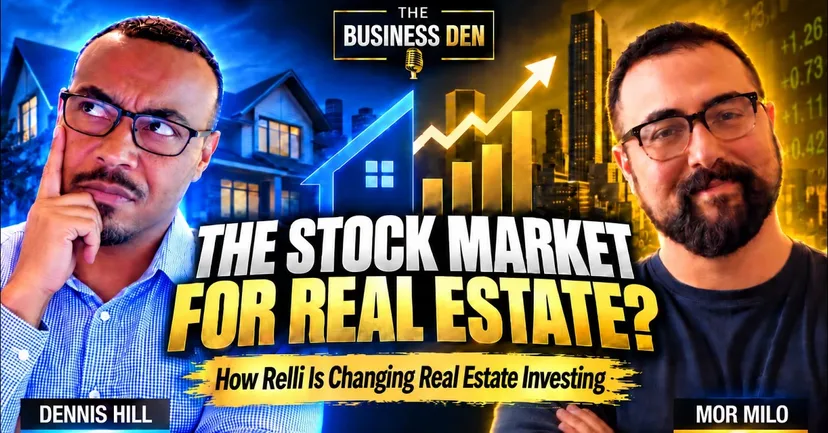
Relli co-founder and CEO Mor Milo joined Dennis Hill on The Business Den podcast to talk about how Relli connects investors with real estate sponsors, and what he sees changing in real estate and AI. They cover how growing up around his parents' rentals shaped Relli, what investors own in a private real estate deal and how they get paid, how Relli vets operators, whether there is a bubble in real estate or AI, and why sponsors need better follow-up with investors. The episode, "The Stock Market for Real Estate? How Relli is Changing Real Estate Investing," was released September 17, 2026 and runs 43 minutes.
Editor's note: first published September 2026, so some details have changed. Today Relli is a marketplace where investors review offerings from reviewed sponsors, express interest and talk to each sponsor directly, and each offering page shows its own minimum. Plans described in this episode, such as a Relli-managed investment with a $1,000 or $100 minimum, are not part of Relli today. Target returns are projections, not guarantees.
Watch on YouTube.
Key takeaways
- Mor grew up helping his immigrant parents run their rental homes, and wanted the benefits of owning real estate without the landlord work.
- In a private real estate deal, investors put money into the business that owns the property; the operator raises that equity (often 20 to 30% of the price) and a bank lends the rest.
- How investors get paid depends on the structure: note and debt offerings target regular distributions, while some equity deals pay little until the property is sold.
- Relli underwrites every operator before they list: business and offering documents, background checks, track record and past exits. As Mor says, every investment still carries risk.
- Mor's advice to sponsors: use a real CRM and follow-up process. It takes about six calls to reach someone, and investors need more than one email and one meeting before they invest.
Full transcript
Lightly edited for clarity, with a few short passages removed. Section times match the YouTube video.
Who is Mor Milo, and what does Relli do? (0:00)
Dennis Hill: All right, today we are joined by Mor Milo, co-founder of Relli. Relli is a private real estate marketplace based out of Irvine, California. Mor, welcome to the show.
Mor Milo: Thank you, Dennis. I appreciate you having me on.
Dennis Hill: Yeah, I'm very excited about this conversation. We've had brief conversations before, but before we get to the real crux of what I wanted to talk about, why don't you share with our audience who you are, a little bit about your professional background and your current role at Relli?
Mor Milo: Sounds great. Hello, everyone. My name is Mor. I'm the CEO and co-founder of Relli. I have a wonderful business partner named Ross Iannarelli, and four years ago or so, we set off on the journey to create a stock market for real estate, with the goal of being able to invest in real estate the same way you invest in stocks on the stock market. Essentially, what our business does is help investors connect with real estate development companies, debt providers and fund operators that are raising capital to deploy into institutional-type real estate assets: big multifamily deals, hotels, medical office facilities, student housing, all sorts of unique, large real estate opportunities that people have been raising capital for over decades, probably longer, where you, as an average Joe, can now participate in some of these deals like the institutions do.
How did growing up around rentals shape Relli? (1:25)
Dennis Hill: Nice. Okay. So we talked previously, and you mentioned that your parents were in real estate. Talk a little bit about what that journey was like, witnessing your parents in real estate, and the influence they had on your career choice.
Mor Milo: No doubt. My parents came to this country as immigrants and worked their butts off, and what they decided to do with their money was invest in property. They bought their home, then they house hacked it, bought another property, and moved from one property to the next, buying as they went, holding on to those properties and becoming the landlord of each one after they moved to the new one. They amassed a small fortune for themselves that generates consistent cash flow that outpaces the W-2 income they earn. That has been an incredible way for them to build wealth, to build security and to have something to pass down to me and my siblings, and it has created a wonderful life for them.
The only thing I saw that I really did not like was the process of being a landlord: managing tenants, dealing with toilets and trouble and trauma and all the things you don't want to deal with. I learned this firsthand. As the son of an immigrant family, you're the free labor, right? So I would run around and help with all the things. We went through evictions, remediations and inspections; we did all of it. The biggest turnoff for me was dealing with the property. I wanted access to the asset, but dealing with the property sucked.
So my business partner Ross and I are now on our fourth startup. We had three startups that didn't end up working out, but what really worked for us was investing in stocks. We did really well with that. We made a bunch of money. We're still not accredited investors, which is a certain designation that qualifies you for certain types of deals, so we only had access to what everybody has access to: the stock market, cryptocurrencies, bonds, things of that nature. He and I both had the same sentiment. We both wanted real estate, but we didn't want the headaches. So we said, all right, how do we build a stock market for real estate? How do we create the same type of environment we invest in on Fidelity, E-Trade or Charles Schwab, but in commercial real estate, managed by great operators who are actively raising capital for every one of their deals? That's what spurred this business: taking the wealth-building tool I saw my parents use to get us to where we are today, and trying to figure out a way for the average Joe to participate with as little as $100 in the same type of assets that the ultra wealthy and massive institutions invest in every single month.
Dennis Hill: Nice. Boy, the experience you gain as a child is invaluable. You can't put a price tag on that, because you already knew what you liked and didn't like about real estate. I'm sure it probably saved you years of growing pains. You didn't have to explore what it was like to be a landlord; you actually lived it.
Mor Milo: Well, look, I am not currently a landlord in any way, shape or form. I support my parents in being landlords, and it gave me the ability to say, okay, I really like these things, I really don't like these things. How do I get everything I want without the things I don't? Originally, my business partner and I came from Fortune 500 companies doing sales and marketing, so over the last four years we had to immerse ourselves in commercial real estate, which is a slightly different business from retail or residential real estate. It works off different variables. It's much more market dependent, the debt is much shorter in term, and the amount of money that needs to go into these businesses is astronomically large. We had quite a learning curve figuring out where we needed to go and how we could deliver great results, because we didn't come from the industry. But the North Star of wanting to create that stock market for real estate, because of what I saw my parents go through as landlords, bolstered me to do this with my business partner and get through the obstacles, because we did have a little bit of context.
No matter which way you slice it, until the money is yours and the responsibility is yours, and you're the one who signs on the line and deals with the consequences, it's not the same. So although I'm very grateful, because I learned quite a bit from my parents about how that process works, I don't think I learned it the way they did by doing it themselves. And I think the biggest opportunity there is that, in the world we live in today, for someone to invest in the same type of property my parents invested in 25 or 30 years ago, the numbers are multiples. That property value is a multiple. So for people in my generation, people older than me and people younger than me, it's very difficult to now come up with $150,000 when you used to be able to come up with $20,000, $30,000 or $50,000 for the down payment on that property.
One of the things we're trying to take from that experience of being an investor in real estate is the concept of having skin in the game, because until you have skin in the game, it's really hard to learn things. For example, when I talk to my friends about investing in stocks: if you've never invested in stocks, take $100 and invest in 10 companies, $100 each, for a total of a thousand bucks, just to be in the market. Because now you have skin in the game, and the second you have skin in the game, you're watching the market, you're educating yourself, you're interested in the news, you want to learn what's happening.
And one of the biggest difficulties in real estate is this: my parents were able to make it happen 30 years ago because they saved and worked their butts off for every single penny. We were super frugal growing up. We had very little money, and now they're doing well for themselves. But coming up with $100,000 for a down payment to get skin in the game and have access to the asset is really hard. What we're trying to do is get to a place where anybody can have skin in the game with $1,000, which is the first level we're going to try to get to, and then eventually a $100 minimum investment, where anybody can put their money in the pool and watch the investment: watch it grow, watch it lose money, watch it break even, whatever happens. You're involved in the process, so you're learning from the process. I think that's the biggest thing I'm taking away from their experience: how do you get skin in the game, so you care enough to participate and course correct? So, to wrap up that very long-winded little spiel, what we're taking is the essence of entrepreneurship and boiling it down to a much more manageable, digestible first dollar.
How does Relli work with sponsors today? (8:33)
Dennis Hill: Nice. Okay, so your minimum investment is currently...
Mor Milo: Currently it's $25,000. Our first target is $1,000, and the next target is $100. The way our business works today: there's a massive market of real estate development firms in the world, and they raise money from super high net worth people. They're stuck in 1999, just like everybody else in real estate. And there's a huge gap, a huge problem for them, which is that they need to get better at sales and marketing so they can get in front of more investors and keep growing their businesses. What's happened is money has become very expensive. Real estate development firms that used to be able to go to big pension funds and raise $10 million, $20 million, $50 million at a time are finding those pension funds distracted by debt that's very attractive. So that money is more competitive, and now they're saying, okay, we need to go out to the average Joe and find a way to get them to give us money and participate in our deals. But the majority of operators in the marketplace don't have branding, don't have marketing, don't have CRMs and don't have processes. More than that, they're limited to working only with what they call an accredited investor. Have you heard that term before, Dennis?
Dennis Hill: Yes.
Mor Milo: So, for the audience: an accredited investor is a person who makes either $200,000 in income alone, $300,000 with a spouse, or has a million dollars in assets outside their primary home. Those are the people who qualify for these types of investments, and they're very hard to find, because they're a very small percentage of the market.
For these operators to get to the average Joe like me, who can invest $100, $1,000 or $10,000 at a time, a lot of digital function needs to go into their businesses that they don't know how to manage yet. So today, what we do to help them start that journey is connect the dots between those higher net worth individuals and those real estate development companies. In the next 12 to 18 months, we intend to roll out a strategy where we will be able to arbitrage those private placement investment opportunities to the average Joe at a $1,000 minimum, so everybody can participate. The way that works, essentially, is we will be the sponsor of the fund, like Fidelity, E-Trade or Charles Schwab offering you an index fund or a mutual fund. We will offer you a vehicle to invest in these opportunities that you would normally never see and never have access to. That's the first step to bringing in the average Joe: getting them in at a $1,000 minimum in the next 12 to 18 months, into these really great deals from operators with a great track record that have been in the market for decades.
What do investors own, and how do they get paid? (11:13)
Dennis Hill: Gotcha. So in a traditional real estate transaction, when someone purchases a home, they sign a note, they have a mortgage. What is their proof of ownership once they become an investor with Relli?
Mor Milo: Investors on Relli participate with the sponsors directly in those individual investment opportunities. We have a range of different offerings. You can invest in a fund that has a bunch of different properties in it, you can invest in an individual syndication, which is a specific property they're raising capital for, or you can invest in different types of debt vehicles, like hard money loans, mortgage notes and things of that nature. Depending on your strategy, you can mix and match whatever you choose.
Now, the investment is into the business that owns the property. Just as an example, let's say we're raising capital for a 500-unit multifamily apartment complex. You probably see them every day when you go to work. The way those deals get done is very similar to the residential market. There's an equity component and a debt component. The equity component is how much money you're going to put up toward the purchase; the debt component is the bank covering the rest. The operator takes responsibility for a deal, then goes out to investors and syndicates capital: they raise money for that particular deal.
For example, let's say you're raising money for a $100 million property, just to keep the math even. Just like in residential, you're going to have 20 to 30% that you have to put up front. That's your down payment. Same concept. So you're looking at somewhere between $20 and $30 million you have to come up with in cash, so the bank can give you the rest of the money. The real estate developers and operators raise money for that equity component, the down payment. They'll say, "Dennis, Mor, we need money for this down payment. Come give us $100,000, come give us $200,000," whatever the number is, $20,000, $50,000, "come participate in the deal. We'll give you equity in the business that owns the property."
You invest your capital into the business, which the operator manages. The operator then puts down the capital with a bank that funds the note. Sometimes there are multiple banks, because it's a bit more complicated on the debt side, but for the sake of ease, the bank provides the debt, and then the operator runs the business, generates the cash flow and pays out distributions to the passive investors like you and me who put in $25,000, $50,000, $100,000 or $200,000. So the underwriting is based on that individual business, which owns a property alongside debt provided by a banking institution, and you're a partner in the business that owns that property. Just like the stock market, same concept: you're buying shares in a business, and you participate in the returns based on the structure of the deal.
Dennis Hill: Gotcha. Okay. So what are the potential returns? How are investors paid? Is there a dividend? Is there appreciation? And how are funds distributed to investors?
Mor Milo: Each offering is different. Some are based on a note, where you're targeting a consistent cash flow distribution on a quarterly basis for a certain amount of money. Some are based on an equity investment over a 10-year period, where you're not going to see money until the exit, and the goal is a big check at the exit. It's very dependent on what you choose. You can see distribution timelines where someone writes you a check every single month, every quarter or every year, or you could have no distributions at all, focused only on equity, in which case you'd have more equity in the property and the goal is a big check at the end. So it's totally up to you and what you like to invest in. Each structure has its own benefits.
How is this different from tokenization? (14:53)
Dennis Hill: Okay. So I've been learning a lot about the tokenization of real world assets. How does this differ from tokenization?
Mor Milo: Great question. Tokenization is a concept that allows a data set to be managed in a way that's transparent and, to a certain extent, tamper-proof, and what tokenization allows for is securing data. Now, tokenization of real world assets may or may not have to do with investment. It's really just a process of taking a specific asset and managing all of its data in a way that's super secure, based on a blockchain, smart contracts and all sorts of technology associated with decentralized finance.
Now, in order to actually sell an investment opportunity on an online platform for tokenized real world assets, there has to be a securitization component. They both need to be there for an investment to be a real world asset and a fractional investment you can give money to. Otherwise, you could have a tokenized piece of property that is completely independent of anybody or anything, and they're just managing their data through tokenization. On the other side, you could have a crowdfunded opportunity with as little as a $100 investment into a piece of property that runs on a tokenized infrastructure.
All that to say: the tokenization component is an infrastructure layer. It's a data layer that lets you manage and secure data. The component associated with investments is securitization: that's the SEC, that's managing compliance, that's the stock market, et cetera. You can have them both working together, or you can have them separate. What we do is advertise securities and exemptions from securities registration, so we advertise investment opportunities. We could have a tokenized asset on our platform, but there are very few in the marketplace, and just because an asset is tokenized doesn't mean you can invest in it.
Dennis Hill: Gotcha.
Mor Milo: So we only offer the investment opportunities. The investments are based on the SEC's rules and guidelines, whether you can invest, or a high net worth investor can, whatever it is. The tokenization component is strictly an infrastructure layer.
How does Relli vet operators? (17:14)
Dennis Hill: Got it. Okay. All right. In a previous conversation, you talked about giving everyday investors access to operators who have already delivered returns for high net worth investors. How do you evaluate or select the operators and opportunities available through the platform?
Mor Milo: Great question. Every operator that gets on our platform is underwritten. We ask that operator for a bunch of information, specifically business documentation and all the investment documentation. We do background checks: we actually go out and learn who these people are who run these businesses, and run background checks on them to make sure they're not bad actors and don't have any nasty skeletons in the closet. Then we do the due diligence on the deals to make sure the T's are crossed and the I's are dotted.
Now, we can't guarantee any sort of investment. Just like any other investment in the world, you take on risk. But what we can do is due diligence on the people behind the investment. Do they have a track record? Do they have investors who have already invested with them? Do they have deals they've exited in the last five years that have been successful? Have they lost money? Have they made money? We go out and ask all of those questions on behalf of the investor, and we do that underwriting before they ever end up on the platform.
Dennis Hill: Nice. Awesome. Okay. So is all of that information made available to potential investors?
Mor Milo: All the documentation is made available. We don't make the background checks, or the additional checks we do that might go a little deeper, available to the market. Although that is a very interesting question. Maybe we could do that. That sounds like an interesting idea. We haven't implemented it yet, but I think it might be something we could implement in the future. I like that.
What shifts is Mor seeing in real estate? (18:59)
Dennis Hill: So what major shifts are you seeing in the real estate market?
Mor Milo: I think it's a mixture of things; it depends on the lens. From an asset perspective, I think a lot of people have veered away from multifamily in the last year or two and started shifting toward storage, hospitality and retail, which have done really, really well. But with that shift away from housing, we have newfound need, right? We're under-deploying capital into those assets because of the emotional feelings of the market. So we're seeing that there are probably going to be some openings for new multifamily opportunities in the Sun Belt, which has been very popular but still seems to need more supply. That's really interesting.
In terms of debt, I think operators are shifting their perspectives. For a very long time, they've been hesitant to deploy capital in anticipation of rates going down. With what we're seeing in the market, rates are going up. What that means for operators is they need to change their strategies. They're shifting their underwriting: how they buy these properties, how much money they need to put into each property, and which properties they're looking for, so they can get good returns on the back end. That might be a bit more conservative. Maybe instead of the low-20s targets we were seeing two or three years ago, we're now seeing targets in the high teens or low teens, but on conservative, well-underwritten deals, where we're taking a long-term perspective based on today's rates, not the astronomically low rates we saw three years ago. That's an interesting thing we're seeing in the market.
And lastly, I think the equity stack is changing. More and more, institutions are seeing opportunities in the secondaries market, with startups that are IPO-ing and going through their funding rounds, and with debt opportunities that are low risk but still provide great returns. Some of the institutional players that were very excited about real estate equity have shifted their energy, which is creating a ripple effect throughout the market, where operators are consistently trying to position themselves toward retail. What we see across the board is that there's an entirely different method for getting an average Joe, a retail investor with a little bit of money, to put it into a deal than for getting an institution. Institutions are pragmatic. Institutions want deals. Institutions have to deploy capital, because if they don't, they get in trouble. So they have a certain way of doing business, and operators are bringing that mindset into the retail community.
But for retail people, even someone worth $50 million, it's their personal money. That $100,000 or $500,000 or a million dollars is a chunk of their assets, and that's an emotional decision as much as a logical one. Time and time again, we see operators making the mistake of drilling down on the deal and focusing on the logic, and not building relationships with investors so they feel comfortable investing in deals. So I think there's a big change happening in the way real estate operators are going to start branding themselves. In the past, they've been quiet, unseen and elusive. Nobody knows who you are; it's "my buddy knows a guy who knows a person." I think we're slowly but surely shifting to where real estate operators understand that good branding and marketing to show off their company and what they do is going to be pivotal moving forward. Those are the three big things I'm seeing right now.
Is there a bubble in real estate, or in AI? (22:38)
Dennis Hill: Gotcha. So real estate values have seemingly increased significantly over the past 10 years, I'd say, and inflation seems to continue to erode the value of the dollar. So my question is: do you think we're sitting on a real estate bubble?
Mor Milo: That's interesting. I think we might have a debt bubble. I think some debt people might be in a little bit of trouble. I'm almost certain we're sitting in an AI bubble, and maybe an aerospace bubble. But in terms of real estate valuations, I don't know. What I do know is that residential is probably going to be a little more consistent than commercial. I think commercial is going to have its day. Residential paid the piper in 2008, and has paid it once or twice since with little corrections, but commercial real estate has not, and I think it's probably time for commercial real estate to pay the piper. So we'll probably see valuations of some of those bigger properties change and drop, and we've already started to see that. Whether that trickles down to the residential buyers' market, I don't know. But with prices increasing over time, and debt now being very expensive, I anticipate there might be a crunch in pricing in the coming 12 to 24 months. That's what I think is going to happen: there's going to be a compression of pricing. It won't be 2008, but we will see compression as we reset the commercial real estate industry.
Dennis Hill: Gotcha. Okay. So you just mentioned something I thought was interesting. You said you're almost sure there's an AI bubble. Can you elaborate on that?
Mor Milo: I'd be happy to. Do you use AI today in your business?
Dennis Hill: Every day.
Mor Milo: Amazing. Who's your favorite?
Dennis Hill: Claude.
Mor Milo: Claude is mine. How much do you pay for him?
Dennis Hill: $20 per month.
Mor Milo: Beautiful. How much do you use him every day?
Dennis Hill: I'd say a couple of hours per day. I try not to spend too much time in it.
Mor Milo: You're using 50 times the amount of compute you're paying for. Think about that. You're paying $20 and getting hours of daily usage, which is costing a lot of tokens on a monthly and annual basis. And who is subsidizing it today? The investors. The investment capital poured into Anthropic, OpenAI, Grok, you name them, is subsidizing your usage. At the top tier of their enterprise business, they have tried to roll out usage-based pricing, and they have been incredibly unsuccessful, because although everyone talks about how much they use AI, the second they start pricing it based on usage, people are no longer as interested. Why? Because the pricing outpaces the cost of employment. Why? Because energy is the commodity this entire industry runs on, and we are nowhere near efficient enough to keep scaling. Not to mention, the quality of the outcomes isn't declining; it's still growing, but instead of growing at an exponential pace as it once was, it's growing at an incremental pace. That incremental growth, with exponential use of power, reduces the value of the product over time. And the second they start to actually make you pay for what you're using, you will stop using it. That's what they're all terrified of, so they're all racing to IPO, because they understand that concept. Sure, they're making money, which is great, but they're not making money fast enough to cover their burn.
So, all that being said, of the winners in the bunch, there'll be a handful. Think of it like the dot-com boom. We're going to have 10 companies that do really, really well, that deliver products people use every day, that make sense financially and can scale and grow. The rest are going to get wiped off the board. They're going to clean the board, and then we'll go into wave two. When they clean the board, most of these companies will fall through the floor, which means the venture capital firms that invested in them will fall through the floor, and the private equity firms that bought into their secondaries will fall through the floor. And the people who pay are the investors, not the operators, because remember, the private equity company still takes its fees, and the VC still takes its fees. The investors are going to feel the pain. The pension funds are going to feel the pain. As a whole, in my opinion, that's the recipe for disaster in the AI space.
And mind you, I'm invested in Nvidia. I'm a happy Nvidia investor. I personally invest in the picks and shovels. I don't invest in the AI; I invest in the stuff they need to build the AI, because I know that no matter what we do, the chips are going to be more and more important every single day. So, all those things together, with the circular finances running around, where they're borrowing from Tom to pay Paul, and Paul is borrowing from Jim to pay back Tom, it's a cycle of money, and eventually it's going to catch up with that entire space. There will be some winners. I think Anthropic will win, OpenAI will win, Google will win, Perplexity will win. Higgsfield might win; they have a cool product. There are some players with good products, but the vast majority, I'd say 98% of the players in the market, are selling absolute garbage. So it's going to be interesting.
Dennis Hill: Gotcha. Yeah, my biggest concern with AI is the regulations and parameters we set. We have to be very careful with how we allow users to use the platforms, because there could be some really bad intentions. That's the scary part. And we're programming something that is smarter than we are, and it's just going to continue to develop and get smarter.
Mor Milo: It will. And did you see what Andreessen said about that very topic, regulation?
Dennis Hill: No, I missed that.
Mor Milo: He said we should keep regulation completely off and let competition take over. There are pros and cons to his argument. I'd say there are more pros than cons for him, and more cons than pros for us. But his perspective was interesting: at the end of the day, the regulators are 10 steps behind the operators, so instead of trying to regulate, let the market do what the market does. Create competition, leave the regulation open and let people push as hard and as fast as they can, because that gives startups a playing field similar to the big conglomerates. The second you start implementing regulatory compliance, you have additional costs, which the big boys can pay for but the little guys can't. Now, obviously, the counterargument is: if we just take all the rails off, what the heck is going to happen?
Dennis Hill: I don't agree with that at all.
Mor Milo: No, but the argument is interesting, right? And I think it comes back to your point: hey, guys, are we out in front of our skis here, financially, logically, ethically? And that's fair. It's okay to be out in front of our skis, but let's not pretend we're not. Let's be realistic about the fact that we're all out in front of our skis.
How does Relli use AI, and where do its leads come from? (30:21)
Dennis Hill: I hear you, brother. I'm with you. So that leads into my next question: how have you used technology and AI to scale your business?
Mor Milo: Oh, we use it every day, just like you do. We're also culprits of getting 100 times what we pay for when it comes to Claude. Claude's one of our best employees. Look, we've been running this for a while. We started this business before AI really started delivering results for everybody, and since the AIs have become effective, we've started implementing them. We've tried a lot of things. For example, the obvious one: adding a chatbot so people can talk about investments on your platform. No one used that. We've tried the telemarketing solutions. Not a good one; highly unrecommended at this time, emotionally. We'll get there eventually, but we're not there yet.
But Claude has been an absolute superstar. We no longer have to pay for outsourced IT work where people build software for us. It has created massive efficiency for a small business like ours in the things it's good at: coding, ideation, generating decks and things like that. It's really good at taking instruction on that. It's good at organizing data in systems and integrating with MCPs. That stuff it's good at. But beyond that, there hasn't been anything really revolutionary where we've been able to replace a human engagement with AI, minus the technical code stuff, which has been very efficient.
So we use it every day. We love it. We try it all the time, and we're always looking at new vendors. But it's stuff you have to stay on top of. Although maybe my macro perspective isn't attractive to most investors, on the micro level I'm very impressed with what we can do with these solutions, and we're just crossing our fingers that we never have to pay for the amount of actual usage we take.
Dennis Hill: So what sort of channels are you using to generate leads and manage those leads?
Mor Milo: A variety. We have a lead generation business, as it sits today, in terms of how we generate leads for our customers, because part of what we do is get them in front of accredited investors. We have a very sophisticated Meta solution that we've integrated with our platform, with some proprietary data we send back to Meta: basically advertising, collecting data, and feeding that data back into the ad platforms to improve results by optimizing for what we want. That's very slick stuff that works really well, and that's essentially what we deliver for our customers: a plug-and-play solution to get accredited investor leads on demand. That's the sponsor side, the sponsor pitch, and it works really well.
In addition to that, we do daily video and image content on LinkedIn, and we have daily content going on Instagram, Facebook, et cetera. That delivers a couple of leads per week in terms of organic. We get a lot more leads from sponsors looking to raise capital than from investors through that. We'll get somewhere between four and six people who show up on my calendar just from checking out our content. Then we have a bunch of different things in different places. For Google, for example, we have a little bit of SEO work that helps us. We have some AEO, which is AI engine optimization, improving those results, so anytime someone asks ChatGPT what the best place to invest in real estate is, we want Relli to be part of that conversation. And we're planning to roll out some interesting stuff on YouTube, probably in the coming quarters, which we're really excited about. It's really just seesawing between what works and what doesn't and trying to fix everything on the way up, as you probably know. But we have ourselves in a lot of different places, and all of the optimization, KPI management and ideation for new campaigns, we run through Claude, which has all of the information on our platform, all of our code, all the information on our customers and all the information on their deals. That way we can integrate everything and put it all in one place.
Dennis Hill: So what metrics are you most focused on improving as you continue to grow the business?
Mor Milo: For us, it's focused directly on our customers. It's all about lowering the cost of capital and improving the quality of lead flow. The most important KPI we're currently focused on is cost per meeting. That's a new one coming into the light, and we'll probably be very focused on it in Q4: how much it costs us to get a meeting on the calendar directly for a sponsor. Because what we're seeing is that sponsors need a lot of help. They need support with optimization: their messaging, their automations, their workflows. All that stuff is nonexistent. So we're doing everything in our power to close the gap between a lead being delivered and a meeting actually going on the calendar.
What would Mor fix with a magic wand, and what's next for Relli? (36:08)
Dennis Hill: Nice. Gotcha. Okay. So you shared a lot about making real estate more accessible, expanding participation and helping sponsors connect with investors. If you had a magic wand, what is one major challenge for Relli that you'd want to fix?
Mor Milo: The biggest thing I see across the board where we are right now: if I had a magic wand, I would wish that real estate sponsors had a real CRM with real workflows and knew how to manage their leads. It's kind of weird. When we first got into this industry, we were a small company, a small startup, a couple of guys who know how to do some stuff, and we went out and made stuff happen. What we discovered is that a lot of these companies, no matter how big, even with billions of dollars in assets, have operated the same way for the last 30 years and haven't changed. Most of their businesses run out of Google spreadsheets, and they're based on relationships they've had for years and years with people who just keep coming back to the same well.
Every time we talk to them about growing their business, everyone wants distribution. Everyone says, "Get me leads, get me distribution. We're going to close them. We're the best closers." But then what happens is you send them these leads, you work really hard to get them in front of who they want to be in front of, and the expectations for the next steps are missing. A lot of the time, I'll have sponsors who expect someone to answer on the first phone call, and if they don't answer on the first call, they won't call again, because they didn't answer the phone, so it's a bad lead. Meanwhile, we know it takes six phone calls to get someone to answer. That's the average: people answer one in every six calls when you cold call them. So if you're not making six calls, you probably aren't going to get them on the phone.
Not to mention, when you ask them, "Okay, well, what is going out to these customers? How are you building a relationship with them? How are you showing them you're worth talking to?" the response will be, "Oh, we send them an email." Okay, well, how many emails? What did you tell them about you? How are you presenting yourself to these people? And usually the answer is, "Oh, we send them one email, all about the deal: you should invest, come give us money." Okay, well, they're a stranger to you. They don't know who you are. You're going to need to give them a little more insight before you ask them for $100,000 of their hard-earned money, right? And once you get them on the meeting: guys, take the time to get to know these people. Maybe take more than one meeting before you ask them for their money.
So that whole process, from someone raising their hand and saying "I'm interested" all the way to a dollar actually being invested in their company, is broken. It's really broken, in a bad way, and most of these operators are so stuck in their ways that they don't even realize it. They can't see it.
Dennis Hill: Yeah.
Mor Milo: If I had a magic wand, that's the one thing I could snap into their brains: they need a good sales process if they want people to actually listen to them, have affinity for them, care about their brand and picture their money working on their behalf in that business. You have to build that. It doesn't just appear because someone raised their hand and said, "I'm interested."
Dennis Hill: Right.
Mor Milo: So I wish I could wave my magic wand and do that. But what we're doing instead, because I don't have a magic wand, is we're going to take responsibility for the dollars. As mentioned, we're planning to roll out an opportunity in the next 12 to 18 months where anybody can invest in these same types of deals as an arbitraged investment through Relli. We'll give you access to the deal that normally was only for super rich people, but Relli will be managing it for you. By doing that, we're going to lower the barrier of entry from $150,000 or $200,000 on some of our deals down to $1,000. Then my team will walk them through the motions, give them good customer service, show them how the systems work and walk them through the deals. That way, the operators can focus on operating real estate, and we can focus on making sure the investors feel good, are taken care of, feel respected and have their money in the right places. That's our solution to it, coming in the next 12 to 18 months, which means we'll be able to open it to everybody else. Because, you know, we feel the pain of our investors and our sponsors. We want them both to win, so we've got to go figure it out.
Dennis Hill: Got you. So you just answered a portion of my last question, I think, and that is: where do you see the company in the next six to 12 months?
Mor Milo: By the 12-month mark, I'd like to start building out what's called a Regulation A offering, which is a crowdfunding syndication that will allow me to arbitrage all of these private placements to the average Joe.
Dennis Hill: Nice. Fantastic. Well, Mor, this has been a fantastic conversation. I really enjoyed it. We talked about a lot: you creating the stock market for real estate, AI, technology and a number of different things. It's been very informative, and I'm sure my audience would agree. So before we go, how can people reach you?
Mor Milo: I'd love for them to come check me out, and even more importantly, check out Relli. The best place to come see us is relli.co, so R-E-L-L-I dot C-O. Check out our platform and create an account, and my team will reach out to you to schedule time for us to connect, so we'll meet directly. If you'd like to reach me directly, I'm very active on LinkedIn under my first and last name, so just look up Mor Milo. Or if you look up Relli Real Estate Investing online, you'll be able to find our company page, no problem. And lastly, if you'd like to follow content and see some cool educational stuff about the market, we post every single day. Look up @InvestWithRelli on YouTube, Instagram, Facebook, et cetera. We would love to have you be part of our community.
Dennis Hill: All right, fantastic. Hey, thanks again for joining us, Mor.
Mor Milo: My pleasure, Dennis. Have a great day.
Listen to the full episode
The Business Den is hosted by Dennis Hill. Learn more about how Relli works or review current offerings.