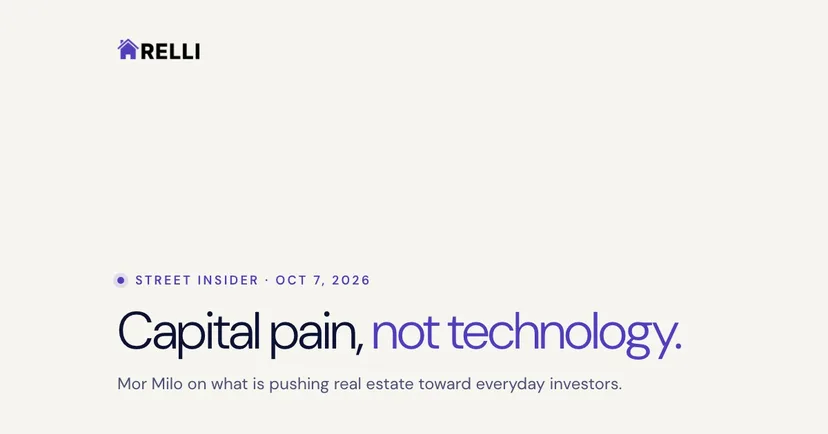
Relli CEO Mor Milo said in an October 2026 Street Insider article that the shift toward everyday real estate investors is driven by capital pain, not technology. Raising money has become harder and more expensive, he explains, so operators are building bases of many smaller investors, and regulation is the main brake on that growth.
Editor's note: first published October 2026. Today Relli is a marketplace where investors review offerings from reviewed sponsors, express interest and talk to each sponsor directly. Each offering page shows its own minimum.
Key takeaways
- Raising capital is harder than it has been in years. Investors burned by deals that underdelivered have grown more sophisticated and have more alternatives.
- Operators are moving away from relying on large family offices and toward many retail investors who commit $10,000, $20,000 or $50,000 at a time.
- Milo believes private real estate crowdfunding is on a path toward roughly $17 trillion, with tokenized real estate as a small slice of it.
- He names regulation, or "red tape," as the biggest constraint on the industry's growth.
By KeyCrew, Street Insider. Originally published October 7, 2026.
Fractional real estate investing is moving from niche to mainstream, with some projections putting the global private real estate crowdfunding market in the trillions over the next decade. Ask Mor Milo, co-founder and CEO of the commission-free marketplace Relli, what is driving that shift, and his answer is not technology. It is pain.
Capital Has Become Expensive
“Money is very expensive,” Milo said. Raising capital is harder than it has been in years, he explains, because investors have been burned by deals that underdelivered and have grown more sophisticated, with direct access to deal flow, technology, and alternatives. At the same time, the brokers who once funded these deals have become less effective, and investors are distracted by attractive competing options, from a stock market setting records to debt instruments paying steady yields.
The result is that real estate development firms are turning away from their traditional reliance on large family offices, which often hold leverage over their deals, and toward retail investors who can commit in increments of $10,000, $20,000, or $50,000 at a time. Building a base of many smaller investors, Milo argues, is how operators create durable, sustainable businesses.
Milo is bullish on where this leads. He frames tokenized real estate, often cited in the low trillions, as a small slice of a far larger private real estate crowdfunding market he believes is on a trajectory toward roughly $17 trillion, based on the industry’s growth over the past 25 years. Younger investors in particular, he says, want to make their own decisions and deploy capital digitally rather than defer to brokers and advisors who charged heavy fees.
The One Real Constraint
If there is a brake on all of this, Milo says, it is regulation. “The biggest issue that we have is red tape,” he said. “If there was less red tape in the industry, then this business would be much bigger than it is today.”
For investors, the takeaway is that the barriers separating them from institutional-grade real estate are falling, driven less by novelty than by necessity on the operator side of the table.
This article is for informational purposes only and does not constitute investment advice or a recommendation to buy or sell any security. All investments carry risk, including the possible loss of principal. Neither the publication nor the author can be held responsible for decisions made based on this content.
Originally published
- Street Insider, October 7, 2026
