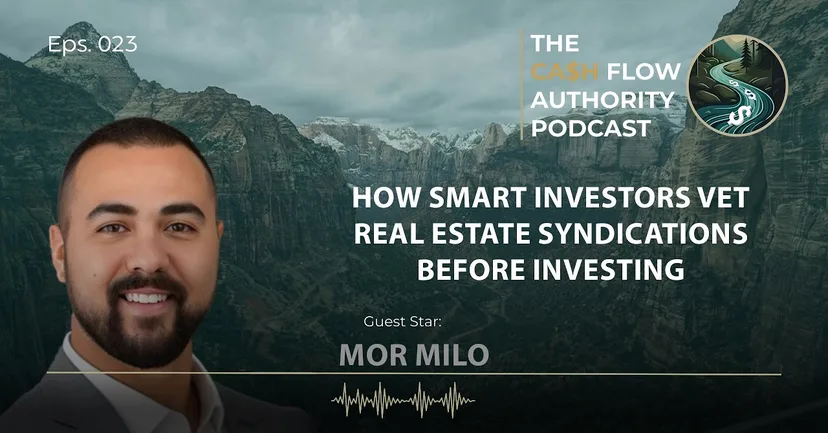
Relli co-founder and CEO Mor Milo joined Chris Jansen on The Cash Flow Authority podcast to talk about how passive investors can vet real estate syndications, and how sponsors can raise capital from individual investors. They cover REITs versus private syndications, Regulation D and crowdfunding offerings, how to stress test a sponsor's pro forma, and why consistent outreach matters. The episode, "How to Invest in Real Estate Without Becoming a Landlord," was released July 23, 2026 and runs 36 minutes.
Editor's note: first published July 2026, so some details have changed. Today Relli is a marketplace where investors review offerings from reviewed sponsors, express interest and talk to each sponsor directly, and each offering page shows its own minimum. Investors pay Relli nothing today, and sponsors pay to list. Target returns and projections are not guarantees.
Watch on YouTube, or listen on Apple Podcasts or Spotify.
Key takeaways
- Publicly traded REITs offer broad exposure, but private syndications let investors pick a specific property or small portfolio and deal directly with the sponsor.
- Read everything: the PPM (how the sponsor will operate), the subscription documents (what you're actually buying) and the offering memorandum and pro forma.
- Stress test the pro forma. Compare build or replacement costs, rent growth and occupancy with market data, then ask the sponsor to explain the gaps. How they answer tells you a lot.
- Ask whether an advertised IRR is the fund's or yours after management, acquisition and disposition fees.
- For sponsors, Mor's top advice is a CRM and consistent, automated outreach, because most interested investors watch a sponsor's content for months before they invest.
Full transcript
Lightly edited for clarity. Section times match the YouTube video.
Why do sponsors need a system for building relationships? (0:00)
Mor Milo: The number one recommendation I give any sponsor before they go out and advertise themselves to the world is to take the time to build a system that is capable of generating relationships with strangers, and getting them to a place where they feel comfortable to open their wallets and give them their hard-earned money. The only way to do that is through a large volume of outreach that's consistent and branded in a way where someone will feel an affinity for what your business does.
Chris Jansen: Welcome, my fellow Flowmasters, to another episode of The Cash Flow Authority podcast. I'm your host, Chris Jansen, founder of The Flow Authority. This show is for high-performing professionals who did everything right. You've got the degree, you've got the income, you've got the career, but you just feel like there's another level out there, something else waiting for you. Here we explore how real estate can become that next challenge worth building, so that you can take ownership of your future and create a life truly by design.
Who is Mor Milo, and what is Relli? (1:07)
Chris Jansen: Today I'm joined by another incredible guest, Mr. Mor Milo. Just a little background on Mor before we get started: Mor is the co-founder of Relli, a platform designed to democratize access to institutional-grade real estate investing. Lots of words; we'll unpack all this stuff as we go through. Together with his co-founder, Ross Steiner, he built Relli to function as the stock market of real estate, giving investors a way to discover, compare and invest in real estate opportunities with greater transparency and lower minimums. So welcome, Mor. Excited to have you on today.
Mor Milo: Hey, what's going on? I'm glad to be here. Thanks for having me, Chris. I do get to make a little tiny correction for you, though.
Chris Jansen: Oh, yeah, please.
Mor Milo: For some reason, someone put out the name Steiner for Ross, who's my business partner. His last name is actually Iannarelli. He would kill me if I didn't do this.
Chris Jansen: Wow.
Mor Milo: But it's not your fault. It's not the first time I've heard that. We're working on scrubbing it from the internet.
Chris Jansen: All right, well, thanks for the correction. I appreciate that. So tell me a little bit about this. This is an interesting idea. A lot of people just want to get into real estate, and they say, "Oh, I don't got the money." As a coach, I can help guide these people and show them different ways to fund deals without their own money. But this seems like another interesting way, where maybe you just have a little bit to put into it. How does this work? Talk a little bit about this model.
Mor Milo: The idea is to create a stock market for real estate, so that anybody can invest in real estate. I don't know if you've noticed, but we can bet, and I use that word very strategically, on anything in today's market using Polymarket or your favorite crazy betting site. If I wanted to bet on the color of the Gatorade at the Super Bowl, I could do that. But for some reason, passively investing in real estate syndications and funds is incredibly difficult. Our goal is to make that incredibly accessible and easy for people to understand.
The story really is that my business partner, Ross, and I have now built four startups. This is our fourth. After a few failed business attempts, we looked at the market and said, okay, what the heck can we do to bring value to people? We had both invested in stocks and crypto and done really well, but we didn't have real estate. We wanted to get involved, but we didn't want to have tenants, because I had watched my family buy single-family real estate for a long time. Very effective strategy. It made them lots of money and built lots of freedom and success for them. But personally, I wanted to be able to do something more passively. We discovered there were really no good options, even for high net worth individuals, to view and access deals all across the country, and eventually the world, in different sectors, from great sponsors with a track record, with a place to centralize all that information. So we decided to go out and try to build it.
Chris Jansen: Okay, awesome.
How do REITs compare with private syndications? (3:59)
Chris Jansen: So how does this compare to a REIT? Some people who invest in the stock market might see REITs and think, can I just go buy some shares in a real estate investment trust and call it a day? Frankly, I don't really know the difference between a REIT and all these other things. Why not just buy pieces of a REIT? I'm sure there are things you're not getting by buying a REIT that you would get being part of an actual syndication.
Mor Milo: Absolutely. REITs are phenomenal. We actually have a REIT on our platform today. A REIT is essentially a tax designation for a particular type of fund, with a requirement to return a percentage of the capital that's generated back to its investors. What you've heard of is publicly traded REITs on the stock market, where you can get a piece of the action of a big company that gives you a little bit from its whole portfolio of investments. Great way to go.
REITs that currently exist for the average consumer are few and far between, and normally don't give you much direct access to assets. So what Relli does is gather the syndications and funds available on the private markets from highly trusted sponsors who have done this time and time again, and bring them to a platform where it's centralized and an investor can see all the different options in one place, where we don't actually take any sort of commission. Our only goal is to give you access to the deals and connect you with the general partners who have hired us to bring them access to new investors. So we actually don't take the capital ourselves. We make a connection for our investors directly with the people they want to invest with, and they're able to have that private relationship to deploy their capital and pursue a return, with a lot more options when it comes to different types of assets.
And by investing in syndications, they can have direct access to a specific property or a small portfolio of properties, whereas with some of those larger REITs, unfortunately, you don't have a lot of control over where you're putting your money. You kind of give it to the company and hope the company grows in value.
Chris Jansen: I see. Okay. Makes sense.
How does Relli find and vet sponsors? (6:10)
Chris Jansen: So how do you find these sponsors? Are you vetting these deals yourselves? How does this whole thing work?
Mor Milo: We sure are. What you'll love to know is that there's a whole industry living behind closed doors, where private equity firms that focus on real estate development or real estate management have for generations been generating returns for high net worth individuals. Most of those deals were on a need-to-know basis. If you know the guy, you know the guy. That entire industry has been built on deals done within a closed network of people.
What's happened over the last 10 years is that many more sponsors have come to market with some of the new regulations from the JOBS Act. So now these sponsors are coming out to the market and saying, "We've delivered great results for a hundred, a thousand, ten thousand investors. Now we want to find new opportunities with complete strangers and give them access to our investments as well."
So what we do is find real estate sponsors with a hundred million, half a billion or multiple billions of dollars in assets under management and a proven track record of success, and we show them how to use our digital marketing solutions to get in front of new investors. By doing that, we give investors access to deals they normally would never hear of. And because we do it at scale with lots of different sponsors, we can show a diversified portfolio of different types of investments someone can invest in, all from the comfort of logging into our online platform.
What do Reg D and crowdfunding offerings cost sponsors? (8:05)
Chris Jansen: Gotcha. Okay. For those listening who don't know this: if you're a sponsor, or you're trying to get into multifamily and raise money for these deals, there's Reg D, Regulation D, 506(b), which is the friends-and-family, hush-hush, don't-advertise way of doing it that Mor was talking about. There's also 506(c), which you can advertise, but then everybody has to be accredited, and things like that. But these things cost 10 to 20 grand or so in attorney fees, just to file all the documents, be compliant and file this with the SEC. Do you do that for your sponsors on these deals? Is it a completely different exemption altogether? Is this a crowdfunding thing? And how does that compare on a cost basis?
Mor Milo: First of all, really astute questions. As you know, 506(b), just to give the audience the background, is only for that closed community. For the most part, the deals we see on our platform focused on accredited investors are 506(c) offerings: C as in cat, and C as in "see" with your eyes. Because you can see those offerings, you can generally solicit them on platforms like Facebook and Instagram and a platform like ours. The majority of the deals in the market that we work with are those 506(c) offerings. In addition to those exemptions under Regulation D, there's another set of exemptions through Regulation CF and Regulation A, which is what we see most often, where an investment firm can actually diversify its investor pool to the average consumer as well.
But as you mentioned, depending on the level of scrutiny from the SEC, there's a cost for legal and compliance to make sure you're doing everything properly. With a Regulation D, on the low end, you're looking at as low as $5,000. On the high end, you'll see boutique firms charging as much as $50,000 to build out your Regulation D offering. With Regulation A and Regulation CF, those numbers are jacked up a little bit, because quite a bit more goes into it from a compliance standpoint. But it also frees you up to offer investments to just about anybody in the United States over the age of 18, which is pretty amazing.
For a sponsor to be on our platform, they need to have a generally solicitable offering. Normally, we see sponsors with a little more of a track record and a larger AUM using a platform like ours. And we also see $10 million, $20 million and $50 million AUM sponsors (which I know sounds like a lot, but take one multifamily offering and you're already at $10 million) starting to build systems and use Reg D 506(c) so they can get out in front of consumers as well and find new investors for their deals. So although there are some costs, I'd say that in the last five to 10 years, that cost has come down dramatically, because of all the new technology tools that make some of the legal processing and word processing easier. And it definitely requires a little more legal and financial documentation to get into that game.
Chris Jansen: So it sounds like the sponsor has to go out and get the offering built themselves before they come to your platform, right?
Mor Milo: I didn't fully answer your question. We have relationships with attorneys who can deliver those solutions on all sides of the spectrum: the super affordable, technology-driven legal service that will deliver it for you for $5,000, or the super boutique, dialed-in firm that will handhold you through the entire process and charge you 50 grand. We have relationships across the board that we can introduce to sponsors, but that's something you want a legal professional to do on your behalf.
What should passive investors check before they invest? (12:12)
Chris Jansen: Got it. Okay. Makes sense. So going back to your model versus other models, if you will. And this question is also for listeners who want to get into passive investing generally, whether it's through Relli, a platform like Relli, or directly with a syndicator. What should passive investors look out for in the pitch decks, or what questions should they ask, like, "Hey, what's my actual return?" I've taken classes on this too, and they talk about how there are so many little tricks, and it's kind of messed up. So I understand why there's such heavy regulation around it. What are some things to look for, and questions to ask, to really pull out, "Hey, what are you actually projecting I'm going to get as a return?" Because I don't really care how the fund does. I care about the benefits to my pocketbook, baby.
Mor Milo: A hundred percent. Okay. Number one, I've never seen projections go any direction other than up and to the right. No matter which way you slice or dice it, the pro forma they deliver you is always going to be the rose-colored-glasses view.
Now, the number one thing I'd recommend is, first of all, get a team around you. So Chris, you building your community, bringing people together so you can have access to each other, rub up against each other and challenge one another: that's a great place to start. In addition, I'd recommend talking to someone who's invested in syndications before, talking to someone who represents you from a financial standpoint and manages your finances, and maybe even talking to a lawyer when you're looking through the documentation, to make sure you're confident. Now, I realize that's not feasible for everybody on every deal, every time they look at a deal, but that would be the ideal situation, and it's what we do internally to do our due diligence and make sure we know what's going on.
What I'd recommend any private investor do when looking at a syndication, once they receive all that documentation: number one, read through everything. Read through the PPM, the private placement memorandum, which is basically the big contract that gives you an idea of how they're going to operate. Read through the subscription documents, which tell you what you're actually buying. Are you buying membership interest in a company? Are you buying a promissory note that will pay you a certain amount of money over time?
How do you stress test a sponsor's pro forma? (14:32)
Mor Milo: And then also look through the offering memorandum and the pro forma. Instead of just looking at it and saying, "Okay, this looks good," take those numbers and stress test them. What is their cost to build per square foot? Does that correlate to the location they're building in? Are they building, or are they doing value-add? If the replacement cost is X, is that what we're seeing in the market? Or is it completely different in the market, and what they're providing me doesn't match what we know from the data?
At that point, either you say, "Okay, this is completely outrageous," or you go back to the sponsor and say, "We see that it costs $300 a square foot to build here. You're showing that replacement cost is $215 per square foot. What's the deviation there?" It's almost 33%. That's a big deviation. "Why do you believe you're going to be effective at delivering on that $215 a square foot?" And let them justify it: "We're vertically integrated, we already have all the hardware, we already have all the supplies, we're ready to go," whatever their story looks like. Then stress test the story, and ask why they think they're in this optimal position. Because as we know, what the pro forma says and what happens in reality are two different things.
At the end of the day, once you give them the money, it's their job to go deploy it. Your job as an investor is done the second the money is deployed. Before you deploy that money, you really need to understand the mindset of the sponsor: how they're going to overcome obstacles on the road to delivering on the product, and what their contingency plan is. If you take the time to stress test all those numbers, and stress test the strategy against what you've seen work in the market by doing some very simple research (you can use your buddy Claude, or whoever you choose from an LLM standpoint, and it'll deliver you all that information), you'll have an argument for the sponsor about what concerns you in their deal. They then have to justify those numbers back to you, and you can make a more educated decision.
What you'll notice is that if you stress test a sponsor and put them up against assumptions you've created, you'll very quickly see how ready that sponsor is to respond to those obstacles, because most people don't do that. If they're ready, have good responses and know what they're talking about, they'll actively prove it to you by telling you how they're going to be effective.
Chris Jansen: Or maybe your question will help them do a better job, like, "Hey, I didn't think about that. Let me get back to you and actually do the research I should have done." And then it's up to you if you really want to...
Mor Milo: But hey, to your point, I'd argue that's a good thing to hear. I'd argue that's someone who doesn't care what things look like. They care about results, if they say, "Ooh, I didn't catch that."
Chris Jansen: Look at that. As an engineer, and this came up on a recent episode too, as an engineer who's great at spreadsheets, I know how easy it is to fudge a number. Instead of 20%, make it 20.4, and it'll still round to 20. You know what I'm saying? There are all these hidden things you're just never going to see. And I'm not saying I do that, please, but I know others are doing that, and there are definitely ways to trick the system.
One other thing I remember from a class I took on launching a fund, which had a lot of overlap: a lot of funds and syndications will just advertise an IRR. But that IRR is for the fund. It's not your return. So just ask the question: is that IRR for the fund, or is that my IRR after management fees, acquisition fees, disposition fees and whatever other fees are included? And make sure you know what the fees are as well. As an engineer, and a lot of folks listening are in that kind of field, so they can all relate, we meticulously do that naturally. We go through and look at all the nitty-gritty details, and we're probably a nightmare for sponsors, because we ask all the questions they don't want to be asked. But peace of mind is everything.
And I think it's prudent to do that, because we're all trained to dump all of our money into the 401(k), into God knows what. Even when I knew nothing about stocks, I was still choosing, because I didn't want somebody telling me where to put my money. I was trying to research and look through all the documents: let me look at the returns, let me figure out what makes sense, so I can at least make some educated choice. Because all I ever heard was, "Have a 401(k), please have a 401(k), put all your money there, max it out." Anyway, I'm getting way off topic, but maybe you have some points on some of those comments.
Mor Milo: I think we do this. I do this. We do this across the board. I love the stock market. I love to invest in stocks, and I have friends who invest in stocks and have different strategies around it. What I've learned is that nobody's truly educated on this stuff. Usually the strategy is following somebody else's advice and doing what they do. Rarely do we take the time to understand why.
When looking at private syndications, especially in real estate, they're pretty digestible: here's the piece of property, this is what it does, this is how much income it generates, this is what we think the market is going to do in the next couple of years. What do you think? Are you interested? Whereas when you start looking at macroeconomics and the stock market, like how the chip industry is going to do with all the new stuff happening in the world, we make decisions on those types of investments without any knowledge, which we definitely should change.
And just like when you invest actively in a single-family residence or a multifamily deal, you're going to underwrite your deal. When you invest passively with an operator, it's even more important to do that underwriting, because that's the number one thing you can control. You can control where the money goes. So from that perspective, build a strategy to underwrite that deal just like you'd underwrite an active single-family deal, and have certain parameters you're looking for, so that when you find a new deal you know: does it fit what I'm looking for? Does it fit my strategy? Does it fit the KPIs I need to make an effective decision? I think sometimes we forget to do that with our 401(k) or our Roth IRA or any of the insurance policies we buy, because usually we trust whoever is in front of us pitching or selling us that product.
How do you balance trust and analysis? (21:50)
Chris Jansen: And I feel like those are two personality types, kind of at extreme ends. There's the engineer mind, the analytical mind, that's going to go down every rabbit hole and probably overanalyze it, because you're never going to know what's going to happen in the future anyway. And then there's the other side, which is all about the heart and the relationship. It's all about trust: "I don't really care. I trust you. You told me to do it. I'm doing it." That can be great, but it can also come back to haunt you.
So there's got to be some balance, and that's tough, because the analytical mind asks, where does trust come into this? But at some point you've got to make a decision, and maybe the trust piece is what takes you over the edge: "Okay, I've analyzed enough. I've asked enough questions, and I trust this person. Let's do it." And for the other side: you trust them, but ask a few questions, at least pierce it a little bit, stress test, as you said, and really make sure this is the right move, just to give yourself peace of mind. Then if the deal goes wrong (sometimes deals go wrong), at least you did everything you could at the beginning to make sure it wasn't going to go south. And you're going to learn something from the process. If it does go south, learn something for next time, please.
What can investors learn from a bad deal? (23:10)
Mor Milo: And look at the beauty. If you do the underwriting properly, look at the numbers, dig into the numbers, make those assumptions, stress test, and do all the things that need to be done before making the decision, then if it goes sideways, you can go back to the analysis you made before you deployed the capital, see what actually transpired, and compare it against what you based your decision on. Then take that, in an analytical way, to the next deal, as opposed to, "Oh, I got burned with these guys. That sucks. I'm never investing in multifamily again. I'm only looking at retail." No, you probably could invest in multifamily again. But what was the variable you missed? What was the thing you thought was going to deliver the results you wanted, but missed the mark? Where is it in the pro forma? Where is it in your analysis? And how do you take that learning and bring that process into your decision-making engine, let's call it? If you build a nice little underwriting system and adjust it for your future deals, you can invest in multifamily, but as a better, more educated investor.
Chris Jansen: Absolutely. And that's true for the active investor too, for the operator, because if you do have a deal go south, you're going to have to answer for it. An even better story than "I've never had a deal go south, I'm perfect" is a redemption story. Everybody loves a good redemption story: "I had a deal go south, but this is what happened, I learned from it, and I kept persevering anyway. I've done this many deals since then, I've adjusted and course corrected, so if anything starts to go south in this deal, I'm going to recognize it, and here's why." That's an even better story, and it probably gives people more comfort than, "No, I've never done a bad deal." Then maybe this is the deal that goes south, because everything's been all sunshine and rainbows for this operator, and that's just not reality.
Mor Milo: There's always a day for a first. You can't bat a thousand. It just doesn't work like that. So you might as well take it as an expensive lesson, and make sure you know what went wrong and why, so it doesn't happen again.
Where do first-time sponsors get stuck raising capital? (25:34)
Chris Jansen: I did want to ask this question. It's a little off topic from what we were just talking about. For sponsors raising capital for the first time, or who've only done a couple of smaller multifamily or commercial deals, where's the bottleneck? Where do they start to get stuck raising capital, and why? What's the biggest thing that holds them back?
Mor Milo: This is something I see from the startup, first fund, first syndication, all the way up to multibillion-dollar AUM, publicly traded, the whole nine yards. It's a problem I see across the entire board. There is a lack of automation in outreach.
Chris Jansen: Okay.
Mor Milo: And that sounds really boring, and it sounds like a given.
Chris Jansen: Yeah.
Mor Milo: But people underestimate how difficult it is to get an individual to believe in you enough to part ways with $50,000, $100,000, $200,000. It doesn't matter what the deal is. It's a big chunk of money. It requires a lot of responsibility, and for the individual, it requires some form of affinity for the person you're giving the money to. Most real estate sponsors are, for lack of a better term, spoiled with institutional relationships, where the negotiating party on the other side of the table has leverage because they're capable of delivering a large check. Think about your lenders. If you've never raised a big check from an institution, think about lenders. They have the leverage to tell you, "No, unless you meet these stipulations, we will not give you this money."
Now, for those who can get in front of those institutions and close business, amazing. But the second those institutions are distracted, most sponsors try to fall back on retail relationships: average consumers, private investors who want to deploy capital. Private investors don't have the leverage to negotiate how much money they get in return, what type of ownership structure they have, how much ownership they have in the deal, or what the timeline is before the manager is replaced. They don't have any of that control. So the process for selling them is completely different. Where the institutions are ready to write a check, will engage you fast and make a decision fast, the retail investors want to feel like they know you and want to build a relationship with you, just like any other person buying any other product from any other company, especially high-ticket ones.
Why should sponsors automate their outreach? (28:19)
Mor Milo: So the number one recommendation I give any sponsor before they go out and advertise themselves to the world is to take the time to build a system that is capable of generating relationships with strangers, and getting them to a place where they feel comfortable to open their wallets and give them their hard-earned money. The only way to do that is through a large volume of outreach that's consistent and branded in a way where someone will feel an affinity for what your business does.
So build a CRM, come up with a strategy to take a brand-new person and turn them into a warm relationship that eventually gives you money, and find a way to automate it. And if you need help with all this, we're here to help. By having all of those functions in a technological system that automates the outreach, as a smaller operator you can focus on the things that drive the business, while consistently building relationships with people through excellent educational content, consistent outreach, and scheduled meetings on a Zoom call or in person, so these people get to know who you are and what you're doing. That way, when you ask them for money, they're actually willing to give it to you.
Chris Jansen: Even for my coaching business, I hire virtual assistants to do that kind of stuff. Yes, I could learn it. I probably should learn these things. And I've built some very simple automation, but even with that, it's always broken and I never know what's going on. I'm like, oh my gosh. And I wonder, am I really building a relationship, or am I just being a pest? Because like you said, it takes volume, but it also takes the right messaging, the right branding, all the pieces. A lot of pieces to that puzzle.
Mor Milo: And you're wearing interesting articles of clothing right now, which represent a guy people have feelings about, but who is one of the pinnacle operators in our business.
Chris Jansen: Okay. Yes. Grant Cardone.
Mor Milo: If you ever go and send him a lead, send him your information, I'd recommend you watch and see what he does.
Chris Jansen: Oh, I see. Yeah, I see. I got two emails at the exact same time today. Every day, he's just pounding away. And I'm like, all right, I still want the emails, because I like some of this. I like probably 1% of the emails, maybe less, but I still want the emails for the 1%. So I just let them come in.
Why does consistent content matter to investors? (31:15)
Mor Milo: You just nailed a really interesting point there, dude. People want to see your content. For example, a big way we generate opportunities for our sponsors is Facebook and Instagram advertising. We do that for our customers, and it works really well. When someone raises their hand and says, "Here's my information, I'm interested in your brand, I'm interested in your business," they aren't always ready to jump on a call with you. In most cases, they actually don't want to jump on a call with you. What they want is for you to take that email, plug it into your newsletter or your outreach, and let them see your content.
Over the next six months, they're watching to see what you're doing. Maybe they like 1% of the content Grant sends, but they're not going to turn it off. Why? Because they want to see what you do. They want to see how you act. They want to see what deals have happened since they sent in the lead. They want to see what your brand looks like and how people are engaging with it. And they want to see how they feel after a year and a half of getting outreach from you, so they can say, "You know what, now I have $150,000, now I have $200,000, and I need to go make an investment. Let me see who's been in my email the longest, who's been the most consistent. Oh, Grant's been emailing me every day for the last three years. Maybe I should take a meeting with him and see what he has to offer." It gives you that at-bat. It might not close the business, but it's going to give you that at-bat. And without that at-bat, you don't have a chance anyway. So you might as well get the at-bat.
Chris Jansen: Yeah.
Mor Milo: And to give you a related situation with a customer of ours that's incredibly good at what they do: they're a publicly traded company, annually audited by EY, with over $5 billion in AUM. They've raised about the same amount of money as Grant Cardone with one-twentieth of the number of investors. He has 20,000; they have 1,000. They've been really effective at raising capital from people within their network. For them, that means a billion and change, which is crazy. Good for them. For most people, that number is 10 million, 20 million, 50 million, 100 million, and then they reach a point where they're kind of like, "Okay, what's next?" That's when you have to make the transition, as a big company, to shift your mindset. But if you can start from the very beginning with a mindset of understanding volume, relationships and corporate sales, the process of growing becomes easier, not harder.
What can sponsors learn from Grant Cardone about sales? (33:52)
Chris Jansen: Nice, man. Calling out GC, Uncle G. I love it.
Mor Milo: Look, whatever you feel about him, the guy knows how to do corporate sales.
Chris Jansen: Oh yeah.
Mor Milo: And at the end of the day, that's what business is, man.
Chris Jansen: Well, there's a reason. I'm a 10X certified business coach. I went through his whole program and learned a lot about sales in there. That's why I include his sales training, Cardone University, with my coaching platform, because no matter where you end up in real estate, you've got to know some form of sales, at least the basic sales cycle and what it looks like. No other coaches are doing that, including sales training, maybe a little bit of negotiating tactics for real estate. Anyway, thought I'd throw that out there. But hey, we're running out of time. We might have to do another episode together, because it's just a wealth of knowledge, man. I appreciate it. Before we go, where can people find you? This will be in the show notes too, but what's the best way people can connect with you?
Mor Milo: First of all, please come check out our platform. It's called Relli: relli.co, R-E-L-L-I dot C-O. That'll take you to our platform. You can create a free account. You can check out all the deals on there. You can connect directly with sponsors, and directly with me and my team. In addition, if you'd like to check us out on any of our social platforms, we're at @InvestWithRelli, and we're on all the platforms. Personally, my favorite is LinkedIn. So if anybody wants to connect with me directly on social, LinkedIn is the best place to find me: first name M-O-R, last name M-I-L-O. I'd be more than happy to connect with whomever I can support.
Thanks for listening (35:32)
Chris Jansen: All right. Awesome. Well, thanks, Mor. I appreciate your time today, and we'll talk to you next time.
Thanks for tuning in to this episode of The Cash Flow Authority podcast. We hope the insights shared today help you take the next step toward optimizing your finances and building sustainable wealth. If you enjoyed this conversation, please take a moment to subscribe on your favorite podcast platform and leave us a review. It helps other entrepreneurs and investors discover the show. And don't forget to catch the next episode for more insights. Until then, keep mastering your cash flow.
Listen to the full episode
The Cash Flow Authority is hosted by Chris Jansen. Learn more about how Relli works or review current offerings.
