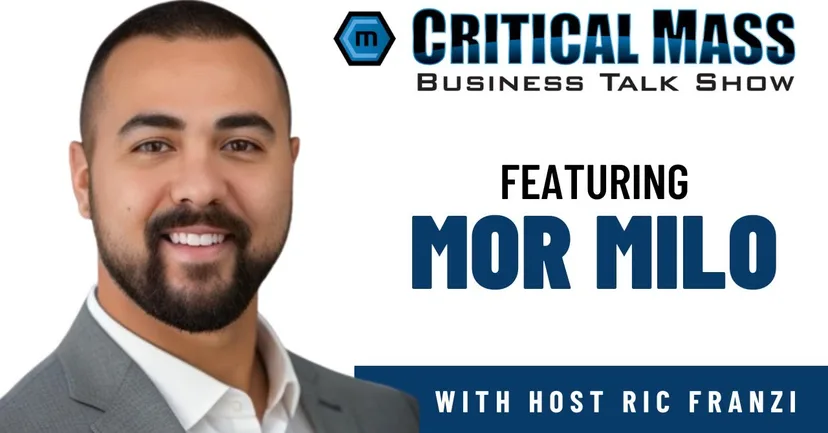
Relli co-founder and CEO Mor Milo joined Ric Franzi on the Critical Mass Business Talk Show to talk about why he started Relli and how the company changed its plan early on. They cover the founding story, why sponsors are turning to individual investors, the pivot toward helping sponsors reach accredited investors, and what has kept Mor's partnership with co-founder Ross Iannarelli strong. The episode, "Mor Milo on Passive Real Estate Investing with Relli" (Episode 1614), streamed live on February 3, 2026 and runs 25 minutes.
Editor's note: first published February 2026, so some details have changed. Today Relli is a marketplace where investors review offerings from reviewed sponsors, express interest and talk to each sponsor directly, and each offering page shows its own minimum. Target returns are projections, not guarantees.
Watch on YouTube, or listen on Apple Podcasts or Spotify.
Key takeaways
- Mor and co-founder Ross Iannarelli started Relli after watching Mor's parents build a rental portfolio. They wanted income from real property without becoming landlords.
- Mor says the hardest early job was education: most people who qualify for private real estate offerings have never heard of the industry.
- With institutional investors finding similar returns in debt, many sponsors that relied on a few large partners now have to reach individual investors, which is a sales and marketing skill.
- Relli changed course early. Instead of asking sponsors to take on new compliance, it focused on helping them reach the accredited investors their current offerings are built for.
- Mor credits a 10-year partnership with Ross, built on trust and integrity, for getting through the hardest stretches of building a startup.
Full transcript
Lightly edited for clarity, with a few short passages removed. Section times match the YouTube video.
Welcome (0:00)
Announcer: You are listening to the Critical Mass Radio Show, Orange County's business talk show, focused on exploring topics of interest to CEOs who are leading middle-market companies, with your host, Ric Franzi.
Ric Franzi: Hello and welcome to this edition of Critical Mass Business Talk Show, Orange County's longest-running business talk show and podcast. And yes, I am your host, Ric Franzi. And boy, we have a good show planned for you. Why, do you ask, loyal listeners out there? Because Mor Milo is our guest. He is the CEO and founder of Relli. Mor, welcome to the program.
Mor Milo: Thanks for having me, Ric. Good to see you.
What led Mor to start Relli? (0:41)
Ric Franzi: Good to see you. Let's get right into it, because when I get a founder on the show, I have to start with the "what were you thinking" question. But let's put it in terms others would accept: tell me about the aha moment, or what you saw in the marketplace that led you to believe the right thing to do was to launch this company.
Mor Milo: Well, I was on the back of the third failed business with my business partner, Ross Iannarelli. We were young and hungry cats trying to figure out the world. What had been successful for us in building our wealth at a young age, in our late 20s and early 30s, was investing in stocks. And my parents had invested in real estate for about 25 years. I had watched them diligently and slowly build a portfolio of single-family homes that turned into a pretty significant amount of cash flow.
Both Ross and I looked at real estate and wanted to participate in that type of investment. We had seen the value of investing passively in stocks, but we wanted something tangible, a hard asset we could invest in. The American dream story of buying a home, potentially turning it into an income property and growing a portfolio of real estate that consistently pays you every single month was incredibly attractive. The idea of being a landlord was not.
Ric Franzi: And you'd seen it firsthand from your parents.
Mor Milo: I sure did. We went through evictions, we dealt with not-so-great tenants, we had Section 8 housing, and we dealt with all sorts of fun scenarios that left a very bad taste in my mouth. Ross, my business partner (three-time failed business partner in the tech world), and I looked at each other and said, we don't want anything to do with being a landlord, but we still want the benefits of passive income from properties we could own, hard assets that could hedge against the market.
So we decided to go on a journey to figure out how to build a stock market for real estate. The goal was a platform similar to Fidelity, E*TRADE, Charles Schwab, your favorite cryptocurrency exchange or your favorite brokerage account, where you could actively buy and sell real estate-backed securities, just like you buy and sell stock on the stock market. The intention is to create a diversified investment opportunity where you can pinpoint exactly what asset classes and what type of returns you're looking for, and build a portfolio of passive investments just like you build a portfolio of stocks in your brokerage account. We decided this was a worthwhile pursuit. We said, okay, this is something we can work toward. Let's go figure it out.
Were there already platforms like Relli? (3:55)
Ric Franzi: Let me ask you, and we're going to talk about the Relli business model in a minute: was there already a clearinghouse, if you will, for real estate like you had envisioned? Are you a first mover in this space, from what you and your business partner have identified?
Mor Milo: From what we see, there are a few other first movers that have built similar offerings, where they are the asset manager, they offer investment opportunities to an end consumer, and they've created an individualized platform specifically for their business.
Ric Franzi: Okay.
Mor Milo: That's been effective. Think of it this way. Let's say you're a real estate development firm and you raise capital to buy multifamily properties. You can raise capital from high net worth individuals, or you can raise capital from average consumers. In most scenarios, they go after the high net worth individuals. There are companies out there that have gone after retail consumers, and they have built those individualized platforms I mentioned.
The way we look at our business, that doesn't deliver on the promise of being able to spread your money across lots of different asset classes and build a diversified portfolio. From our perspective, they have a portion of what we want to create in the marketplace, which is a truly built-out exchange with a marketplace of investments, where a consumer could invest in lots of different deals across the country, as opposed to one specific operator.
How did people react to the idea early on? (6:31)
Ric Franzi: Which leads me to the following question, which I have to ask you. When you have a new vision for a business and you see the opportunity, and you go to the investment community or to others and explain your idea, which they probably haven't heard anything like before, how was the early reception to the vision you and Ross had?
Mor Milo: Well, I'll tell you, it's difficult to explain, because it's something that has lived behind closed doors forever. This industry of real estate development firms that raise capital has existed for decades. You've always heard about people putting their money together and buying property. The business we've built is essentially an additional layer on top of that very legacy business. And the majority of people don't know how that industry operates. They don't know how capital is raised to deploy into these deals and build property.
So there's an education we need to provide, not only for the retail consumer who has never heard of this before; the 95% of people who qualify to participate in these types of deals have never heard of this industry either. So we consistently battle the struggle of having to educate our audience and get them to a place where they understand what we do, so they can diversify into real estate-backed securities. It's been a journey to figure out how we can meet our customer where they're at and speak a language they can understand.
How does Relli help investors diversify? (8:21)
Ric Franzi: Right. Because people get comfortable with proven models, things they know. I think you did an excellent job early on of talking about something people know, which is the stock market. You buy equity, maybe you buy mutual fund shares, but it's a clearinghouse, in my mind, a place of commerce. And that idea didn't exist before Relli for the asset class you are bringing to the marketplace. Am I correct in how I explained that?
Mor Milo: Yes.
Ric Franzi: Okay.
Mor Milo: The difference with Relli is that we consolidate it all in one place. All of these things exist in a very segmented format, but the goal is for us to bring them all together, because unless you're in that space, you don't know how to get into it. So you're essentially unable to access it.
Ric Franzi: And it feels to me, and I don't want to put words in your mouth, that you are trying to bring this opportunity to a larger audience: to make real estate investments in lots of different types of real estate.
Mor Milo: That's exactly correct. There are so many different avenues people can take to invest in real estate that don't require them to be a landlord, and that give them the ability to participate in deals that normally would be reserved for high net worth individuals and institutions: industrial facilities, retail shopping centers and all sorts of wonderful assets that pay well and have Fortune 500 tenants that consistently pay the bills.
Ric Franzi: It's a different way to do something similar to what an individual or a family, like your family, traditionally did, which was to buy the hard asset, own 100% of it and take on all the debt. What I like about what you're talking about, if I understand it correctly, and help me clarify this: just as you can diversify your portfolio in the stock market, at Relli, because of the range of investment opportunities in these different assets, you can do the same thing as an investor. Is that correct?
Mor Milo: You can. And the beauty in that is that we have gone about vetting these people and finding operators with experience in successfully delivering distributions back to their investors, and we've put them on our platform for investors to come and see. Currently, the majority of the deals that exist have a $25,000, $50,000 or $100,000 minimum. But what we're seeing in the marketplace is that more of these operators are valuing the retail dollar and reducing that minimum down to $5,000, $1,000, $100. What we intend to do is create the platform all of these operators come to, to be vetted and to introduce themselves to a larger audience of investors who can deploy their capital.
Why are sponsors looking for new investors? (11:25)
Ric Franzi: I didn't even think of that, really. There's the demand side, which you're addressing by creating a larger pool of people who could invest. But on the supply side too, if it's been a closed market, their opportunity to raise capital is constrained too, isn't it?
Mor Milo: It absolutely is. In the last five years or so, with the shifts in interest rates, there's been a massive shift in how operators raise capital. A lot of these operators had the luxury of operating behind closed doors, without a logo, without a website, and they are struggling to raise capital the same way they did before.
Ric Franzi: Yeah.
Mor Milo: Because the institutional investors that normally look for those equity investments, where they can receive a higher return for a slightly higher risk position, are now seeing opportunities in the debt space with similar returns and less risk. And the operators are now asking: what's the next thing for us? What are we going to do so our business can continue to flourish and grow if the 10 institutional investors that have always deployed with us are now distracted?
Ric Franzi: Right.
Mor Milo: What's happening there is that operators who have been excellent at running real estate businesses now have to learn how to raise capital, which is a sales and marketing skill. To get to market and properly set expectations as a business on how they can build a community of investors, they're turning to companies like ours to fill the gaps they might have in building systems and in the foundational messaging for creating relationships with complete strangers: strangers who might be interested in investing in their product but don't know who they are. Our platform allows them to engage with that audience as easily as turning on a light bulb.
So much like we're solving a massive problem for the retail investor, who normally would not have access to deal flow because they're an individual with access only to their own network, we're also solving a massive problem for the real estate development firms that have had a spoiled experience raising capital, for lack of a better term, because of their relationships. We're helping them not only connect with more investors, but do so more effectively.
Why did Relli change its plan? (14:22)
Ric Franzi: Well, if what you said materializes, which is people being willing to bring the investment level down from $25,000 to $15,000 or $10,000 or even $5,000, that really does open up significantly more opportunity for potential retail investors, because that's not as intimidating an investment to make as it is today. Is "intermediating" too strong a term? Has your ambition for what Relli can be, you and Ross, grown since you got into this and really understood the opportunity? Or have you had to pivot and shrink your initial ambition for the business?
Mor Milo: Great question. Ross and I definitely had a moment where we looked at one another and had to make a pivot. Our aspiration of creating a platform that operates exactly like a Fidelity or E*TRADE was a massive vision to accomplish, and it required these real estate development firms to adopt a new way of doing business. What we discovered was that the operators loved what we were up to, but the idea of taking on new levels of compliance without a proven product we could deliver to them as an early-stage company was a bit too much to chew. It was just too big of a jump.
So we decided to take a small pivot. Instead of focusing on getting operators to adopt a new way of doing business that allowed average individuals with $100, $1,000 or $10,000 to deploy their capital, we decided to meet that customer where they were and deliver a product they could use and put in their arsenal of tools, to get in front of the accredited investor audience they needed for their current investment opportunities.
By doing that, we've done a few things. Number one, we've created a lot more relationships. We've been able to start doing more business by delivering value to these customers today. And we've started to attract the operators that do have the offering types set up for non-accredited investors to deploy capital. We are slowly but surely positioning ourselves to be a platform that can reduce their marketing expense, so they can leverage Relli to drive traffic to their site.
Now, the end goal for our organization is to be more of a financial exchange than a marketing agency. Our goal is to bring on some of the compliance and operations functions, like becoming a broker-dealer and transfer agent, so we can maintain and manage the transactions happening in a digital format and build this marketplace with an audience that can hold a portfolio of assets within Relli.
The beauty of the pivot we made was that it gave us the opportunity to work in a much less regulated environment, where we were focused on marketing. We were able to focus on the most important component of the business, which is driving those investor relationships to our customers, so we could build a customer base and then expand a product line from there. That has seemed to be a solid strategy for us to start making some money, start building our business, grow our community and, slowly but surely, grow our audience of customers as well.
Ric Franzi: So there's a teachable moment for other founders, in my opinion. What I heard, and correct me, is that there was too much friction in the business model, and you took the friction out by bringing these developers more of the same people they're used to dealing with, to get them comfortable with your platform. And that creates the business model that gives you the time and the cash flow to realize your and Ross's dream of a marketplace.
Mor Milo: That's exactly right.
Ric Franzi: An expanded product. I mean, that's really hard when you've committed to a vision. It took you 300 conversations, and I respect the fact that you could have 300 conversations and not get discouraged, but then find the opportunity inside that business model that made sense for the moment, and then scale it. So say the same thing to Ross for me, which is kudos to both of you for being able to do that.
Mor Milo: Thank you, and I will make sure to send him your regards. I couldn't have done any of this without him. He's really the other half of my brain, which I'm very grateful for.
How have Mor and Ross kept their partnership strong? (19:55)
Ric Franzi: We only have a little bit left, but I'm always curious when I talk to a founder at the early stage who started with a partner. There's a lot of stress in starting up a business, especially given what we've talked about. How have you two been able to maintain the positive relationship that got you through 300 conversations and figuring out the right business for the marketplace? How have you guys survived?
Mor Milo: Ross and I have a longer history than just Relli. We've now been working together for 10 years. We started out together at BMW, selling cars. Ross had a vision to build a company, he enrolled me in his vision, and we went and built something. It didn't work out, but we sold quite a few cars and did pretty well for a couple of young bloods.
Since then, he and I realized we were on the same plane in the way we thought about the world and what we were willing to put in to get the life we wanted at the end. That came alongside, unfortunately, losing people along the way who didn't fit that vision and didn't see ethics the way we did. We were able to overcome all those obstacles together, and through that, what has been created is a brotherly bond. I cover his six, and he covers mine. To a certain extent, I can trust him blindly, and the same goes the other direction.
That has been the glue that kept things moving forward in the darkest, bleakest hours, because they've come up. Every startup comes up against money issues. Everyone comes up against having to spend their savings to keep the bills paid, and having to deal with other partners who don't participate and don't do their job. If we had more time, there'd be a lot more to say. But the biggest thing that comes to mind when I think about the one most important value between the two of us, the one that has kept our relationship and our businesses going, is integrity. I trust him to be in integrity. That doesn't necessarily mean "I had this thing to do and I did it." Sometimes it's "I didn't do it," and the fact that you come clean and say, "Hey, this is the thing I didn't do, and this is what I need help with." I think that's what kept us going through thick and thin.
How to reach Mor and Relli (22:55)
Ric Franzi: So if someone would like to connect with you on LinkedIn or learn more about Relli, how do they do those two things?
Mor Milo: We are on all social platforms at @InvestWithRelli, so check us out literally everywhere: Instagram, Facebook, TikTok, YouTube, LinkedIn. Personally, my favorite social is LinkedIn, so if you want to get hold of me, that's a great way. In addition, our online platform is open to all investors, so please check out relli.co. That's www.relli.co, R-E-L-L-I dot C-O. Create an account so we can connect with you directly. And lastly, for anybody who's old school and wants to send an email: mor@relli.co, M-O-R at relli, R-E-L-L-I dot C-O. Not that that's super old school or anything.
Ric Franzi: Or they could send you a letter in the mail. Do you have your mailing address? No, I'm just kidding.
Mor Milo: I would love a letter. If they're really that interested, they can go to our website, see our address at the bottom and send me a letter.
Ric Franzi: So I said at the top of the show, ladies and gentlemen, that I thought we had a good one planned, and Mor, you definitely did not disappoint. Thank you for the time today. Continued success. Very impressive, my friend.
Mor Milo: Thank you for everything, Ric. I really appreciate it.
Listen to the full episode
The Critical Mass Business Talk Show is hosted by Ric Franzi. Learn more about how Relli works or review current offerings.
