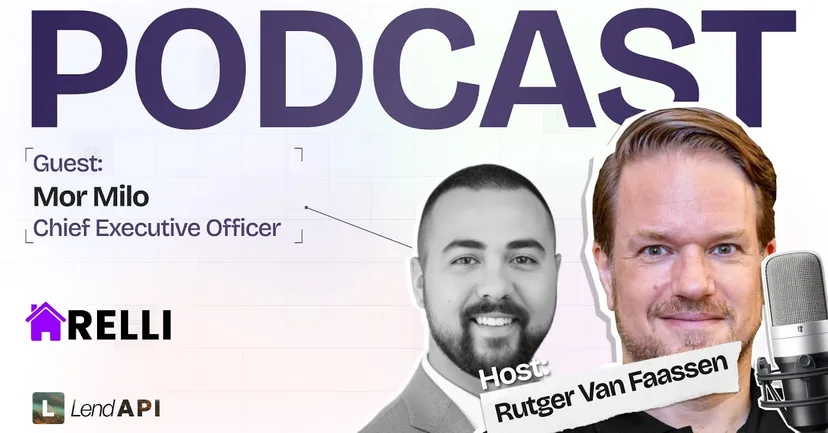
Relli co-founder and CEO Mor Milo joined Rutger van Faassen on the LendAPI Partner Podcast to talk about how Relli got started and how it connects real estate sponsors with accredited investors. They cover why Mor and co-founder Ross Iannarelli built the platform they wanted to invest on, how private real estate deals have traditionally been raised, and Mor's favorite early customer story. The episode, "LendAPI Partner Podcast with Mor Milo, CEO of Relli," was released July 3, 2025 and runs 12 minutes.
Editor's note: first published July 2025, so some details have changed. Today Relli is a marketplace where investors review offerings from reviewed sponsors, express interest and talk to each sponsor directly, and each offering page shows its own minimum. Target returns mentioned are projections, not guarantees.
Watch on YouTube, or listen on Apple Podcasts or Spotify.
Key takeaways
- Relli is Mor and Ross's fourth startup together. They built it because they wanted to invest passively in larger real estate deals themselves.
- Most private real estate is raised the same way: a sponsor raises equity from investors, adds debt, operates the property and distributes income. For decades those deals were shared mostly through personal connections.
- Mor estimates only about 5% of accredited investors know these offerings exist and actively invest in them.
- Sponsors' most immediate need is access to new accredited investors. Many are traditional firms that are new to online marketing and technology.
- In Mor's customer story, an LA-based CEO moved from an 8% multifamily deal to an offering from GLH with a preferred return that targets 10% and steps up each year to 15%, with an option to exit after 12 months. Target returns are projections, not guarantees.
Full transcript
Lightly edited for clarity. Section times match the YouTube video.
Welcome (0:00)
Rutger van Faassen: Hello, and welcome to another episode of the LendAPI Partner Podcast. Today, my guest is Mor Milo, who is the CEO of Relli. Welcome to the podcast, Mor.
Mor Milo: Thanks for having me, Rutger.
How did Relli get started? (0:22)
Rutger van Faassen: We'll start off with the same question that we ask everyone, which is: how did your business get started?
Mor Milo: It has been quite the journey. We started about three years ago. I'm now on my fourth startup with my current business partner, and it came about, obviously, because of three failed previous startups. So you have to go on to number four. That's how that works, right? But what we ended up learning was that my co-founder and I could really rely on each other, and finding loyal co-founders is very hard. So in this most recent startup, we decided to take on the world together and just say, "You know what, it's me and you. Let's try to figure it out. Let's see what we can do."
The impetus for the business came from our personal interest in finance and investing. With the results that we created through the stock market, through cryptocurrencies and other vehicles of investment, we wanted to expand our portfolio. We wanted to do it in real estate, but we didn't have the opportunity to do it passively. I had personally watched my parents as landlords with their small portfolio of real estate, which generated amazing cash flow and wealth for them, but they also had the absolute terror of dealing with tenants. So we decided that we wanted to invest passively, but discovered that there were really no great options for average consumers who were non-accredited, non-high net worth, non-institutional investors. So we essentially decided to create the platform that we wanted to invest on.
Rutger van Faassen: That's very interesting. So you saw firsthand with your parents what one scenario was, and you said, "We're not going to do that. Let's find a way to get the benefits of investing in real estate, but not have the sleepless nights managing tenants and all of that." All of that comes with actually being a landlord.
Mor Milo: That's exactly right. And moreover, what we really wanted was an experience where we could diversify into really high-quality investments and not just be focused on the single-family home flip. We wanted a piece of the retail assets where the rent is paid, because Walmart always pays the rent, right? We wanted a piece of that. We wanted some self-storage. We wanted some debt. We wanted different things that we didn't have access to as landlords or owner-operators at a small level. So we decided to build a market where we could create that diversity, and that's the iteration we have today. It's focused on accredited investors, and slowly but surely, we're expanding toward the public markets. So it's very exciting.
How does Relli work for accredited investors today? (3:08)
Rutger van Faassen: Okay. So passive investment, that's the use case you solved for. Tell us a little bit about how that works for accredited investors, and maybe how that's going to work in the future for the general public.
Mor Milo: Real estate as a whole normally works the same way, no matter what type of asset you're buying and no matter what price the asset is at. There's an equity component, there's a debt component, and then you deal with operating the asset. Currently, the way the market works is that people raise capital for the equity component so they can put the money down to go acquire the debt, and then they operate the asset and distribute income to the investors who helped put up the equity.
That market has been behind closed doors for decades. It's, "I know this guy, and he connected me with this deal, so I gave him $100,000." It's either you knew the guy, you had a bunch of money, or you had a really great financial advisor with connections. The deals have existed forever; they just haven't been available to the public.
So what we did was create a platform where real estate sponsors across the country can very easily advertise their real estate investment vehicles to the accredited investors who may be looking for those passive investments. Today it's very simple. We offer a completely free marketplace to the passive investor, where they can check out real estate deals in all different asset classes across the country and passively deploy their capital, $10,000, $25,000, $100,000, $200,000, $500,000 at a time. And they can pursue that cash flow as well as the equity growth from those assets.
What is the long-term vision? (4:50)
Mor Milo: In the future, what we intend to create is a true stock market experience. Just like when you log on to your Fidelity, E-Trade or Charles Schwab account, you can choose between hundreds, if not thousands, of listed offerings and invest in a fractional way in shares of a business. We want to create the same type of marketplace for the average consumer, with the same high-quality real estate investments that institutions and high net worth individuals are currently investing in.
The way we go about doing that is by integrating technology and the new compliance regulations that have come out in the last 20 years or so, which allow real estate developers to expand their community to non-accredited investors, average consumers who want to invest $100, $1,000, $10,000 at a time. And we're seeing some real estate developers already participating in these strategies. You might have heard of a guy named Grant Cardone. He's very popular on social media and has a huge following. What he has done incredibly well is build an audience that resonates with his brand and give them opportunities to invest alongside him in his real estate assets.
What we're attempting to create is a platform where any high-quality real estate developer, not just those with millions of followers on Facebook, Instagram and TikTok, can plug into a platform like ours and offer our audience of retail investors those same types of opportunities while improving the economics of their deal. So that's the future.
What stands between today and that vision? (6:39)
Mor Milo: Between where we are today and where we need to go, there's a lot of education and a learning curve. There are a lot of real estate development firms that are very antiquated or traditional in the way they do business. So getting them to integrate technologies they've never used, manage compliance they've never dealt with, and work with investors in a format they've never dealt with is a bit of a challenge.
What we believe is that if we do a great job meeting our customers where they're at today, which is those real estate developers, and provide them value with what they need right now, which is access to new accredited investors, we can get there. Just to define that for the audience: an accredited investor is simply somebody who makes over $200,000 a year or has over a million dollars in assets. Although that $200,000 a year seems like a lot, that's a rather large group of people in the marketplace, and I'd say maybe 5% of those people know that these offerings exist and are actively deploying into them. So we have a lot of opportunity to help those people.
With a solution where we help our customers where they're at, by giving them this marketplace and helping them connect with more investors who are now educated on investing in these types of assets, we can build trust with those real estate development firms. Then we can show them a path to public offerings that can improve not only the bottom line, by putting more profit in the pockets of the investors, but also the efficiency of the business through technology, branding, marketing and so on.
Rutger van Faassen: So you bring the two parties together and make it seamless for them, so they don't have to worry about all the operational parts. Investors just put up the money, and on the other side, the developers provide the projects they can invest in. That sounds very interesting and very valuable.
What is Mor's favorite customer story? (8:37)
Rutger van Faassen: Now, tell me, what's your favorite customer story?
Mor Milo: This is great. This is actually a rather recent story. We're an early-stage company. We launched our platform about three months ago, and we recently had an investor who deployed $100,000 into one of the real estate investment opportunities on our platform. He's an LA-based CEO who is not active in his investments. He has a great CPA and a great financial advisor, and he relies on them heavily to put him in front of the right investments, just like any smart business owner should.
He came to us looking for an alternative to another deal he had previously invested in. It was a multifamily real estate investment, where he had also invested $100,000 and was receiving an 8% return on his investment. So he came to me, presented the deal he was invested in, and said, "Mor, I know you have all these deals on the platform. What do you think you can do to help me get a better experience?" Immediately, I was able to show him a few different deals on the platform with different structures that could target more income for him.
But at the end of the day, what we fell back on was the fact that he loved the experience of essentially being the bank and having consistent cash flow come in every single month, and his goal was a higher cash flow position. So we ended up connecting him with a deal on our platform hosted by a group called GLH Capital, where instead of that 8% preferred return, he would start at a targeted 10% preferred return. And every year that he kept the capital in the real estate fund, the target would step up by a percentage point, capping out at 15%.
Rutger van Faassen: Sounds like a pretty good deal.
Mor Milo: What makes it even sweeter is that if he doesn't like the deal after 12 months, he can get out of it. So that specific deal gave him a couple of really great things. Number one, it beat his price, right? He had a certain amount of money coming back, and we were able to find him a higher target. Number two, it was a shorter-term deal. The holding period was very short, which was much better than the other deal, because he was locked into that multifamily deal. He could be more flexible and liquid in this deal. But beyond that, if he was loyal and stuck around, he would continue to target more income as he stayed with this company. So I think we did a few things for him. We gave him a more liquid offering, we gave him an offering with a higher target return, and we gave him access to different deals so he could choose.
Wrapping up (11:22)
Rutger van Faassen: That definitely sounds like you were meeting the customer's needs and then some. So a great customer experience there. This is probably a great point to wrap up our conversation today. Thank you very much, Mor, for being on the podcast.
Mor Milo: Rutger, thanks for the time.
Rutger van Faassen: Until another episode.
Listen to the full episode
The LendAPI Podcast is hosted by Rutger van Faassen. Learn more about how Relli works or review current offerings.
