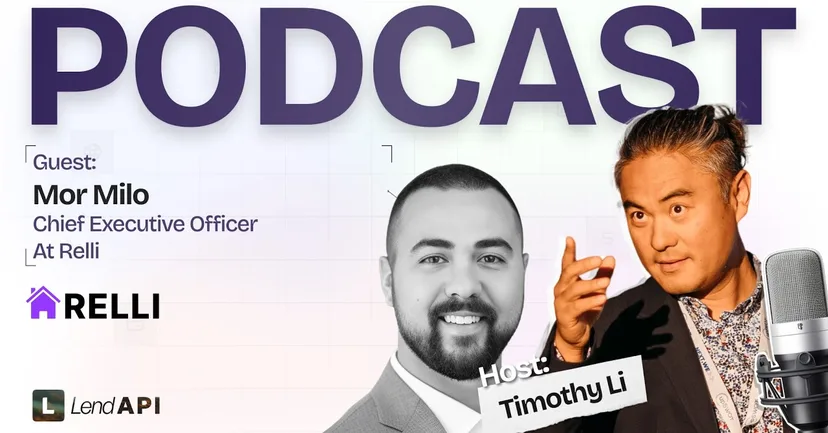
Relli co-founder and CEO Mor Milo joined host Timothy Li on the LendAPI Podcast to talk about how Relli vets real estate sponsors and what investors should read before they invest. They cover what accredited investors and sponsors are, why some longtime landlords are moving into passive debt offerings, how Relli reviews every deal before it lists, why the private placement memorandum matters, and what falling rates could mean for real estate in 2026. The episode, "LendAPI Partner Podcast with Mor Milo CEO at Relli," was released February 26, 2026 and runs 31 minutes.
Editor's note: first published February 2026, so some details have changed. Today Relli is a marketplace where investors review offerings from reviewed sponsors, express interest and talk to each sponsor directly, and each offering page shows its own minimum. Target returns mentioned are projections, not guarantees.
Watch on YouTube, or listen on Apple Podcasts or Spotify.
Key takeaways
- A sponsor is the operator of a property and the investment vehicle around it. An accredited investor, as the SEC defines it, has $200,000 in individual income ($300,000 with a spouse) or $1 million in assets outside their primary home.
- Mor says Relli fills a gap in sponsors' marketing, helping them get in front of investors who qualify for their offerings.
- Relli reviews every deal before it lists and turns some down. Mor says the team looks for operators with a long track record in one specific niche.
- Read the private placement memorandum (PPM) for every private investment. It describes the offering, its structure and its risks.
- Lower rates help deals pencil. If rates stay high, debt offerings targeting 8% to 12% can compete with riskier equity positions.
Full transcript
Lightly edited for clarity, with a few short passages removed. Section times match the YouTube video.
Welcome to a new season (0:00)
Timothy Li: We're kicking off this podcast season for 2026, now that everybody's back from vacation and all that stuff. I want to thank our previous season's host, Rutger van Faassen. He's done an amazing job at Information Banker, and he's moved on to bigger and better things. You can follow him on LinkedIn. I'm going to take over this time as the host of the LendAPI Podcast.
And we've got an amazing individual. I've come to know this person over the past couple of years. We've had lunch and dinner; we met at a local fintech meetup in LA, and I've got to thank those guys as well. It's been a great pleasure to get to know Mor, and I'm just so happy to have him on. This is going to be a different format. Rutger had three questions. I have nothing, so I'm just going to free flow. I invite people I know, so hopefully I can toss some questions to my friends here to get the conversation started. Let's get it going. Mor, good to see you. Happy Chinese New Year. I want to say Happy New Year all around.
Mor Milo: Happy New Year to you too. I haven't seen you since the new year.
Timothy Li: Yeah, we should get together.
Mor Milo: Happy New Year, everyone. And good to see you, Tim.
Who is Mor Milo, and what is Relli? (1:23)
Timothy Li: Yeah, absolutely. For everybody else in the audience, and there are going to be hundreds of people watching this, tell us a little bit more about you and what you're doing. Then I'd love to dig into your background. We both have an immigrant story, and I just love that story from you. Maybe you can share some of that with us, and then we'll get into the fun stuff in a second. The mic is all yours, Mor.
Mor Milo: Thank you, Tim. My name is Mor Milo. I'm the CEO and founder of a company called Relli. I'm a young entrepreneur who's been through the trials and tribulations of many startups. This is my fourth startup, and it's been a journey. I am an immigrant. I came to this country from Israel when I was four months old, grew up here and moved around quite a bit, from New York to Texas to Colorado to Los Angeles, where I now live. Actually Irvine, a little further south of Los Angeles. I'm extremely excited about creating impactful products that help people. And I like finance, so I built a finance company.
I did it with my amazing business partner, Ross Iannarelli, who has been a good friend of mine for the last 10 years and has been along the journey with me through all four of my startups, including Relli today. So it's been a blast. Now we're building Relli, which is attempting to become a stock market for real estate, a platform like Fidelity or E-Trade where you can invest passively in real estate. We're in our early stages of building. We currently have a product for accredited investors to connect directly with amazing sponsors who have a lot of experience across all different asset classes, and it's growing every day.
What are accredited investors and sponsors? (3:13)
Timothy Li: Our audience is super sophisticated, but there are a couple of terms I'm going to push on a little bit. Accredited investor: it feels like this is a platform where you get everybody together, and there are multiple parties that are going to join Relli. Tell me more. What is an accredited investor? What is a sponsor? What is this platform trying to do to create more value for Southern California folks, since it's real estate central, but also everybody else under the sun? Tell me more about these terms.
Mor Milo: Sure. And maybe we can take a step back even a little further. Most people aren't familiar with the concept of passive investing in real estate, because it's something that hasn't been available to them. Most people think of a passive investment in real estate as purchasing a single-family residence and turning it into an income property. What my business partner and I wanted to do was get involved in real estate, but we didn't want an active hand. We didn't want to be landlords. We didn't want to deal with tenants. I watched my parents build a small portfolio of single-family homes and deal with leasing those homes to tenants who didn't always treat the property well. They had lots of renovations and all sorts of headaches.
What we discovered was that wealthy people and institutions have for many years been investing alongside real estate development companies, deploying their capital to build large properties. Those high net worth people and institutions can invest their money completely passively and empower an operator, somebody who actually does the day-to-day, to produce a return for them from a piece of property they don't manage.
So, the terms you mentioned. A sponsor is the operator of a piece of property that has an investment vehicle for an accredited investor, or an investor in general, to invest in. An accredited investor is a term the SEC uses to describe a higher net worth individual: someone with $200,000 in income per year individually, $300,000 with a spouse, or a million dollars in assets outside of their home. Those individuals are able to invest in the private syndications and funds that exist in the real estate market today.
Timothy Li: Right.
Mor Milo: And our goal is to take that market that currently exists and empower it to offer investment opportunities to average consumers as well.
Timothy Li: Got it. $200,000, $300,000: that sounds like just about everybody who lives in Southern California and LA. I guess they haven't changed that definition. And that million dollars in assets doesn't include your primary residence, right?
Mor Milo: You got it. It's outside of your house, basically.
Timothy Li: That seemed like a high bar back in the day, but I feel like a lot of people fit that definition today. So Relli itself: you have sponsors, right? These people are touching the properties, buying them, listing their projects on your platform, and then you help these sponsors attract investors? Is that the main functionality of Relli?
Mor Milo: That's the current main functionality of Relli. What we do is fill a gap in real estate sponsors' marketing departments, helping them get in front of investors who qualify for their investment opportunities, on demand, from the moment they engage with us.
Why are some landlords moving into passive debt offerings, and what do investors own? (6:51)
Timothy Li: Right. And you're right. Our family has some of these single-family homes, no different from what you talked about earlier. Every day there's something new. My God: the toilet, the garage door, the AC unit. I feel like whatever gain you think you're making, it all sinks into the property management company and all these repairs. There's a little equity value, but there's just a lot of headache. I feel like if I can follow a real estate guru, somebody who has done this for so long and has a consistent return, it's no different than investing in an equity stock. But it has a big backstop to it, which is the property itself, which feels safer.
Mor Milo: I have a great story about a real estate investor who's been investing cash in single-family homes for the last 20 years. It's one strategy. It's a good strategy, not a bad strategy. It's an excellent strategy, but it requires a lot of cash. The returns are solid and consistent. We recently had a conversation about his portfolio, about $6 million worth of single-family homes he owns. He came to the table through a debt offering on our platform that was targeting a 12% return on his cash every year.
Timothy Li: Pretty good.
Mor Milo: With absolutely no work. His response when I described this offering was absolute excitement, because the amount of headache he's had to deal with to receive a 5% to 8% return on his money from these very active investments is not worth it, when you can just give it to a lender that has deployed over $120 million in just the last 12 months into debt with structured operators, and you get paid in the mailbox with no heavy lifting. That's a beautiful thing. And that's one avenue you can go down that is probably on the lower end of the risk spectrum, where you can target a consistent return from hard assets based on first position liens, and participate like the bank in the real estate industry without having your hands on the asset. So many more options.
Timothy Li: Right. I want to push on that a little bit. These percentage returns, 12%, 10%: nothing is guaranteed in life. You've got to look at the average. You've got to do your own study. Whatever percentage we say, it's just historical numbers. These are risky investments. Owning private single-family homes feels like I own something. I can touch it. I can feel it. How do I get the same feeling if I put, like this gentleman, $6 million of equity into a team? It's almost like investing in a startup. How do I get the same kind of assurance that I actually own something? Is it through an LLC? Do I have a real claim on these properties? Is my money being spread across 20 different things? How do you give that feeling back to people who have investment experience owning that stuff on their own, even though there's tons of headache behind it? Tell me more.
Mor Milo: That's a beautiful segue, because what I think people don't realize is that they have much more control over where their money goes than they feel they have. Most people feel that if you want to get into real estate, you get into a single-family home, and that's the only place to go. But with passive investments and the experienced operators in the marketplace, you can actually deploy little pieces into different operators in different sectors of the market that have full professional teams, where you still have a piece of that real estate as a business owner and a partner, and you don't necessarily have to deal with that pain.
The reason we're building Relli is that what we really loved about investing, especially in the stock market and in cryptocurrencies, was the control: being able to look at a company or a product and say, we believe this is the future. We believe in these operators. We believe in the people running these companies. Research them in depth, then create a portfolio diversified across different sectors to reduce risk, so we have multiple operators in the market creating returns for us day to day.
How does Relli vet sponsors and deals, and who does the vetting? (11:44)
Timothy Li: Got it. So it's just like diversifying stocks. You put a little bit of your hard-earned money across the board. Would you go so far as to underwrite a property, or do you only check out the operators? I see you're nodding here.
Mor Milo: We check out every single deal that comes to the table.
Timothy Li: Every single property, the whole situation? You do a full write-up or something? Wow.
Mor Milo: Absolutely. We have a general counsel and a CFO who look at every single deal, and we make underwriting decisions based on a financial methodology to choose who we like and who we don't.
Timothy Li: You're the experienced co-pilot for investors who want to invest in this.
Mor Milo: There are obviously no guarantees. But what we have as a team, which most average investors in the marketplace don't have, is professionals we've hired to support us and make sure we make the right decisions. What we offer is an extra layer of vetting for those exemption-based deals. And eventually we're going to start to see more publicly offered deals for average consumers, which have been qualified by the SEC. There will also be a pretty nice big stamp on some of these deals from a governing body backed by the US government.
Timothy Li: I got it. So, I run a software company, and people ask me all the time: Tim, who gave you the right to write the software to manage whatever LendAPI does? Give me a little more of your background and your partner's background. I think I've met Ross before as well. Who gave you guys the right to underwrite these sponsors, to look at these properties and give them a grade, to give investors the confidence they need to put a dollar in? Tell me about that experience.
Mor Milo: Number one, I'd say the most important thing we've learned along the journey is that we don't know what we don't know. Approaching people with more experience than us, who can give us insight and feedback on the right decisions, is the best way for us to move forward. We are finance, marketing and sales people who saw a massive gap in the market for most real estate development firms, which is in their sales and marketing department. What we have to offer them is Fortune 500, scalable solutions we can implement in their business.
And we've brought people around us who have experience and a track record working with companies like CBRE, working for big or mid-market developers, underwriting deals day to day, and people who are specifically focused on SEC securities law, corporate law and real estate law, so we have a support system around us. The audacity to build Relli really came from a problem we faced ourselves. We wanted access to the real estate market, but we wanted to do it in little chunks, in ways where we could piggyback off the experience of great operators and generate those returns, just like we do in the stock market.
I think that passion for creating something that levels the playing field for the little guy has given us the audacity to go out and take on a massive problem in a very large industry. And I think our humility has allowed us to bring people around us who know more than we do.
Timothy Li: Okay. So the team has some experience, and you have access to a whole knowledge network: "Hey, we don't understand this market or this type of property. Could you take a look at it for us?" That gives our audience confidence.
What happens when a deal goes south? (15:31)
Timothy Li: Okay, got it. So let's do some real talk. Toward the end, we've got to do some real talk. If a deal goes south, and sometimes it does (not to say that deals on Relli have gone south, just based on experience), how much control do you have? Sometimes investors may have to swap in a new sponsor or a new management team because something's not going right. What have you seen in the market? Again, not to say it's happening on your platform, just out there. Things go south all the time. What can people expect a platform like yours to influence? "Hey, look, sponsor, you've got to do a better job," or if they can't, there are some things we can do to bring in help. Give us some stories about things that have fallen apart in the overall world of real estate investing. What happened?
Mor Milo: Well, first of all, there have been deals we've turned down. We look at them and say, okay, look, guys...
Timothy Li: You won't even list them?
Mor Milo: We won't list them, no. Look, we're a young company, and there's obviously risk in real estate and risk in investments. We need to do our absolute best to vet these deals to the highest possible caliber, to make sure the products on our platform are high quality. So we feel rather confident in the decisions we're making around sponsors.
And just like in the stock market, companies go under. Deals go sideways. That's part of the game, no matter which way you slice it. What we're doing is attempting to find only operators with a 10-year-plus track record in a specific niche and provable experience delivering returns to investors. In addition, we're telling our customers exactly what the risks are: listing the PPMs and showing all the risks, giving additional disclaimers, and producing content to make sure people understand that anything you invest in has risk. Just like on Kalshi or Polymarket or whichever crypto exchange you choose, there's going to be risk.
What we believe, from our experience working with these sponsors, watching investments go the right way and seeing some that weren't appropriate for our platform, is that the deals in this sector have a lower risk profile than a large percentage of the other markets available to investors. And although there is inherent risk, and there's never a guarantee, we have a responsibility to make sure we only have high-quality sponsors with great track records.
What is a PPM, and why does a sponsor's niche matter? (18:53)
Timothy Li: Right. So you do a lot of work to filter from the very beginning: a 10-year track record, audits. I'm guessing those are financial audits, independent audits. And you mentioned a key word. We're all about demystifying these PPMs. Break down that acronym for me, and then I want to touch on what you said about niches, anything hot and popular right now that we should know about.
Mor Milo: PPM is a private placement memorandum. A private placement memorandum is a very long document. It's not very sexy. It's not very fun. But it's an incredibly important component of every single deal. No matter where you invest in a private investment, ask for the PPM, ask for all the documentation, and read through everything. The goal of a PPM is to describe the offering, its structure and its risks. If you don't read through that PPM and don't understand the value of understanding it, you need to reassess the way you look at investments in general. But I feel that's a whole different conversation we can have.
Timothy Li: Yeah. A whole different conversation about how people like to invest.
Mor Milo: That's right. But that document is absolutely crucial. Any investor deploying their capital should read every single word of it.
Timothy Li: Right. Just because millions of people qualify for the so-called accredited investor label, they also need to equip themselves with some knowledge. It's different from single-family homes, where you work with a realtor and a property manager, and there's one toilet and two beds. These are bigger opportunities. I'm assuming these are commercial real estate, maybe multifamily apartments, doctors' offices, malls and things like that. The way you collect rent and seek out tenants is probably completely different from what a single-family home investor is used to. So where can people access these PPM documents? Do they have to get qualified, log into the platform and start browsing deals?
Mor Milo: That's exactly right. Every single deal on our platform will have its PPM listed. After creating an account and verifying your accredited status, you'll be able to access all that data, and those documents are downloadable.
Timothy Li: Right. And it's free to log in, a free account. They just go and browse.
Mor Milo: Correct. Completely free to investors. And to go back to your comment about accredited investors, I think retail investors should start looking at these as well. I think the average consumer is now participating in more alternative investments than ever before. Many people are deploying their capital into cryptocurrencies they don't understand, into systems they don't understand, into businesses they don't understand. I think investing is a sport you need to learn. You need to really understand the financials, understand how a pro forma works, and look at companies and compare them side by side with other companies in their industry.
Mor Milo: That's what we're trying to do for the real estate world with Relli, which is why we have deals in medical office, single-family residence funds, debt, multifamily and self-storage. We're kind of all over the place in terms of inventory. And the niche component you mentioned is incredibly important, because any operator raising capital should really understand the specific sector of real estate they're investing in. If they're a self-storage sponsor, they should keep building self-storage. We want to see them continue to be successful with self-storage until they scale to an institutional level where they can diversify. Where things get tripped up is with newer, opportunistic sponsors raising capital for asset classes they might not understand. So we always look for operators raising capital for assets they've done business in, in that sector, over and over again.
How much do you need to start, and what is changing? (23:41)
Timothy Li: Exactly right. So, something simple like self-storage: I see them all over the place off the freeways, and I'm learning how to invest in this kind of model. Do I need to cough up a million bucks, or can I just test the water and pledge two, three, four thousand dollars, just to see what it feels like and how the platform works? What are the requirements and qualifications? I know there are qualifications for accredited investors, but can I put in a dollar just to be part of the mix? God knows people waste a lot of money on the Kalshis of the world. You know what I'm saying?
Mor Milo: Yeah. We're not at a dollar yet.
Timothy Li: Okay.
Mor Milo: We're working our way down. We're trying to get down to $100, which we're very excited to get to.
Timothy Li: Wow.
Mor Milo: Currently our lowest investment opportunity is $25,000.
Timothy Li: Got it.
Mor Milo: So it's reasonable for most people, but we really want to get in front of everybody. There are a couple of deals we're working on right now that, if they go the right direction in the next two to three months, will let anybody, non-accredited or accredited, participate in debt funds with as little as $1,000. I'm not going to say too much more, because I haven't closed those deals and I don't want to talk about them yet.
Timothy Li: No problem. Next episode.
Mor Milo: Great. Yes. Next episode. But what I will comment on is that the market is shifting. Many more sponsors who have normally raised capital only from accredited investors are now shifting their focus toward what's called a Regulation A offering, which gives them the opportunity to raise capital from non-accredited investors.
Timothy Li: Right.
Mor Milo: So anybody can participate.
Timothy Li: Yes. These Reg A and Reg A+ funds I've seen popping up are a legacy of the JOBS Act, back in the Obama days. I think the idea was to unlock this: wealthier people have access to beefier, higher-quality real estate, and the common man should have access as well. So you mentioned that retail investors should look at this too. Can they log into Relli today and look at some of these deals, even though they can't really invest until you set up a Reg A fund?
Mor Milo: That's correct. As of right now, what we're able to do is collect their information and keep them posted about the first Regulation A offering. We're hoping there'll be one sooner rather than later. We have a couple in the hopper that look solid, two specifically: one in debt, one in industrial. So very soon our early-stage company will be elevating its game and offering opportunities to retail investors.
Timothy Li: Right. Doesn't that unlock another 50 or 70 million investors who want to pop a couple of thousand dollars into a Reg A or Reg A+ fund, just to be part of the conversation that owns a hotel or whatever it might be? That's super interesting.
What do falling rates mean for real estate in 2026? (26:47)
Timothy Li: One last thing: rates are coming down a little bit. Is that a distraction for the platform, or do you think it adds to it? I think the rate has fallen below 5% as of right now. So what's happening? What are you thinking about that?
Mor Milo: Rates dropping helps everybody. Is it organic? Is it the right move? That's a different story. For us, we want our sponsors to win. So any time a deal can pencil better for an investor, that's a good thing.
Timothy Li: Sure.
Mor Milo: If that improves, deals will pencil better. And if debt doesn't improve, then debt funds and debt investments are also very attractive, because they start to get into that 8, 9, 10, 11, 12% target category, where they can compete with equity positions that have a higher risk profile.
Timothy Li: That's right.
Mor Milo: But we're also seeing institutions shifting their energy from some of the more traditional equity investments they make to preferred equity positions, to debt positions, to first position liens.
Timothy Li: There's the equity, which comes from the crowd, accredited or otherwise, there's probably a little bit of mezz, and then there's the debt. Any time there's slightly cheaper money, there's an opportunity to buy a bigger thing, or refinance out of a previous engagement. The other thing hitting the news is that commercial real estate in the San Franciscos of the world has fallen dramatically. I've also seen that the graffiti building in LA has a new buyer now. So what does all that add up to, in your opinion, Mor? Give us a crystal ball read.
Mor Milo: You're going to make me get out a crystal ball.
Timothy Li: I'm going to give you one today. It seems like there's a lot of activity, right? There are a lot of deals to be had. That's what I'm reading.
Mor Milo: '26 already has a different energy to it than '25 did, and people are very active. I've talked to so many sponsors who are underwriting literally thousands of deals. They've underwritten thousands of deals, and they're looking for their next opportunity. I think what's going to start happening is that sellers are going to start selling, and they're going to come off some of the larger valuations they've been looking for, so they can offload and move on to the next opportunity. At some point that dam is going to break. It might not be pretty, but it will break.
Timothy Li: Yeah. It has to, right? It's a cyclical thing, although this cycle has gone on too long and gotten a little weird. We have the midterms coming, and a new Fed chair being installed. All sorts of things could happen.
How to find Relli (29:47)
Timothy Li: Mor, thank you so much for being on this podcast and talking about you and your business. I love your energy, and you're another friend of mine in Los Angeles. How do people find you? What's your website? How do people log in?
Mor Milo: Super easy to check us out: relli.co. You can create an account. You can check us out on all socials at @InvestWithRelli. You can also find me personally on LinkedIn; that's my favorite of all the platforms. First name Mor, M-O-R, last name Milo, M-I-L-O. And I'm honored to be on here, Tim.
Timothy Li: Thank you for coming. I'll have all this in the episode notes, and we'll do a social blast when this episode is processed. I'm so happy to have you as my first guest of this new 2026 season. Thank you so much.
Mor Milo: Appreciate it, Tim.
Listen to the full episode
The LendAPI Podcast is hosted by Timothy Li. Learn more about how Relli works or review current offerings.
