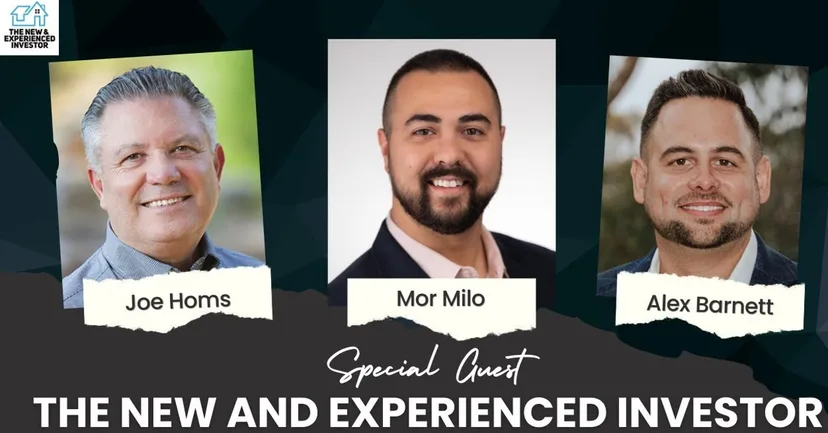
Relli co-founder and CEO Mor Milo joined hosts Alex Barnett and Joe Homs on The New and Experienced Investor podcast to talk about how sponsors raise capital and how individual investors get access to private real estate. They cover what an accredited investor is, Regulation D and other ways to raise capital, why funding got harder for developers after 2021, and the hosts' 2025 market predictions. The episode, "The Stock Market Of Real Estate With Mor Milo," streamed live on December 26, 2024 (Pacific time) and runs 56 minutes.
Editor's note: recorded in December 2024, so some details have changed. Today Relli is a marketplace where investors review offerings from reviewed sponsors, express interest and talk to each sponsor directly. Each offering page shows its own minimum. Target returns are projections, not guarantees. The plans described in this episode, such as crowdfunded offerings with $100 minimums, are not part of Relli today.
Watch on YouTube, or listen on Apple Podcasts or Spotify.
Key takeaways
- An accredited investor, as Mor explains it, earns over $200,000 a year ($300,000 for a married couple) or has over $1 million in net worth outside their home. Many private real estate offerings are open only to them.
- Under Regulation D 506(c), a sponsor can advertise an offering publicly but may accept only accredited investors, and the sponsor must verify that status.
- Offerings open to the general public (Regulation CF or Regulation A) carry heavier SEC requirements, such as audits and ongoing reporting.
- Mor says capital deployed into private real estate roughly halved each year from 2021 to 2024, which pushed developers to look for new sources of investors.
- Real estate developers are not capital markets experts, so the legal, compliance and investor-relations work around a raise is where many of them need help.
Full transcript
Lightly edited for clarity, with a few short passages removed. Short video clips the hosts played on air are noted in brackets and not transcribed. Section times match the YouTube video.
Welcome to The New and Experienced Investor (0:00)
Alex Barnett: What's up, you guys? Welcome back to the podcast. I hope everybody had an enjoyable holiday. I know everyone's sitting at home in front of their TV right now, so thank you for joining us on The New and Experienced Investor podcast. We are the number one live podcast in Laguna Hills, so congratulate us next time you see us.
Joe Homs: Congratulations.
Alex Barnett: Thank you. We're a real estate investor podcast that brings investors from all walks of life together. I'm one of your hosts. I'm Alex Barnett. I'm the new guy.
Joe Homs: And I'm Joe Homs. I guess that makes me the experienced guy.
Alex Barnett: Sure does. Welcome back, everybody. How was your get-together yesterday?
Joe Homs: Good. I had a good time.
Alex Barnett: Glad to hear that. I hope you all enjoyed yourselves. We have an amazing guest in here today. He's talking about a new, revolutionary way to invest in real estate. It's going to blow your mind. Before we bring him in, let's talk about our meetup really quick: January 20th.
Joe Homs: January 20th, yep. We don't have a speaker yet.
Alex Barnett: So we have to find out who's going to speak next month, and we'll blast that out and let everybody know. But the last meetup was really cool. It was this last Monday, and it was crystal ball predictions. I think we had about 50 people signed up, but only half of them showed, which is not unusual. Honestly, it was the day before Christmas Eve. We had a good time, and with the smaller group it was easier for people to connect, I noticed. It's up on YouTube right now if you want to see it.
Joe Homs: I made some bold predictions.
Alex Barnett: Oh yeah. So we're going to quiz you at the end of next year and see which ones you got right.
Joe Homs: I'll just look at the video before you start quizzing me. I did make a prediction that interest rates were going to be down to 5%. Bold. But I did see BiggerPockets put out a prediction of 5.5%, so they didn't go as bold as me. That's what I'm predicting, 5%. We'll see what happens next year. I think there's going to be a big turnaround in everything, the economy, everything.
Alex Barnett: Well, I hope so. My bank account could use it. Enough of that, so let's bring our guest in. Super excited. He drove all the way from down the street today, so we're really lucky to have him. You got the crazy holiday traffic right now. So thank you so much, Mor Milo. Welcome to the podcast.
Who is Mor Milo, and why did he start Relli? (3:31)
Mor Milo: Great to be here, guys.
Alex Barnett: Absolutely. Why don't you go ahead and jump on in and let everybody know what you were doing before you got into real estate, and how it's going right now?
Mor Milo: I'm more than happy to. My name is Mor Milo, and I am the CEO and founder of a company called Relli. What we're doing is building the stock market of real estate. We would like for everybody to participate in real estate investing, me first and foremost. I'm actually a tech startup founder. Over the last eight years or so I dabbled a little bit in the corporate world as well, but I spent a lot of money building startups, some of which went decently and some of which didn't go so well.
I had an opportunity to purchase a piece of property about eight or nine years ago for 100 grand cash. It's probably worth about 400 or 500 grand today. About three years ago, I looked back on that decision and said, "I really wish I'd owned that piece of property." That kind of started my journey with my business partner, who I've been working with for the last eight years over four different startups, to better understand the market and what the real estate landscape looks like for an average Joe like myself to get involved and get my foot in the door.
What I discovered was that it's quite difficult unless you have a rather large sum of money. In order to participate, you really have to take on a lot of responsibility as well: become a landlord, manage and maintain a property, if you want to go that route. Obviously you can flip, you can wholesale, you can do a lot of different things. My family happened to be landlords, and that was the method I thought would be best for me. Then I came to realize that I really preferred the model of investing through stocks or crypto or different mutual funds, looking and digging through different securities I could participate in. I would really love to give my money to somebody who actually had a track record and was capable of delivering great returns, like they would for their high net worth investors.
We discovered there weren't a lot of places where someone like myself could go and put $500, $1,000, $5,000 or even $10,000 into some form of real estate-backed security that is directly affected by a piece of property, a hard asset that exists in the world. The majority of opportunities available were maybe a REIT, where you had to trust a sponsor to go and deliver a bunch of money to a bunch of different people. But we wanted to diversify. We wanted to be able to gamify our experience. So we went on this journey to try to build this platform.
So far, three years in, we're in a wonderful place. We just launched our first product. We have our first investment opportunity with a great group out of San Diego that's building affordable housing, and we're on our journey to truly putting American land in American hands and giving everybody the opportunity to invest with any budget in highly vetted, quality real estate assets across the country. That's what we've been up to for the last couple of years, and that's what brought me into real estate. I actually had no background in real estate until three years ago, when I dove headfirst into the capital markets and finance side of the business.
Joe Homs: Love that. Well, I think real estate could really use a fresh pair of eyes, fresh technology, all that kind of stuff, because not a lot's changed since the beginning of real estate, from what I can tell. They're not making land anymore.
Mor Milo: That's true.
Joe Homs: That's one of the big ones. They just made land once, and that's it.
Alex Barnett: Until we go to Mars.
Mor Milo: That's what we're talking about today. The first real estate developers on Mars.
Alex Barnett: There you go. Elon's on the forefront, making it happen. And I like "American land in American hands." That's pretty cool.
Mor Milo: That's our game plan.
What does "American land in American hands" mean? (7:35)
Alex Barnett: Can you elaborate on that?
Mor Milo: To your point, they're not making any more land, but there is quite a bit of land available to do stuff with, which is pretty exciting. If you look at the United States specifically, there's a lot of development in a few massive metropolitan hubs and some stuff close to those hubs, but a lot of open space. In the world we're currently living in, you don't necessarily need to be so close to a metropolitan hub anymore. With remote work and the way the employment landscape is going, we can get a little more creative.
So I think, number one, developers are looking for great ways to create awesome assets that generate a profit but also do well for Americans: build great properties that people can live in, explore, buy things in retail facilities and have experiences. For example, we have a couple of surf parks that are interested in raising capital from surfers to build a surf park, where those surfers can then come and enjoy that facility.
There's lots of land, there are lots of great applications for that land, and there are lots of people who want to participate in real estate but maybe don't have the know-how to purchase their own property, or the know-how or time to flip or wholesale, but might want to participate in a fractional, passive way in pieces of property that interest them. Maybe you're a golfer and you want to invest in a golf course. Maybe you live in Tennessee and you think your backyard is the best place to build ever, but you don't have the know-how. Okay, come find a developer to invest in. Come find a highly qualified sponsor you can give money to, to build based on your thought process of what's going to be the next thing in real estate.
With data centers coming down the line, there are going to be a lot of technologists and people who like technology who will have the opportunity to invest in growing all the infrastructure we need for new technology to come to light. It's all real estate based. It all needs land to operate. So we want to be the backbone for the financing of American businesses across the country, by giving average Americans access to invest in those businesses. That's really the name of the game: how do we keep this money in the ecosystem, creating amazing property for people to use, but also creating investment vehicles where we have American businesses thriving and average Joe Americans investing in hard assets?
How does the platform work, and what is an accredited investor? (10:17)
Alex Barnett: I think it's great, because you're totally right. When people look at getting into real estate, I think the number one thing they say is, "I don't have enough money to do it." So maybe you did save up $5,000, and instead of putting it all on Doge...
Joe Homs: Please don't.
Alex Barnett: ...you could put it into something you enjoy. Now, is this an app? How does that work? What does it look like?
Mor Milo: Web-based, super simple. You can hop onto relli.co, create an account and check out the different offerings on the platform. Today we have one excellent offering for accredited investors only, but in the very near future we'll have our first crowdfunded opportunities to invest in with as little as 100 bucks.
Alex Barnett: Now, if Joe and I have a flip that we want to get funded, is that something we could put on your platform? Does it work that way?
Mor Milo: That's a great question. That's exactly how it works. Joe, for example, you have lots of experience flipping homes. If you decided you wanted to create an investment vehicle for average consumers or accredited investors to provide you with funding, so you could leverage your talent in flipping homes to generate a profit for those investors, then we could support you in listing that offering on our platform and advertising it to accredited investors, or to the mass public, where Joe would be the sponsor of that specific investment opportunity and could deliver a return back to those investors.
Alex Barnett: Can you define real quickly what an accredited investor is, and a non-accredited one?
Mor Milo: I'd be more than happy to. An accredited investor is essentially a designation from the SEC, where a household or a person has over a certain amount of income or a certain amount of net worth. The income requirement for a single person is $200,000, and $300,000 for a married couple, or over a million in net worth in assets outside of your own residence. If you qualify with that type of net worth or that type of income, then you're an accredited investor, which allows you to invest in alternative assets, like real estate investment funds, that are available to high net worth individuals.
Joe Homs: And do you know when that rule, or law, or whatever you want to call it, came into place?
Mor Milo: It's a great question. I couldn't tell you the date. It's been around quite a long time.
Joe Homs: The reason I ask is that I was investing in different things 40 or 45 years ago, very similar to what you're doing. Prudential Insurance, American Express: there were big companies out there doing very similar stuff, but they didn't have any accredited designation. And I never ended up making any money on any of that stuff. I think that's where it came from. Back then they were taking money and saying, "We're going to give you this return back," and they were nice returns. That's probably one of the first problems: if they're offering you a big, giant return, you should actually be looking into it.
How did Relli vet sponsors? (13:43)
Joe Homs: So in your fund, let's say Alex and I wanted to do that. Is there a place in there where you want to vet me? Where you say, "Okay, we need all this info from you, Joe," to make this more attractive to somebody else?
Mor Milo: That's absolutely right. First things first, the fund would not be mine. The fund would be yours, Joe. You would build out that fund in your name with your track record, then bring that fund to us, and we would support you in advertising it. The best way to think about it is the stock market. If I go to my Fidelity or my E*Trade or my Robinhood account, I have access through a platform where I can connect with different sponsors by investing in them, buying shares. Same concept here. We would have your business securitized so it could be listed on our platform, and you could raise capital from the right investors.
Let's say you were only offering investment opportunities to accredited investors. There would be a lesser requirement than if you decided to offer investment opportunities to the general public, because there are different rules associated with the background of that investor: their net worth, their experience and whether they can get taken advantage of. So what we ensure is that we have the right type of fund or vehicle in front of us that can approach the right type of investor. For example, if I have an accredited-only offering, non-accredited investors will not be able to participate, and the barrier to entry is a verification that the investor is accredited. We will actually collect documentation from that investor to confirm the accredited status of that person or household.
For a public offering, you would need a Regulation CF or Regulation A offering. Now, I'm not a lawyer, but we have plenty of lawyers we work with, so if you ever have questions about this, we can dig a lot deeper. Just like Apple or Google have gone through a process of setting up an entity through an S-1 registration (they're big blue-chip stocks, they've gone through the SEC, gotten certain approvals and qualifications, and they have certain auditing requirements every quarter and annually), the same concept applies to our developers who choose to raise capital from average consumers. They will be held to a higher standard. They need to get qualified through the SEC through one of these lower-tier securities so they can list those offerings on our platform and we can legally collect capital from those average consumers.
That process in itself requires time, money and effort, so we will only go through it with developers who have a track record of success and can show us multiple funds where they've already delivered returns back to accredited investors. Then we can justify saying, "Okay, these guys have done this a few times. They've delivered returns back to their accredited investors already. Now they're ready to go to the public markets. Let's increase their visibility and give them a larger audience to raise capital from, so they can lower their cost of capital, increase their profitability and continue to scale their business." So we have an extremely difficult vetting process with our developers. We don't just take anybody. And anybody who would like to raise capital from average consumers has a whole different list of SEC requirements that we support and walk them through: who they need to talk to and how they need to operate. They will be held to that standard of annual audits, annual reviews, quarterly reporting and so on.
Joe Homs: So it's kind of like a syndication on my part. I have to put that together before I come to your platform.
Mor Milo: That's correct.
What are Reg D and the other ways to raise capital, and what did Relli charge? (17:55)
Mor Milo: If you're familiar with the term Reg D...
Joe Homs: I've heard of it, but I have no clue what it is.
Mor Milo: Essentially, it's an exemption through the SEC that allows a sponsor to raise capital into a security, an investment vehicle, that's exempt from registration because of a certain set of rules. For example, with Reg D 506(c), and I'm getting a little into the weeds here, you would be able to raise capital from only accredited investors and generally solicit your offering to anybody. When you send in that exemption, they essentially put a stamp on it and say, "Okay, we see that you're raising capital from accredited investors only. Play by the rules or get in trouble." So now it's the sponsor's responsibility to ensure the investor on the other side of the table is accredited.
That is one type of vehicle you can use. There are many others, like an LP/GP structure, which you guys are probably pretty familiar with, where you have an LLC with a general partner who manages it and some LPs who deliver capital, so you have equity to place into different deals. Each vehicle has its own methodology for how you can raise capital. What we want to be is the listing platform where sponsors can list their offering, attract the right investor for that offering type, and then work to deliver a return back to those investors and create a happy relationship between both sides.
Alex Barnett: And do you guys charge a fee, obviously? Is it per person, the size of the deal? What are your fees?
Mor Milo: It depends on the deal. For example, if you had a Reg D deal focused on accredited investors only, and you're interested in marketing that offering to high net worth individuals, we have a marketing platform where you would list, and we would charge you up front to get on the platform and then a monthly marketing fee. If you were to do a crowdfunding campaign, where you would list your offering and we would manage all the moving parts associated with your raise, like the broker-dealer, the transactions, collecting payment and the subscription documents, that's more of a usage-based fee structure. It's based on how many investors you have in a particular investment, charged monthly, and how many investment opportunities you have on the platform.
Alex Barnett: So mostly the people you're looking for have got a proven track record. They're doing what they're doing. They just need to expose what they're doing to more people.
Why has capital been hard for developers to find? (20:57)
Mor Milo: Essentially. It's been really interesting to watch the markets over the last two or three years. You've probably noticed that funding has been rather difficult for real estate sponsors, developers and venture firms looking to place capital. What we're seeing is that there's a massive need for more supply, but funding is a big holdback for a lot of developers. Money is expensive, it's hard to find accredited investors, and institutions have been a little more held back in the last two years.
What we've really seen since 2021 is a waterfall of capital being deployed. We saw an absolute high in 2021 of capital going into closed-fund real estate deals and venture capital deals, and by 2024 we're slowly starting to tick back in the right direction. But 2024 has been about half of what we were doing in 2023, 2023 was about half of 2022, and 2022 was about half of 2021.
So right now the name of the game is: how do we find effective money to build supply, so we can help solve the housing crisis in the United States? How do we elevate opportunities for those sponsors to reduce their cost of capital and increase the impact they can make by building more supply? Well, let's go get them some money. And more than ever, average consumers have been completely priced out of the market. Nobody can buy right now. Average consumers are having a very difficult time finding their way into the American dream of a first home for their family.
How do we solve both of those problems? Let's give the average consumer a way to get their foot in the door in the number one long-term asset in America's history without the barrier to entry we've seen until now, and give that opportunity to the small and medium-sized businesses that have the know-how, the capabilities and the teams to build that property. Then you have a win-win: we have more supply, small businesses winning, and average consumers investing in real estate, and hopefully that rolls into them buying their first property. Everybody wins. As consumers we're getting priced out, so how do we find a foot in the door? Here we go. As businesses, we're struggling to find the right cash for the right deals at the right price. Here you go. Let's pair the two, have a beautiful marriage and find a way to make it work. So that's where we're at.
Alex Barnett: I know you talked about possibly doing a fund or something for the flips one time.
Joe Homs: Yeah, yeah.
Alex Barnett: You don't remember that?
Joe Homs: You actually listen to me.
Alex Barnett: I listen to you.
Joe Homs: That's nice. Maybe it's time to do it. I've always found it very difficult to do syndications. It's not easy stuff. You've got tax implications, you've got reporting requirements, you've got so many moving parts that at the end of the day your return on investment goes down because you have to do all that compliance stuff. Do you see anything in the near future that's going to reduce the compliance? It's there to protect the normal investor who is not accredited, I understand that, but there are a lot of hurdles to jump.
Mor Milo: There's no doubt. What I will say is this: we have enough technology to overcome some of these hurdles. Processing data and dealing with compliance is just sets of rules, and we have ways to manage rules. The problem is that it's really difficult to understand which rules to follow and which are more or less important, and nothing is black and white. So I think it's all about getting the right people in the room so you have the right direction on where to go.
That was something we tried to do really early: figure out the obstacles, the difficulties and all the pieces that come into play. We tried to build a network of people around us who could give us great advice: lawyers, accountants, auditors, firms, anybody we could get our hands on who had knowledge or experience in this space, dealing with syndications, securities and all these moving parts. I think what really needs to happen is a group that's willing to put all these resources together and create a simple process. At the end of the day, real estate developers are real estate developers. They're not capital markets experts. Their job isn't to be a securities attorney. Their job is to build real estate that turns a profit. So for us, it's been really important to build some of that infrastructure, so we can provide a white-glove experience for those developers, because of the level of complexity.
Now, I can't go to the SEC and tell them to change things. That's not going to happen. Maybe one day we'll have enough scale to turn the tides in Washington, but we're not there just yet. What we can do is our homework, and our absolute best to have all the right providers, vendors and experts behind us, so we can create the most seamless process. Because if it's possible, it can be done again, more efficiently and more easily.
Some people love this example. Grant Cardone has built an entire business around raising capital from the public. However you feel about Grant, that's totally understandable. At the same time, he has raised one and a half billion dollars for five or six billion dollars' worth of real estate, and he's constantly sending out checks to his investors every month, every quarter. Why can't that be Joe doing flips? Why can't that be GLH doing affordable housing? I don't see any reason why not. The conversation is how we make it accessible for someone who maybe doesn't have an audience of 10 million people to talk to, or an army of lawyers to build the right structure. Let's get all of that in one place, and let's use technology to do it.
Alex Barnett: Well, we are the number one podcast in Laguna Hills.
Mor Milo: That's right. It's not nothing. It's getting there.
Why is financial regulation so hard to navigate? (28:13)
Alex Barnett: "Army of lawyers," I do like that, only because we had a meetup guest who came by and told us his story. He started a fund during 2008. He admitted he scaled a little too fast, and then the market went boom. All he wanted to do was take some funds from one project to help another, so everyone could win. Well, he gets hit with wire fraud charges. He's got the black vans rolling up, taking him out of his house, with all of his neighbors watching.
Joe Homs: And he went to jail.
Alex Barnett: He went to jail for 10 years.
Mor Milo: And this is the thing that hurts, and it speaks back to the conversation around compliance. I'm currently raising venture capital. I would love to be able to write a check to somebody for a percentage of however much they raised for me. I can't do that. That's illegal. That's the selling of securities, and I would get in lots and lots of trouble if I did. That ties my hands. If I had someone who was capable of connecting me with the right investors, and I could properly compensate them for connecting a highly qualified investor with my venture capital deal, I would be more than happy to write them a check for the percentage. But most people don't know that's a rule, so people go pay those percentages, and then the SEC comes back and says, "You messed up in 2004 at three o'clock in the afternoon."
So I think there needs to be a bit of a shift in mentality, and I think that's coming with the new administration, which is exciting. It's going to be really interesting to see what happens. There are already some rumblings at the SEC. And it needs to happen, not only because of what we're doing (there are lots of us building opportunities in real estate), but if you look at crypto, at DeFi, at literally anything in finance right now, the regulators are a hundred years behind the operators. That's really the issue. It's not that they don't know. They're just not up to speed, because it's almost impossible to be. I try to keep up with what's happening in finance, and it's moving at light speed, so expecting the regulators to keep up is a very difficult task.
As the most powerful country in the world, with our country on the forefront of finance and our retail investor being the most coveted investor in the world, we do need to make sure we're on the same playing field as the rest of the world, with the same advantages to invest our capital and turn a profit as a nation, as the Emiratis do, or anybody else around the world with less regulated securities systems that let people move money freely, so businesses can turn a profit, create jobs and create tax revenue. There are good things coming, and there's technology to overcome this. No matter which way it turns, whether we get the beautiful new world we're hoping for in finance or not, we have the technology to deal with it.
Joe Homs: I think technology is going to solve a lot of the issues. But then it's a cat-and-mouse game, where they come up with more regulations to trip you up.
Mor Milo: Absolutely.
Joe Homs: That's always been like that. But people will figure a way around it. It's kind of like the tax system: rich people have attorneys and don't pay taxes, so it's the middle class that ends up with the squeeze.
Alex Barnett: But then it's kind of on you. Like you mentioned, these are just rules. If you know how the game is played, you can put your chips in and make a little moolah.
Mor Milo: That's the game. Whether it all plays out exactly the way we say it will is a very different thing.
Alex Barnett: Very true.
How is technology changing real estate operations? (33:35)
Mor Milo: But look, I think finance is going to be a wonderful place to be over the next 10 years. I think real estate is going to be a wonderful place to be, and there's so much opportunity for disruption with proptech. I think it's just now starting to get its footing. It's been really difficult to disrupt real estate, because it's the devil you know, so you play the game you know. Slowly but surely, people in the real estate space are starting to come around to new data solutions and new financing solutions.
Alex Barnett: Exactly. If it keeps going the way you're saying, especially with a company like yours, I guess you'll have a wallet or something, and you're like, "These are all my investments right here. I've got some money here, some money here, some money here." It's all diversified.
Mor Milo: And if we continue to push into the small and medium business space and help some of these American businesses, there's also a great opportunity to work with strategic partners. For example, we recently connected with a group that has technology that lets real estate developers and owners manage the appliances in their units better. Let's say you had a thousand units, with a washer and dryer in every unit that you need to maintain, plus a bunch of other appliances: microwaves, refrigerators, whatever it might be. This software ingests all the data on every one of those products and provides live updates on which products need to be refurbished or maintained, or have warranties coming up, so you can strategize more effectively how you spend money within your property and create the best ROI for your investors.
How do you do that? By reducing the number of trips back and forth, reducing shipping costs by ordering multiple things at the same time, and fixing multiple problems at once that you can anticipate, because you know the warranty on an item comes up in a month. You might as well replace it now, since you're already making a trip out to that property and sending out the workers. Let's just do it all at once. So leveraging data, tech and new solutions in the marketplace is on the forefront of developers' and sponsors' minds as they continue to grow and scale. If we can start injecting those technologies into our developers' line of sight, they're going to see efficiencies in their businesses, which at the end of the day turn a better profit for everybody. So I'm excited.
Joe Homs: That's very interesting. Do you see it working with just a single flip? Does it have to be that?
Mor Milo: That's just one example. Over the last year or so we've been mingling with as many technology companies in this space as we can, because we have mutual customers. Our customers are real estate developers, just like the data companies' are. We've slowly started to realize that sponsors and developers are eager to find efficiency, because it's an older business that has been stagnant for a while and is ready for some updates, and they want to be on the forefront and have that advantage. So we've started placing different opportunities, and they've been fruitful.
That's one of a few data solutions we've been able to put in front of developers. One very interesting predictive data solution let a developer predict litigation in a certain family matter that could end up with a house on the market two years from now. They could get early access to that house, because they know one brother is unhappy with another, and they could come in as the white knight and provide some money to relieve the situation, because that trust needs to be split up. So really creative things are happening in real estate right now, where people look at opportunities to create funnels of data and then produce a really high-quality byproduct from that data.
The more creative minds we have working on different problems in the industry, the more developers will take on new technology to increase the efficiency of these real estate products. And if we can get some retail capital in there and inject a more affordable cost of capital into the developer's pocket, while still working toward a great return for those average Joes, there are so many ways to create exponential improvements in a game that has been thought of as a little stagnant for a long time. It's always, "What's the cap rate? What's the NOI?" How do we take this to the next level? How do we take the cap rate out of the conversation and focus on operational efficiency, on creating the most value for tenants, instead of trying to pinch out an extra quarter point? I think technology will do that. I think democratization will do that. I think decentralized finance will do that. So I'm really excited for what's coming. It's going to be an incredible year.
Alex Barnett: Are you ready, Joe?
Joe Homs: I'm ready.
Alex Barnett: He's been waiting for a long time.
Joe Homs: I've been waiting for the last four years. It's almost like my Cybertruck. It took me that long to get it too. It's finally here, baby.
Alex Barnett: That's really great, man. You're getting me pumped on this. I see now why you're the face of the company.
Mor Milo: Well, thank you. I really appreciate that. And I do want to give a shout-out to my guys, because without them I couldn't do this. I have two incredible technical co-founders. One is Ross Iannarelli, my right hand, COO and president, who has been with me for the last eight years working on every project we've done. I couldn't do what I do without him. And our new third amigo is Abdul Zahid, our CTO, an ex-Rackspace and Raytheon guy, incredibly smart. I literally haven't heard the word "no" come out of his mouth. I'm really grateful to both of them for sticking through the process with us.
Alex Barnett: That's excellent. It takes a team. You can't do anything by yourself.
What do Mor and the hosts make of 2025 market predictions? (40:37)
Alex Barnett: So this is a part of the show where I have some videos I'm going to bring up, and I want to get your reaction. The first one is more real estate predictions.
[The hosts play a short video of a commentator's interest rate predictions.]
Mor Milo: Well, first of all, he said something very interesting, which is that if we were smart, we wouldn't be reducing the rates so fast. Obviously all of us would really love for rates to go down. At the same time, we're seeing unprecedented times. Markets are in a place they've never been before, pushing into new heights. Be greedy when others are fearful and fearful when others are greedy, and right now others are starting to get a little greedy, and I'm a little fearful. At the same time, I'm very excited for what's to happen in the next couple of years with the new sentiment around the market and the way people are feeling about the power of the US market after the election. We could see some really cool stuff happen that we've never seen before. I'm hesitant to make a particular prediction. What I was personally saying, up until maybe this moment, funny enough, was that we probably shouldn't be reducing rates for another six to eight months. I think we should probably put the brakes on a little bit. But that's how I feel about the situation. How do you guys feel about it?
Alex Barnett: Joe says 5%.
Mor Milo: By when?
Joe Homs: The end of next year. I mean, we're still getting offers on our properties. As long as you buy right, that's a tried-and-true rule. If you buy right and you price it right on the other end, you're going to have buyers. The rates aren't really going to make that big of a difference. They figure it out. On one deal we're doing now, they're asking us to buy down the rate.
Mor Milo: People find ways to do things when they want something.
Alex Barnett: I agree with that. And, as you mention all the time, the rates come down and prices are going to go up. So where does that leave us? I don't know if that solves anything at this point.
Joe Homs: Well, we get the rates down to 5%, where people feel comfortable and say, "I'm going to go buy something," and hopefully they do. But prices go back up, so you might as well buy now and hold on to it.
Mor Milo: If you can find a way to make it happen, go buy something.
Alex Barnett: We have another video. The next one is, is renting better than buying right now? Let's take a look.
[The hosts play a short video of a creator arguing that renting beats buying in today's market.]
Alex Barnett: I don't want to laugh. This guy's pretty good, because he just roasts people.
Mor Milo: He's great, actually. He's wonderful, because I think sometimes people just need to get slapped with some reality: "Hey, dude, you either need to spend less or make more." I think it's all about mindset. If you have a place you want to invest outside of real estate, because it's more approachable and the cost of getting into real estate is so expensive, then I see the value in being a renter in this market. At the same time, that's the entire reason I'm building what I'm building. That's why I'm here. But I'm trying to give a good answer: if we didn't have Relli today, what would you do? I really think the name of the game is to stack your chips and purchase a piece of property when you can actually have some leverage in it, because at the end of the day a massive payment is not going to help you in any way, shape or form. You're just going to go bankrupt. You might as well rent, put some money in your bank account, get a little more frugal, save some more money, spend a little less and put a nice down payment on a piece of property. That way, worst comes to worst, if you need to rent the property out, at least you maybe have a little cash flow there. Having a massive mortgage payment has never been something I've been excited about or would recommend to anybody.
Alex Barnett: Especially if you're in that situation where you've got to put some of it on a credit card. I don't know if that's really solving a problem.
Joe Homs: That's creating a much bigger problem, at 30% interest.
Alex Barnett: It's kind of interesting, especially around here. We're renting in Dana Point, and if we were to buy the place we're at, our mortgage would be insane, at least double, maybe triple. So we're banking on seller financing.
Mor Milo: It's a good way to go. I just talked to a developer about a seller-financed deal he did, and they're very, very stoked on that deal.
Alex Barnett: That kind of solves a lot of the problems as well. But so does Relli, you know what I mean? You could start investing in real estate without having to have a massive down payment, get some cash flow in your pocket, and build up a down payment to go buy that real house.
Mor Milo: There you go. Absolutely.
Alex Barnett: What else have we got? We've got one more: Dan Peña predicts a 2025 crash in commercial real estate.
[The hosts play a short video of Dan Peña predicting a commercial real estate crash.]
Mor Milo: Look, you guys would know much better than I would, as I'm very new in this game. But what I'll say is this: I see the big corporations starting to hedge by buying real estate, and now's the time. If you had a bunch of income this year and a big old tax bill to pay as a big corporation, what would you do? Put your money into some commercial real estate that's on its butt. That's absolutely what you'd do.
Alex Barnett: You know what, that's what I said as part of my prediction.
Mor Milo: I actually think I closed one of my investors with that, because I had that opinion. I was like, dude, how are we not seeing that the big corporations have all this money lying around, a big tax bill coming, and there's just so much to buy for pennies on the dollar? The owner-operators who have been holding this commercial real estate for the last 30 or 40 years have a cost basis that's 20% of what the property is supposed to be worth today, its speculative value. They're willing to take a haircut on that deal so they can walk away clean. And guess who's going to buy all that property? The big corporations are coming in to swing their big money bags. If I were them, that's what I would do.
Joe Homs: That's a big tax break.
Mor Milo: Oh yeah. I agree entirely.
Joe Homs: They're going to buy your Dana Point property, BlackRock, and then rent it right back to you at a premium.
Alex Barnett: BlackRock's the devil. Well, they're playing with the house's money too. That's why Relli is trying to get all the average Joe money.
Mor Milo: Exactly. Give it back to the right people.
Are micro homes the next trend, and how can people reach Relli? (51:07)
Alex Barnett: Especially the commercial, like you said. You've got all these retail and office buildings, and people are already starting to convert those to apartments, so there's going to be a lot of development going on with those. It'll be interesting to see.
Mor Milo: I think the newest trend that's going to start coming is micro homes, but not necessarily the boxy homes you see. I think we're going to start seeing two-bedroom, one-bathroom homes popping up with smaller square footage, in little communities like those townhomes that normally were three or four bedrooms with two or two and a half baths. You'll start seeing them as two-bed, one-bath, tiny starter homes for half a million or a quarter million in California, something like that. If you go a little deeper into the United States, those numbers are going to dwindle significantly. But I think the newer generations really want something of their own. They don't necessarily want to live in a cube within a big multifamily building. So I think anybody who can create a community around some micro homes, maybe build the neighborhood Starbucks and the neighborhood Target and have a little community for remote work, has a huge opportunity.
Joe Homs: I've had a micro home for 45 years. The only problem is my children were in there, and they weren't paying rent. It didn't work out very well.
Alex Barnett: I don't think yours would be considered micro.
Joe Homs: It's become micro. It was rent by the room. I'd knock on the door every month, but I didn't get anything. For some reason there was never money waiting for me.
Alex Barnett: It's a crying shame. So how can people start working with you, if they're an investor, or they have an opportunity, or they just want to be on the platform?
Mor Milo: Come check us out at relli.co, R-E-L-L-I dot C-O. You can get hold of us there as an investor by creating an account and a profile, all that good stuff. We'll absolutely reach out to you, say hello, see how you're doing and see what interests you have, so we can make sure to line up the right deals. If you're a developer or sponsor and want to raise capital on the platform, you can reach out to me and find me on LinkedIn: first name M-O-R, last name M-I-L-O. You can also email me directly at mor@relli.co. I'm happy to talk to any developer with a track record of success who's looking to raise capital. I'd love to put them on the platform. And for anybody who's a strategic partner (accountants, auditors, brokers, mortgage people, real estate people of any kind), we're looking to spotlight these professionals as much as we can so we can start building that community. Same thing: reach out at mor@relli.co, and we'll have a chat and see if we can put you in our strategic partner portal.
Alex Barnett: Awesome. Well, thank you so much for breaking all this down. It's very exciting stuff, the future of real estate right here. If you enjoyed it, let Mor know. Reach out to him if you want more information. Let's get this baby rocking.
Mor Milo: Thank you, guys. I appreciate the invite.
Alex Barnett: Absolutely. We'll be back here in two weeks. Joe's going to be up in the mountains next week.
Mor Milo: Where are you going?
Joe Homs: Big Bear.
Mor Milo: Nice. That should be fun. Hopefully you get some time off.
Alex Barnett: He's going to take his laptop. He's going to be working, just from a different location. So we'll see you the week after that, and hopefully by then we'll have a meetup guest to tell you about. Thank you, guys, for joining us, and we'll see you soon. Bye.
Listen to the full episode
The New and Experienced Investor is hosted by Alex Barnett and Joe Homs. Learn more about how Relli works, review current offerings or read more from Mor Milo.