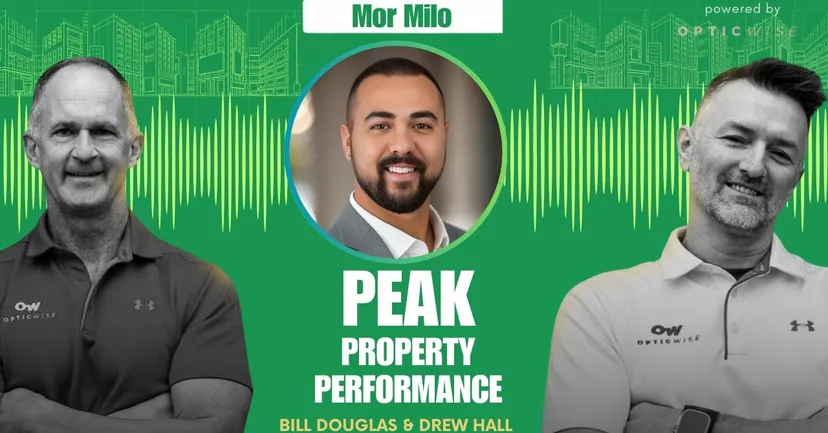
Relli co-founder and CEO Mor Milo joined hosts Drew Hall and Bill Douglas on the Peak Property Performance podcast to talk about why capital isn't actually scarce in commercial real estate, and how better data reduces friction, risk and cost. They cover how sponsors are building brands and systems to reach individual investors, what accredited and non-accredited investors can access, how SEC rules could standardize deal reporting, and how Relli screens sponsors. The episode, "Reducing Risk and Friction with Better Data in Real Estate Investing" (episode 21), was released February 5, 2026 and runs 36 minutes.
Editor's note: first published February 2026, so some details have changed. Today Relli is a marketplace where investors review offerings from reviewed sponsors, express interest and talk to each sponsor directly, and each offering page shows its own minimum. Returns mentioned are projections, not guarantees.
Watch on YouTube, or listen on Apple Podcasts or Spotify.
Key takeaways
- Capital hasn't disappeared. Higher rates let institutions earn similar returns in debt with less risk, so sponsors have to compete harder for equity from individual investors.
- Individual investors decide on trust before numbers. Mor's advice to sponsors: build a CRM and consistent, automated outreach, because he estimates 97% of interested leads aren't ready to invest for 24 to 36 months.
- Offering documents aren't standardized today. Mor expects Regulation CF and Regulation A offerings, which carry SEC reporting requirements, to make side-by-side comparison easier over time.
- At the time, Relli looked for sponsors with at least $25 million in assets under management and prior exits, plus background checks. Investors still take on risk and should do their own diligence.
Full transcript
Lightly edited for clarity. Section times match the YouTube video. The recording does not separate the two hosts, so host lines are attributed from context.
Welcome (0:00)
Drew Hall: Welcome back to the Peak Property Performance podcast. Today's theme in CRE financing: why capital is not scarce, and how better data reduces friction, risk and cost. I'm your host, Drew Hall, and I've got with me Bill Douglas. Welcome, Bill.
Bill Douglas: Drew, great to see you again. Finally recording again in the new year. It's been a little delay.
Drew Hall: Our guest today is Mor Milo. Mor, before I introduce you, say hello to everybody.
Mor Milo: Hello, everybody.
Drew Hall: It's a pleasure to have you. Mor focuses on a problem commercial real estate has lived with for a long time: how fragmented data, limited transparency and manual processes add friction and cost to the joyful capital-raising part of this whole business. With Relli, R-E-L-L-I, he's helping bring more structure and clarity to how deals are evaluated and funded. Not replacing relationships, but improving how decisions get made. Today we'll talk about why capital isn't actually scarce, how lack of visibility drives risk premiums, and what owners need to do as data plays a bigger role in financing. So again, Mor, welcome to Peak Property Performance.
Mor Milo: Thanks for having me, guys.
Bill Douglas: Where are you sitting today? I didn't even ask you.
Mor Milo: I'm in Irvine, California, so not too far from Disneyland, just a quick 15-minute drive.
Bill Douglas: Beautiful Irvine. Drew and I, at OpticWise, had a big client there at one time. I love flying in and out of John Wayne. It's the easiest airport in the world.
Mor Milo: I love it personally myself. Long Beach too.
Bill Douglas: Yes.
Mor Milo: But yeah, I can't complain. I live in paradise. Taxes are a little too expensive.
Bill Douglas: It's a sunshine tax.
Mor Milo: 100% accurate.
Bill Douglas: I look out the window and see snow. You have a sunshine tax.
Mor Milo: I have beautiful sunshine right out my window, so the tax is worth it, I guess. Here I am.
Bill Douglas: There you go. It's working.
Is capital really scarce, or is visibility the problem? (1:54)
Drew Hall: All right, Mor, let's start off with this concept that perhaps capital was never the problem. Rather, visibility is the problem. The idea here is that real estate has always had capital chasing it, and we know that. What's missing is clear, comparable data, the information. So from your vantage point, what actually breaks down between capital and deals in the traditional real estate model?
Mor Milo: What I would say is that the business has been in a traditional format for a very long time. Up until maybe the last 15 years or so, deals happened behind closed doors. In real estate financing, at least the equity component, firms at the mid-market and enterprise level were doing business and you'd never know about it. Millions and billions of dollars were changing hands behind closed doors. It didn't require the presence of a brand. What it required was a track record, some experience, a provable model and a good pro forma.
What has happened in the last 15 or so years is that a lot of people have decided to become sponsors, creating a much more crowded marketplace of operators raising capital from the same funds within those institutions and from the same high net worth individuals. And over the last 10 years or so, with the advent of social media, operators have been able to build brands that retail investors want to communicate with. But although some operators may be great marketers, great marketers aren't necessarily good operators. So you had a lot of operators in the space who raised a lot of capital based on promises made in pretty marketing decks, and those deals haven't come to fruition. Retail investors are now in a position where they have more options than they've ever had. They have deals out in the open, advertised on social platforms, and they've been burned by operators who haven't delivered on their promises.
So in addition to some scarcity of retail capital, there's also a shift in the market around debt. Rates have shifted in a way that lets institutional capital deploy in a less risky position into similar deals where they used to have to put capital into the equity stack to receive a significant return. Now they can do the same thing with debt. They can target an 8, 9, 10, 12 or 15% return on their investment from a first-position lien, preferred equity or some other form of debt vehicle.
So what you now have is a situation where real estate development firms have been very fortunate, and for lack of a better term, spoiled, in that they haven't had to build a brand for their businesses. They haven't had to build systems to ingest data and make decisions in marketing, investor relations and operations, to differentiate themselves from the rest of the pack and gain access to capital that might currently be scarce. What we're seeing is that operators who go full-court press into technology, marketing, data, systems and trackable methodologies are seeing results, using more traditional corporate methods we've seen in big Fortune 500s and B2B businesses. Those businesses never had the good fortune of a small group of experienced operators with a very specific, targeted audience of investors looking for a small number of deals.
So now the operators taking on Fortune 500 methodologies in their outreach, their data and their internal operating systems are getting a leg up on operators who, up until now, have been resting on their laurels. Those operators had certain relationships they could count on to deliver capital for their deals, and that capital is now being distracted by better rates on debt, by a larger number of operators raising capital, and by a scarce marketplace where investors have been burned. So more than ever, real estate developers are having these wake-up moments and saying, "Oh, shoot. What we've done for the last 15 years isn't going to work for the next 50."
What is a retail investor, and who counts as accredited? (6:48)
Bill Douglas: I have to chuckle. We have the same experience with operators on the digital and data side as well. You said something about a retail investor. For the audience, clarify what you meant by retail investor.
Mor Milo: So, retail versus institutional. Institutional would be large companies that professionally deploy capital. Retail investors are usually individuals, or what you'd consider a family office, that have a high net worth and can deploy capital as an individual.
Bill Douglas: And the individuals are still accredited investors, as retail?
Mor Milo: Yes.
Bill Douglas: That was the clarification I was looking for.
Mor Milo: For the most part, they are accredited. There are new vehicles that have been used more and more in the last, call it, four or five years that allow average consumers to participate too, meaning non-accredited investors.
Bill Douglas: Let's make one more definition there. What is an accredited investor?
Mor Milo: An accredited investor is someone who has over $200,000 in income by themselves, over $300,000 in income with a spouse, or a million dollars in assets outside of their residence, so outside of your direct home. Traditionally, retail investors in the private markets have only been accredited investors, because of the vehicles the investment firms created to deliver those opportunities.
Bill Douglas: That's good. We understand that.
Mor Milo: You made a very interesting point around retail. Our end goal is actually to get to the average consumer, to anybody over 18 in America who wants to deploy their capital passively, with as little as $100. I'm making this distinction because, slowly but surely, we're seeing more investment vehicles that allow a non-accredited investor to deploy capital, and we're building a platform to house all of those investment vehicles. Right now, most of the opportunity is for the rich people, but we really want to open it up to everybody. And that's happening on a macro level.
Bill Douglas: That's a massive expansion of the capital pool. Is that a safe presumption?
Mor Milo: Yeah. You're talking about maybe 14% of the country falling into that accredited category. So you're talking about the vast majority of Americans now being available as investors in these opportunities.
Bill Douglas: It's a 6x expansion, is what you're saying.
Mor Milo: Big.
Bill Douglas: All right. Thanks for that.
How are sponsors using data to build their brands? (9:21)
Drew Hall: Mor, I wanted to follow up. You were talking about operators and their brand building. Are you saying operators are leveraging new tools and quantitative data to do more brand building? Is that how you were couching the brand building concept?
Mor Milo: Yes. What a lot of operators have had the great pleasure of experiencing is active, eager investors looking to deploy their capital with experienced operators. In the last two or three years, you've probably heard, that has changed. Sponsors are having a much more difficult time raising capital because of the scarcity issue, after the last, call it, five to seven years of deals not going great.
What we talk about, when it comes to optimizing around data for marketing and branding your business for investor relations, is creating systems that can consistently keep your content in front of people and track the outreach that's happening. Most operations in the real estate space, when it comes to investor relations, are kind of: I have a lead list, we picked up the phone once or twice, we sent out a couple of emails, we have our newsletter. Nothing gets tracked. There's no consistent outreach up front. There's no brand building around creating a relationship with a stranger, because most of those operators are very used to selling off their pro forma, based on certain logical facts.
What they usually miss is that retail investors, whether accredited or non-accredited, buy with their emotions and justify with logic. In order to build a relationship with somebody who's getting inundated from every direction, because in the social media world we live in you're getting stimulus from everywhere, you have to break through that noise. You have to systematize your process for taking a stranger, building a relationship, and turning them into an active partner who does business with you. So across the board, we're seeing that it's not necessarily...
What changes when deals are presented as data instead of stories? (11:22)
Drew Hall: That could be a great transition to what changes when deals are structured like data instead of stories. When you move from relationship-driven narratives, like you just talked about, to standardized, truly comparable deal data, it changes things on both sides. When investors can finally compare deals apples to apples, what changes in underwriting discipline, expectations, audience, capital pools? When, instead of a brand-based story, you actually have the data on the deal, how does it change the whole pitch, the reception, the process, the closing, the funding, everything?
Mor Milo: It's becoming table stakes. You need to have it.
Drew Hall: The data is becoming table stakes.
Mor Milo: Oh yeah. If you don't have good data you can deliver, especially to the institutional guys, who are the ones who care most about the data because they can go do diligence on their own and come back and renegotiate their deals based on that diligence with the sponsor looking to receive capital... Especially for the institutional guys, if you're not leveraging the data in the marketplace to create better pro formas that speak to current market conditions, and represent the deal in a way that fits the thought process of a sophisticated, institutional, professional investor who has access to the same data, if not more, to make those assumptions and deploy their capital appropriately, you're not going to be able to compete. That's number one.
On the retail side, it's a little different. For the retail investor, it's much more important that you focus even more time on building the relationship, because the data, again, is table stakes. If you take 10 deals in the market and compare the offering memorandums, and you have one deal that doesn't have the same data as the other 10, you're probably going to take that deal and put it to the side.
How could new SEC rules make offerings easier to compare? (13:21)
Bill Douglas: With Relli, what it offers now, or in your vision of how you're going to make the capital pool wide open, do you have templates you expect everybody to present their deal in? Or are the investors forcing the offering memorandums to standardize? How are you going to compare data if it's not normalized?
Mor Milo: That's a great question, and something we've started working on, from the perspective of building tools for institutional investors to segment the information and create efficiencies in their diligence process. But it's not standardized. You're going to have data in different places, formatted in different ways. When you look at an offering memorandum in the marketplace, most of them will have all of those components, and your job as an investor is to figure out who's the closest to honest.
It's daunting. I've tried to do it as an individual, because I love this space. We're in it professionally, and I have passive capital involved in it as well. It's daunting. It's hard. Our goal, at the end of the day, by having a centralized solution where we can sit as the middleman of sorts, balancing the relationship between the investors and the general partners, is to create standardization around reporting. And this is very future-focused.
Today, for example, most deals operate under what's called a Regulation D offering. Regulation D offerings are exemptions from SEC securities law that allow operators to operate in a slightly more flexible manner, as long as they're delivering their opportunities to investors who are qualified. We can dig into the differences between B and C and all that fun stuff.
Bill Douglas: But if you get into unaccredited investors, Reg D goes away, doesn't it?
Mor Milo: Well, Reg D 506(c) will be accredited only. But if you go Reg D 506(b), you're allowed to introduce 35 non-accredited investors. The difference between those two offerings is that a 506(c) is generally solicitable: you can advertise it. With a 506(b), you can't generally solicit the offering to the world, but you can offer it to your friends and family to invest even if they're not qualified.
To take it a step further, Regulation D offerings don't have particular parameters around reporting or auditing. Whereas in the new world we're slowly shifting to, there are two regulations being used for real estate that go out to non-accredited investors: Regulation CF, crowdfunding, and Regulation A. Both have certain requirements for reporting through EDGAR with the SEC. Once you have a mass of those types of offerings, with requirements for auditing and reporting, you can create standardization in how you analyze that data, just like we analyze data on the stock market through all the reports associated with an S-1 security.
But because we haven't built a marketplace with enough offerings that qualify under those regulations, and created a consolidated platform to bring them all into one place, we haven't been able to create that standardization. Our goal is to create it, and I feel very confident that in the next five to seven years, we will. Where we started, and this came from the whole conversation around how we get this thing to market and start showing value to people, is to centralize all the data in one place and give you the three or four most important documents every operator should have and that you should be looking at: your PPM, your private placement memorandum; your offering memorandum; your subscription documents; and any other auxiliary documents associated with the particular assets within that specific offering. So slowly but surely, we're building those systems so we can at least consolidate all that data in one place. The next step is to start creating standardization, which in my opinion will come with those more regulated offerings, because of the requirements associated with the SEC.
Is there a gap between how risk is managed and how it's presented? (17:42)
Drew Hall: Mor, let's talk a little bit about risk. There's obviously an inherent reduction of risk with the increased transparency we've been talking about and the use of all this great quantitative data. Do you see a gap between how risk is actually managed operationally and how it may be presented to investors?
Mor Milo: Oh yeah, there's a huge gap. This is something I lose sleep over consistently: operators do not all work to the same standard. People make decisions, and not all people make the same quality of decisions, let's say. Up until now, it's been very difficult to separate the wheat from the chaff, because every PPM looks like a long contract and every offering memorandum looks like the best thing since sliced bread. So we're going to have to start creating standardization around how we keep track of the people receiving capital and deploying it into deals on behalf of investors. Up until now, it's been incredibly hard to hold operators accountable.
So from our perspective, what we do our best to do is only find people who have at least $25 million in assets under management, who can show us they have prior exits or good transactions in their history, and who can pass the checks we do to make sure they're an upstanding citizen and someone capable of taking on the responsibility of receiving capital.
Bill Douglas: That would be a massive value add, Mor, from an individual's perspective, trying to play in this world, accredited or non-accredited. That would be a hugely attractive feature for me. I'm not making a statement other than my personal belief, because I've tried to do this whole investing thing, and it's scary.
Mor Milo: It's not easy. It's not easy. I'm very grateful to my CFO and my general counsel, because without them, to be completely honest, I would be very lost. I'm a marketing and sales guy. I fell into this because I watched my parents build a small single-family residential real estate portfolio that started paying them, and they were doing great with it. But I saw the hell they went through dealing with tenants and management and all that fun stuff. So we said, okay, we're tech people, we're Fortune 500 guys. How do we build the stock market for real estate? And we kind of stumbled into where we are here.
But what I'll tell you is that being able to see who's good and who's not is very, very hard to master. Even with our legal support and our financial support, and with my background and my business partner's background in finance and business consulting, it's been a challenge to build systems to properly vet these people. We improve every single day, but you're still taking a certain amount of risk.
Bill Douglas: Every investor always is. That's assumed just by putting capital in play. But Drew and I have conversations on this podcast all the time about how data improves operations, all kinds of operations, but basically OPEX. How can we reduce OPEX by leveraging data, and where does the data come from? Your digital infrastructure. So this conversation is fascinating to me, because the data is genuinely capable of impacting the cost of capital, which has a huge impact on OPEX, or even getting the deal funded from the start. Is it a go or a no-go? Beautiful piece of property, beautiful vision, I couldn't get it funded three years ago, and now I can. That's massive to me, all because of the data.
What should operators do now to raise capital? (21:17)
Bill Douglas: So let's talk about what needs to go differently going forward. Again, control of data and clarity of operations are becoming prerequisites, as you said, for efficient capital access. For the owners and operators listening out there, what signals do capital providers increasingly look for that didn't matter five years ago?
Mor Milo: I'm going to shift the perspective a little bit. I think what sponsors and operators need to do to better position themselves to raise more capital going forward is understand that volume and consistency are what will actually separate you from the rest. To a certain extent, real estate deals are pretty straightforward. There are only so many variables. Of course, there's always going to be risk. A 500-unit deal in Houston next to another 500-unit deal in Houston: likely they're pretty similar deals. The difference between the person who gets funded and the person who doesn't is the relationships they build, and how many of them they have.
For an operator to build relationships, they have to understand that it's a numbers game. If you don't know how much, by when and how many touches, if you don't have any visibility or metrics on what you're doing to communicate with the people you expect to open their wallets and give you money, you're dropping the ball. Most operators come to the table and say, "All I need in my life is 10 institutional guys who give me a million dollars on every deal I do." Okay, good luck finding them. How many thousands of people are you going to have to comb through to find 10 guys who will blindly give you money every time you have a deal? How many dinners and golf outings and boating trips can you do to find those 10 people?
Drew Hall: Let's boil this down a little further. If you had to give one piece of advice, what should a mid-market owner start doing now to avoid friction when they raise or refinance their next round of capital?
Mor Milo: Build systems. Build a CRM, a repository you can put your data into. Build automations for outreach, where you have emails, SMS, voicemail drops and an AI chatbot to help you schedule meetings, all going out consistently and ferociously to the people you're generating leads from. If someone is showing you interest, don't expect them to pick up the phone on the first call or the first text message, and understand that they may have sent you their information, but out of 100% of people, 97% are not ready for the next 24 to 36 months. If you're only expecting to close the people who are ready right now, you've got 3% of people. That's who's left. 3% of people are ready to give you money right now.
Bill Douglas: I also heard you say they're thirsty for information about your successes, about, I think you said, good corporate citizenship. I heard you say some things I don't see in many PPMs, and that's the track record.
Mor Milo: All of the above. Look, I think sponsors need to start looking at raising capital like a corporate sales and marketing engine, like they're building a system to sell a product.
Bill Douglas: Is your vision for Relli to enable them with that?
Mor Milo: Yes and no. I think the vision is to give them the foundation they need to understand how to connect with strangers. Then, through our platform, I hope to augment a lot of that functionality. I hope to create a plug-and-play solution that brings them into the 21st century, where they can manage all of their investment operations from one consolidated place, while also having an audience we've built of people looking for deals to deploy capital into.
Bill Douglas: That was a nice clarification. Thank you. This whole thing fascinates me. We could talk about it forever, but I think this has been an awesome conversation. Drew, what do you have to add there? I'm sorry, I talked over you twice. I apologize for that.
Drew Hall: No, Mor, go ahead. What were you saying?
Mor Milo: What I'd say is, I think operators in 2026 are feeling the pain of struggling to raise capital in this market and are looking for ways to build systems that can support them. We've seen it time and time again with a lot of operators: they just don't know where to start. So I really think what's going to start happening is that real estate operators with $100 million, $200 million, $500 million in assets under management, but no logo, no website, no LinkedIn and no other information anywhere (and there are a lot of those people, you'd be very surprised) will start building brands, showing their faces and creating consistent outreach. They'll deliver value to people interested in what they're doing through SMS, email and voicemail, with actual educational content that helps passive investors like us learn what we need to learn to figure out who we want to give our money to and who has good assets to invest in.
So I think we're going to start to see a lot of those people who have been behind closed doors, who haven't wanted to show their faces or tell you how they made their millions and built their systems, start to show their faces, show what a good track record looks like, and actively put out information about themselves. That's the next step, and that's what I'd recommend any mid-market operator in the space do. If you have wins or losses or stories to tell about your real estate investment journey and you're looking for investors, you need to consistently be posting on social, sending out emails and text messages, doing webinars, doing podcasts. Media, media, media. Go show your face, and make sure that when they click on your link, they have something pretty to look at.
The Extra Floor: books, advice and habits (27:16)
Drew Hall: Nice. All right, Mor, before we wrap up, something we do with all of our guests is something we call the Extra Floor. It's a quick set of five questions to help listeners get to know the human side of you. Just gut responses, as short as you want. Here's question one: what is a book or a podcast that has shaped how you think?
Mor Milo: I'll actually mix those answers. My business partner Ross and I have now started four startups in the tech space. The first three failed. The first one was an automotive startup. We sold a bunch of cars, but we didn't make any money, because we didn't know a lot of things. After that deal fell apart, Ross and I looked at each other and said, "How do we set ourselves apart?" We had heard that CEOs read 50 books a year on average. I don't know, there's that statistic out in the ether. So we said, okay, how do we read 50 books a year? Let's start a podcast and read a book a week, every single week, and every Sunday we'll do a podcast about the book, and that will keep us accountable. We ended up reading 160 books in a row, which was a life-changing experience. And interestingly enough, a book that has changed my life is The 5 Love Languages.
Bill Douglas: Oh, I love that one. Interesting.
Drew Hall: They have one for sales too. They have one for kids.
Mor Milo: Oh, I haven't read those two.
Drew Hall: There are different versions. There's a love languages book for kids. Highly recommended for all the parents out there. Sorry to interrupt, Mor, but it's on my top five list.
Mor Milo: It's really good. It gives you the insight, whether you're an employer, a partner, a son, whatever, it doesn't matter, to tune in to what the people in front of you actually need, or to ask what they actually need, and then deliver it to them the way they want it. I think that's a very, very powerful sentiment. So that's why that book comes to mind.
Drew Hall: What's the best piece of career or life advice you've ever received?
Mor Milo: Can I curse on this podcast?
Drew Hall: Hell yeah. No, it's up to you.
Mor Milo: Don't think about failure as failure, and just keep going. I recently had a conversation with a wonderful human being I've been mentoring a little. He's been running his own business, and he recently had to go get a job. Mind you, he's still going to run his business, but he's a young guy who just graduated from college. For the last two weeks, he'd felt off. I asked him, "Hey man, what's going on?" He said, "Well, I had to take this little gig." I said, "Dude, I'm so proud of you. Congratulations. You're going to learn so much. That's so relevant to what you're doing. That's so exciting." He was like, "What do you mean? It kind of means I failed. I wasn't able to run my business properly." I said, no. Anybody who's never tried to go do something might see it that way. But anybody who's tried to go do something and had to come back with their tail between their legs, and get slapped a little by reality, ends up coming back stronger. So this is a good thing. Point being: take the hits on the chin and keep going. Be persistent.
Drew Hall: Absolutely. That's great. Adaptability. Third question: what is one habit or practice that consistently makes you more effective?
Mor Milo: This is something I think people should be more aware of, especially if you're in a position of leadership. Just because you think something is right doesn't mean you should disqualify other people's feelings. So I think a good habit is to pause before reacting and give the most charitable reading to the response or input you're getting from whoever is in front of you.
Here's an example. I made an offer to somebody to do some work, and they got very defensive. In my head, I'm thinking, I'm offering to give you money. And what I was offering was fair. But they felt like I wasn't present with them and was barking orders at them when I was making them an offer. Now, is that right or wrong? Who cares? I had to be willing to say, "Hey, did I upset you in any way? Could I have approached this more effectively?" I had to be willing to take down my ego and say, "Look, I don't know how you're feeling. I feel like I'm right, but that doesn't give me the justification to walk all over your feelings. How are you feeling? Why did that not land with you? Why was that not effective?" That opened the floor for this person to come back and say, "Look, I'm actually really grateful for the opportunity, but the way you said this made me feel less than." And I was like, oh snap, that wasn't my intention at all. That's not what I was saying. So the practice of pausing, and not letting my righteousness justify why someone should feel bad about something, is an incredibly good habit.
Bill Douglas: And it's great, because I think that used to be more common and just expected. But in today's "what have you done for me lately," social-networking-driven mentality of "let me just get my words out," it's just not that common.
Drew Hall: That's good. Especially around election season.
Mor Milo: Am I going to go there?
Drew Hall: Fair, Mor. Next question: are you an early bird or a night owl?
Mor Milo: A little bit of both, weirdly enough, but more of an early bird these days. I'm a 5:30 to 7:00 AM gym guy; somewhere in there is usually when I'm in the gym. That hasn't been a normal thing forever, maybe the last five years. But I'm also a partier who likes to go dance. I like rave music, and I like to hang out with my friends and do all sorts of fun things at night. That's been much less of my life story in the last five years, especially with Relli in the last three years. So I'm a little bit of both, but I guess now I'm leaning more toward early bird.
Drew Hall: You can shift back and forth. All right, final question, Mor: when you're not working, what do you love to do that recharges you?
Mor Milo: Skiing has been something I've picked up in the last two years that's become one of my favorite things to do. It reminds me a lot of driving, which is interesting, because I'm a huge car guy, and driving has always been my happy place. In the last two or three years, I got back into skiing. I skied a little when I was a kid, but I wasn't very good. What I realized is that there are only a few activities out there that make you truly present in the moment, the way being on a mountain does, where at any moment you could fall, eat it and fly a hundred feet down the side of a slope. That's powerful. Every time I go skiing, I don't think about work the entire time I'm skiing, which is a cool experience.
Bill Douglas: Maybe that's even the point sometimes, huh?
Mor Milo: A hundred percent. It's unfortunate, because the West Coast hasn't gotten any snow in the last couple of months, so I've been fiending to get out there on some snow. But I saw this morning that Keystone, I think, and Breck finally have all their lifts open as of today. So the snow has been very late in Colorado too.
Bill Douglas: January 27th.
Mor Milo: Yes. I was shocked.
Bill Douglas: Yeah, that is late. It was 65 degrees in Denver on Christmas Day. It was a really late season. So it means spring is going to be awesome here.
Mor Milo: That's amazing. I'm all for it. I'm on your side, Bill.
Bill Douglas: Well, if you come out here, let me know.
Mor Milo: I will. That sounds like a plan. I was actually just in Utah, at Park City. Really lucky: there was no snow, and the day before we showed up, there were two or two and a half feet, which was like, oh, thank goodness.
How can listeners reach Mor? (34:55)
Drew Hall: Good. Wow. We'll put these in the show notes too, but for those not looking at the show notes, how can listeners contact you, should they wish?
Mor Milo: Lots of ways. We're very active on all the social platforms at @InvestWithRelli, so "invest with" and then Relli, R-E-L-L-I. Our website, if you want to check out our platform, create a user account and check out some of the deals, is relli.co, R-E-L-L-I dot co. Personally, I'm most active on LinkedIn, so just look up my first name, M-O-R, and my last name, M-I-L-O. The best place to hit me up is LinkedIn. And email is always a good place too: my first name, mor@relli.co.
Drew Hall: Thanks, everybody.
Listen to the full episode
Peak Property Performance is hosted by Drew Hall and Bill Douglas. Learn more about how Relli works or review current offerings.
