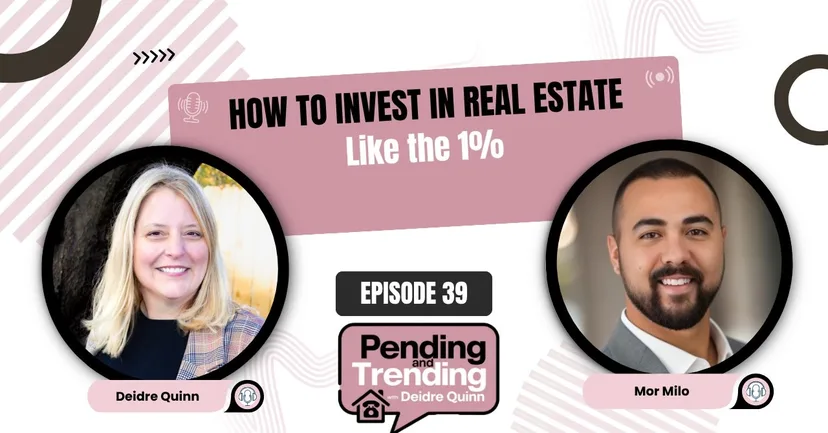
Relli CEO Mor Milo joined Deidre Quinn on the Pending and Trending podcast to talk about how private real estate is opening up to more investors. They cover why sponsors are turning to individual investors, how Relli vets sponsors, what first-time investors should look for, and one investor's move from owning rentals to truly passive income. The episode, "How to Start Real Estate Investing With Just $100," was released April 30, 2026 and runs 25 minutes.
Editor's note: recorded in April 2026, so some details have changed. Today Relli is a marketplace where investors review offerings from reviewed sponsors, express interest and talk to each sponsor directly, and each offering page shows its own minimum. Target returns and distributions mentioned are projections, not guarantees.
Watch on YouTube, or listen on Apple Podcasts or Spotify.
Key takeaways
- With many institutions shifting toward debt, individual investors have become a bigger source of equity for real estate sponsors, and sponsors are building a digital presence to reach them.
- Mor estimates only about 5% of accredited investors have invested in private real estate offerings like these.
- Relli vets every sponsor's background, track record and deals, but investors should still read every page of the offering documents and review them with their advisors.
- For first-time investors: talk to someone who has invested in a syndication, go through the documents with an experienced investor, and compare several deals and sponsors.
- Owning rentals is often far from passive. One investor is selling 20 to 25 cash-bought homes to invest with larger operators instead.
Full transcript
Lightly edited for clarity. Section times match the YouTube video.
Welcome (0:00)
Deidre Quinn: I'm Deidre Quinn, and welcome to Pending and Trending, a podcast that started in real estate and grew into so much more. Here we talk about the power of building wealth, creating opportunities and designing a life that lasts for generations. With expert guests and real conversations, my mission is simple: to help you elevate your journey and build the legacy you deserve.
Welcome back to Pending and Trending. I'm here today with Mor Milo. He is the co-founder of Relli, a platform created to expand access to institutional-quality real estate investments. Alongside co-founder Ross Iannarelli, he developed Relli as what he described as the stock market of real estate. It allows investors to discover, compare and invest in opportunities with greater transparency and lower entry points. Thanks so much for being on with us today.
Mor Milo: My pleasure. Good to meet you.
What is Relli, and what problem does it solve? (0:51)
Deidre Quinn: I'm happy to have you on. Let's dive right in. For our listeners, can you explain what your Relli platform is and what problem you set out to solve when you started conceptualizing it?
Mor Milo: No doubt. Essentially, our goal is to become a stock market for real estate. What we envision is a place where you have the ability to invest in real estate with as little as $100, just like you do on the stock market, on the Fidelity app or Robinhood or any of your favorite brokerages. And to do so in real estate that is large: huge properties, big multifamily assets, big industrial assets, maybe a data center, things of that nature, like a high net worth investor would. But to do it in a consolidated platform where you'd be able to see your portfolio in one place and manage that portfolio as you grow from a small fractional investor to, hopefully, an active real estate investor in your own right, or just continue to expand your portfolio of passive investments.
What we discovered was that there was a huge market out there for high net worth individuals, but average consumers couldn't participate. And we really wanted to get in, me and my business partner, Ross. So we decided to build the foundation for the platform that we wanted to invest on.
Why is private real estate opening up to more investors? (2:44)
Deidre Quinn: That's amazing. I can't tell you, in all the years I've been in the real estate and investing world, it really wasn't until my podcast that I started meeting so many people investing in so many different ways. Certainly my listeners are like, "Oh, wow, that's really interesting. I hadn't heard of that before." So I think it's wonderful that you're doing that. What's changing now that's allowing those doors to open and more people to participate?
Mor Milo: I would say what is shifting, number one, is our current debt market. Sponsors, the real estate development groups that raise capital, have been plagued by institutional investors shifting their energy toward debt, because they have a better position in the debt stack from a risk perspective, and the returns became similar to what they could receive in an equity position. So retail investors are what's been keeping the real estate syndication and fund market afloat, because those institutional investors have shifted a lot of their energy toward debt.
So those who have great relationships with their investors, and good deals that could weather the storm of higher interest rates and a scarcer market, are succeeding. And that has shown many sponsors that their reliance on one or two or five partners that are "consistent" in their business deploying capital, and I say consistent in air quotes, meant they had to scurry and figure out how to get a digital presence and start speaking to retail investors. So in the last five years, post-COVID and post what's happened with interest rates, we're seeing a lot of energy going toward public marketing of private real estate investment deals for accredited and high net worth individuals.
And in the background, over the last 10 or 15 years, since the JOBS Act, more small businesses have offered investment opportunities to average consumers through crowdfunding. Real estate sponsors are starting to see that as an opportunity to diversify their investor pool and to systematize how they raise capital for their deals. The culmination of those variables, all coming together in a beautiful stew, is creating an opportunity for average consumers to start looking at these investments.
In the past, these syndications and funds were available to investors who were in the know. Those investors were able to deploy $25,000, $50,000, $100,000, a million, whatever, into a real estate syndication with a large number of units or a large industrial facility or whatever the asset happened to be. They have syndicated and pooled their money and deployed that capital for decades upon decades. That's how the business was built.
What's also happening is that sponsors are realizing that only about 5% of people who qualify as what's called an accredited investor, which is an investor with over $200,000 in income individually, $300,000 with a spouse, or a million dollars in assets outside of their primary home, have been reached to invest in these types of alternative investments. With the internet and its last 20 years of evolution, real estate sponsors and investors have been very slow to make adjustments, because it's a business where "this works, let's not change it." But people are starting to see the light and say: if we can reach the 95% of high net worth individuals who don't know these deals exist but would probably be more than happy to invest in them, we can build a really powerful business.
And if they take it to the, call it, 80% of the rest of America that isn't accredited, and offer an average Joe an investment for $100, they've created a massive pool of investors they can work with to build more property, which at the end of the day will hopefully help with the housing shortage we currently have.
How do investors discover and compare offerings on Relli? (7:09)
Deidre Quinn: Absolutely. So how does Relli allow investors to discover and compare opportunities?
Mor Milo: That's a great question. We have an online platform that's available today for investors to see a few deals. I think we currently have eight active deals as of this moment, and another one launching in the next week or so from our first publicly traded customer on the platform, which is very exciting.
An investor has totally free access to our online platform and to a concierge service we provide, where we offer different deals that we've vetted from sponsors all across the country. Whenever we get new deals, we update investors once they create an account, and they can engage with us and our concierge team to learn more about how these investments work and connect directly with the operators who are raising the capital and managing the assets. So we provide a full-service solution for investors to find their next deal, connect with the sponsor, learn more about who they're investing with, and deploy their capital across a large selection of opportunities.
How does Relli vet sponsors, and how much should investors rely on it? (8:20)
Deidre Quinn: Now, you mentioned the word vetting. What do you do to vet them, and what does that look like on your end? And how much should an investor rely on that?
Mor Milo: Every investor should do their due diligence, no matter which way you slice or dice it. You should have your team: a financial advisor you can refer to and real estate professionals in your corner, and we can help you connect with those types of people.
What we do is manage the top tier of vetting for the sponsor. Who is this person? What's their background? Do they have a track record with investors who have received returns in the past? Do they have a deal that makes sense? Is it within the realm of possibility? And do they have enough credibility as an operator for us to feel confident that investors will be able to trust this person?
So we'll look at the deal specifically. We'll look at the background of the sponsor presenting the deal. We'll dig into their previous deals and how much they've done in the specific asset class they're advertising. And we're in the process of incorporating tools that run background checks on SEC registrations they've done in the past, other companies they might have worked for or worked with on other real estate deals, and a range of other background checks, to make sure these people are real, that they have experience, that they have a track record of assets that have proven to be profitable, and that their legal and compliance is in neat and organized order.
That probably takes about 70 to 80% of the hard labor off the table for a passive investor who's learning how to invest in one of these alternatives for the first time. Beyond that, we still recommend that you read every page of the private placement memorandum and the offering memorandum, and run all of that documentation past your financial advisory team to make sure it fits your portfolio. Because no matter which way you slice it, it's an investment. Investments can lose money, and there's a certain amount of risk with any type of investment, whether you're in a first-position lien on a house or investing in a fund of assets. Each has its own risk, and each needs to be actively diligenced before you invest.
What should first-time investors look for? (11:02)
Deidre Quinn: Do you have some top things you would recommend novice investors look for when doing this for the first time?
Mor Milo: Yes. First things first: talk to another person who has invested in a syndication or fund and get their experience of the emotional roller coaster of investing in a private syndication or fund, because it's a completely different experience from investing in a mutual fund or index fund on the stock market. So number one is to get people in your corner who have previously invested in deals, and we can actually help connect people with that.
Another piece of advice: look at deals with others. What I mean is, actually spend time on the phone with a more experienced investor walking through the offering memorandum and the private placement memorandum. Take 30 minutes, take an hour, look at the documentation, understand what things mean, ask questions. There are no stupid questions, okay? Because there are lots of variables and terms that don't make sense off the bat. You have to get cap rates and NOI and all that stuff explained. It's a language, so you have to immerse yourself in that language.
And it's like any type of investing. Before you invest in technology, you should probably research the top technology firms. Before you invest in energy, you should research the top energy firms. Look at multiple deals; that's why we have a platform. Talk to multiple sponsors. See different deal structures, because every deal is different. I think the most important component is education and curiosity. Be curious and ask lots of questions, because it's a new world. Before making any investment, whether it's $100 or $100,000, you should know the basics of what's available in the marketplace, how the available investments are structured, and who the operator is, including their previous experience doing what they're doing.
Where are the biggest opportunities for investors right now? (13:19)
Deidre Quinn: Very good. Where do you see the biggest opportunities right now for investors? And for the type of investor you're talking about, there's obviously a wide spectrum.
Mor Milo: It depends on what type of deals you qualify for, and on your risk appetite. What we have seen be consistent in the market over the last two or three years is retail: double net and triple net lease product, like a Sherwin-Williams or a Walmart or a shopping center. That type of asset has consistently performed, even through this game we've been playing with interest rates and market scarcity.
Multifamily has a track record of producing outsized returns, but it has been on a much more fluctuating curve over the last five years, both emotionally and in how the asset class is perceived. Is it overbuilt? Is it underbuilt? Are we building in the right places? Do we need to go to different places? Primary, secondary and tertiary markets have all fared differently. There's been some fluctuation, but traditionally that asset class has produced really well, because there's a need. A very big need.
At the same time, we have a little debt scare going on in the market right now, where private debt is taking a bit of a hit because people are concerned about all the maturities coming due and the lending that's been done. But debt has historically been one of the lower-risk and more consistent performers over time.
All that being said, I think what's most important is to get educated on investing as a whole. What do I mean by that? If you're familiar with TIGER 21, it's a club of very high net worth investors across the country with a very small, intimate community. I believe the minimum for an individual to join is $10 million. If you look at their data, about 26% of their investment capital goes into real estate, and the remaining 75% or so is spread across multiple sectors. Those super high net worth investors put about a quarter of their money into real estate, spread across the different sectors within that asset class.
I think investors need to start building portfolios with a set percentage in each kind of asset, balancing risk across the whole portfolio. That education needs to happen first. And now that more crowdfunded real estate syndications are coming to market, I think in the next 10 years we're going to see more of these assets reach the average consumer, in a way where investors at every level of the wealth spectrum will be able to put a set percentage of their capital into each of these asset classes, digitally. I think that's going to be a really powerful tool, and investors should start getting educated on it, because it's the next opportunity for the average consumer to diversify into investments backed by real property that produce income.
How does Relli make money if it's free for investors? (17:09)
Deidre Quinn: That's so insightful and makes so much sense. Now, with your Relli platform, is it free access for investors? How does that work? Who funds it? Who supports it?
Mor Milo: The general partners fund the platform for the limited partners. What does that mean? The passive investors get a free solution and a free concierge team to support them, because the real estate developers raising capital are looking to advertise on our platform. And we do a multitude of things for them. We take on a lot of marketing work most of them are not super familiar with, which helps them focus on generating returns for their investors. That makes the real estate developers happy.
And the passive investors get access to a digital platform with a bunch of different deals, with calculators to estimate different returns and benchmark them against other investments in the market, like the S&P 500 and Treasury bonds. You'll also have access to our team at Relli, a concierge-style service where we schedule meetings with investors, show them different deals, connect them to different sponsors, and show them how to use the platform. And that's all 100% free.
Deidre Quinn: I love it. So you have your platform that anyone can go on right now and check out the different possibilities. They can connect directly with your team, compare the deals and use the tools you currently have in place. And you're also adding more.
Mor Milo: Adding more all the time. Yes, you nailed it.
From owning rentals to truly passive income: an investor's story (20:08)
Deidre Quinn: Excellent. Do you have anything last you want to share with our listeners?
Mor Milo: I'd love to learn what your listeners really care about. What has been the biggest feedback from your listeners about what they enjoy in this content? Maybe I can bring a story to the table that's of interest.
Deidre Quinn: What I'm finding is basically what you were explaining. A lot of listeners aren't familiar with all the different options. Historically it's: go to work, get a paycheck, invest in your 401(k), give money to a financial advisor. If you want to accelerate that, or be conservative, you place it in different accounts, similar to what you're talking about but different. And they listen to my podcast and say, "Wow, you know what?" They start with one episode and keep listening to more, because everyone has a different spin on building wealth and investing. So that's it in a nutshell.
Mor Milo: Okay. I think I have a great story for us here. The idea of buying a property and turning it into a profitable enterprise is interesting for an average consumer because it's right in front of you. You rent out a property, someone moves in, they pay you, it's passive income, everybody's happy.
I spoke to an investor named Eric, who had been buying single-family homes with cash for the last 25 years. What he had discovered is that "passively" investing in rental properties, again in air quotes, was the furthest thing from passive. It was incredibly difficult: dealing with tenants, evictions, maintenance, management and administration. Where's all the money going? How's it coming in? Accounting for it, taxes. And after all of that work, he was making maybe 11% or 12% in a good year, and somewhere between 6% and 8% in a not-so-good year.
He came to our platform interested in an offering targeting a 12% annual distribution, paid quarterly, from debt placed on homes. And the conversation we had was very pointed: "I'm old, I'm tired, I don't want to keep doing this. Why do I have to deal with tenants? Why do I have to deal with maintenance? Why do I have to take care of toilets? If I sell my 20 or 30 properties and put that capital into debt positions paying anywhere between 7% and 12%, and I do nothing, isn't that better, and actually passive?"
He is now in the process of selling his 20, I believe it might even be 25, properties, which he bought with cash and no leverage. Respect to him; that's one way to do it. He's finding operators with larger operations and teams to manage and maintain those assets, and looking to give his capital to people who can deliver a truly passive return, using his own ability to underwrite a deal and tell good from bad because of his experience.
The point being, there are many ways to do this. Even people with a long history of investing actively are now setting their sights on different opportunities, because the internet is delivering those opportunities to their front door. We're building an engine that gives investors the opportunity to learn how to get into these assets and earn truly passive income from companies with a track record, a specific real estate niche and a management team focused on delivering returns. And we're bringing that to the front door of the average consumer. So we're excited about all of that.
How to find Relli (23:54)
Deidre Quinn: That's great. What an amazing platform you've developed, and what a great story about Eric and his journey. Thank you so much for being on. Can you share the best way for our listeners to find you or get to your platform?
Mor Milo: Sure. Relli is easy to find. Go to relli.co, that's R-E-L-L-I dot co. From there you can create an account, see everything totally for free and connect with us directly for free. If you want to connect with me directly, check me out on LinkedIn; that's my most active social. Or go to our website and schedule a meeting with us, and I'll likely end up on your call. You're welcome to find us on any of our social platforms at @InvestWithRelli, and you can find me, Mor Milo, on LinkedIn and reach out directly. We are here to serve, so come find us.
Deidre Quinn: Thank you so very much.
Mor Milo: My pleasure.
Deidre Quinn: Thanks for tuning in to Pending and Trending. Remember, generational wealth doesn't happen by accident. It happens by action. If you liked today's episode, share it with a friend, subscribe, and let's keep elevating your journey together.
Listen to the full episode
Pending and Trending is hosted by Deidre Quinn. Learn more about how Relli works or review current offerings.
