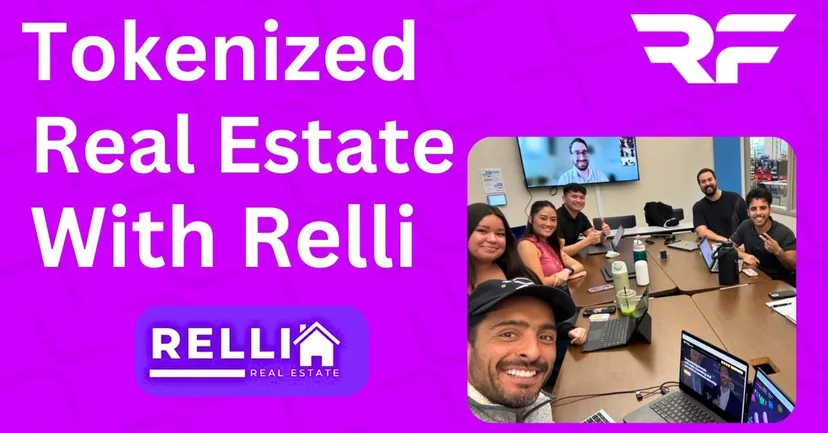
Relli co-founders Mor Milo (CEO) and Ross Iannarelli (COO) joined Ray Fuentes on his YouTube channel to talk about why they built Relli and how it works with real estate sponsors and investors. They cover the founders' path into real estate, who Relli's ideal sponsors and investors were, the Relli expert network, and their views at the time on crypto and tokenized real estate. The episode, "Relli: The Stock Market of Real Estate | Invest Fractionally Today," was released May 24, 2025 and runs 38 minutes.
Editor's note: first published May 2025, so some details have changed. Today Relli is a marketplace where investors review offerings from reviewed sponsors, express interest and talk to each sponsor directly, and each offering page shows its own minimum. Target returns are projections, not guarantees.
Watch on YouTube.
Key takeaways
- Mor and Ross built Relli because they wanted to invest passively in larger real estate projects and found the deals hard to find and hard to access. Ray met them through Cal State Fullerton's mentorship program, where his marketing students worked with Relli.
- Relli's ideal sponsor, as Mor described it: active, with recent exits, at least 10 to 15 years of experience and at least $10 million to $20 million in assets under management or transaction volume, focused on a specific asset class and location.
- Ross explained that investors can browse offerings by simple categories, dig into the details at their own pace, and set up a meeting directly with the sponsor to get their questions answered.
- The Relli expert network grew out of sponsors' questions about legal, accounting, audit and capital raising. It lists professionals who can help both sponsors and investors.
- Mor's view in 2025 was that sponsors would use traditional offering routes, such as Regulation A and Regulation CF, before newer tokenized structures.
Full transcript
Lightly edited for clarity, with a few short passages removed. Section times match the YouTube video.
Preview (0:00)
The video opens with short clips from later in the conversation.
Mor Milo: Relli is the stock market of real estate. We are essentially building a platform that operates similarly to how Fidelity or E-Trade works, where you can manage a portfolio of passive real estate investments right from your couch. So Ross and I decided to build a stock market for real estate, where anybody can go and see real estate deals across the country and passively invest in any asset class.
Ross Iannarelli: Let's say a hotel being built in your community that you can invest in, right? You can really be a part of rebuilding your community, and you can make some investments and make some gains along the way.
Mor Milo: Fractionalization of real-world assets is the future of commercial real estate globally, for the sheer sake of creating the efficiencies that have been direly needed in the industry for at least two decades. The second that they leverage the available options for non-accredited investors, layering the tokenization piece on top of the securities that are available to average consumers will be gasoline on the fire.
The product is expanding when it comes to investment opportunities across the country, in different asset classes that people can diversify into, with amazing sponsors with great track records who are actually investing in our business as well as investing in advertising their deals on our product.
Ross Iannarelli: Take a browse, see what investments fit your appetite, and we're excited to continue to build.
Welcome and introductions (1:34)
Ray Fuentes: What's going on, family and friends? Today I'm excited to be interviewing the team at Relli. Relli is the stock market of real estate, connecting real estate sponsors across the country with capital by facilitating transactions with retail, accredited and institutional US investors. Relli helps real estate sponsors raise money in the cheapest, fastest and most efficient way possible, as this world goes digital, opening up new markets and new opportunities. I'm proud to be interviewing the founders of Relli, Mor and Ross. Let's bring them up on the stage. Welcome, Mor. Welcome, Ross. Let's tighten up that screen here. Boom.
Mor Milo: What's up, Ray? What's going on, man? Good to see you.
Ray Fuentes: It's so good to see you guys. Thanks for joining me today. How are you doing?
Ross Iannarelli: It's been a good day, man.
Mor Milo: Doing great.
Ray Fuentes: Good. It's a great day. We're on the back end of a busy week. But before we dive in, let me give you guys a much-needed introduction. Then we'll dive into some questions, and we'll circle back to your areas of expertise toward the end of this conversation, to drive home for the audience who you guys are and why you are exceptional leaders at the helm of Relli.
Let's start off with you, Mor. Mor is the CEO and founder of Relli. Mor has deep expertise in finance, HR and leadership. Off the clock, he dedicates his time to coaching, philanthropy and empowering others through personal and community development. Ross Iannarelli is the founder and COO at Relli, where he drives product and marketing strategy with a data-first approach. Ross is a multi-time founder with expertise in product management and analytics. Ross transforms insights into growth, innovation and value for investors and his customers.
So again, gentlemen, it's quite the honor to have you two here. For those in the audience, I want to explain how we actually became connected, which was through Cal State Fullerton's mentorship program. I had the privilege of supporting these two fine professionals while mentoring the marketing students at Cal State Fullerton. Cal State Fullerton offers a unique program for its graduating students to support real businesses as part of their final projects, and Relli happened to be the company my mentees were working with. I was thrilled for this mentorship opportunity, because Relli is pioneering what I believe is the future landscape for real estate investments.
What is Relli, and why did Mor and Ross build it? (4:04)
Ray Fuentes: So again, gentlemen, thank you for joining me. Let's dive into all things Relli. What is Relli? What was the inspiration for Relli? Mor, why don't you kick things off, and then Ross, you drive things home.
Mor Milo: I'd be more than happy to. First of all, thanks for having us on, Ray. We're super excited to be here. We love your platform and everything you're driving for the cryptocurrency space, the DeFi space and the Web3 space, so we're excited to be able to contribute. Relli is the stock market of real estate. We are essentially building a platform that operates similarly to how Fidelity or E-Trade works, where you can manage a portfolio of passive real estate investments right from your couch.
The idea really came from our own desire to be able to invest in these types of assets. Selfishly, I watched my parents build a small portfolio of real estate. And over the time that Ross and I were building previous startups, I watched real estate flourish and some of our startups fail. I looked at Ross one day and said, "Ross, we need to diversify into real estate. We have stock, we have crypto, we're investing in all sorts of stuff. It's hard to get into the real estate space. But what would it look like if you and I could invest $5,000 passively in real estate development opportunities?"
We knew that wealthy investors would put $50,000 or $100,000 together at a time and go build massive projects across the country. But we just didn't have access to them. We didn't know where the deals were. We didn't know who the people were. We didn't qualify. We didn't have enough money. So Ross and I started looking at what average Joes like myself, who want to invest $5,000 or $1,000 at a time, had access to, and the options were really limited. There were only a couple of platforms out there, each one completely separate from the others, so you had this siloed experience where it was really difficult to manage a portfolio, and there weren't many options. So Ross and I decided to build a stock market for real estate, where anybody can go and see real estate deals across the country and passively invest in any asset class, with proven sponsors who have been around the block and have been delivering excellent returns to their investors for many years. Ross, do you mind following it up?
Ross Iannarelli: Yeah, of course. To piggyback on what Mor said, it's a little bit about that access, right? We had invested in different places, but real estate, especially when I think of myself, where would I go in real estate? The closest I've really gotten would be maybe to buy a house and flip it into a vacation Airbnb, right? But then I have to do tenant management, and there are a lot of things there that I don't have a background in. So it was about finding opportunities that I could diversify into. I don't need another stock or another cryptocurrency. I want to add some real estate, something I know can be with me for the next five or 10 years.
So it was about getting access to these larger deals, right? Whether it's a hotel, oil and gas, a lot of different opportunities, versus going to get an Airbnb or putting your money into a Vanguard fund. It's about finding a place where you can take some ownership, the same way we pick our stocks. We all try to pick our winners and figure out what we like. Do you like investing in residential? Do you like investing in commercial? Is it something in your area? We just thought how cool it would be to have, let's say, a hotel being built in your community that you can invest in, right? You can really be a part of rebuilding your community, and you can make some investments and make some gains along the way. So for us, it really seems like a great bridge, and we're excited to be able to bring that to people.
Ray Fuentes: What a wonderful opportunity. It sounds like a really good opportunity. So thank you guys. Hey, this is a friendly environment, so fire away at will.
How does Relli think about crypto and tokenization? (8:00)
Ray Fuentes: Thank you for the detailed explanations. Coming from the private equity and fintech landscape, I see this as a revolutionary time for exponential growth around these new secondary markets. For you, it happens to be real estate focused, but what I hear is the access Relli is providing to a demographic of investors that has been underserved. So it's really great to see that you guys are that bridge. Let's move on and talk about Relli's core mission in this evolving real estate investment sector. We tap-danced around the forward-thinking crypto sector. Are you guys being mindful of those trends at all? And if so, what's your approach?
Mor Milo: It is something that is consistently top of mind for us. To give you some insight, when we first decided to create a platform for these types of securities and exemptions, we had to make a decision. We started three years ago, and we decided to go down the route of TradFi first. It was during a time of massive uncertainty. Currently, in the ecosystem we're in, there's more and more traction around decentralized systems. However, the real estate industry is an antiquated industry that's been around for many years, and the decision makers in the industry are from an older generation. Essentially, you have a group of financial professionals and capital markets professionals who do things in a very traditional way, and the thought of changing something that isn't broken is terrifying to them.
So we knew when we went down this journey that we would have to incorporate decentralized finance into what we're building, because it's the future. We also knew we'd have to balance the response of our customers, the real estate development funds that are raising capital, and their ability to take on these new challenges and structures. For example, we recently had a conversation with a group based in Florida, an active and trustworthy real estate sponsor in the multifamily space. They've decided that in order to continue to grow and scale their business, they would like to create a tokenized asset that they can raise capital through. However, the lack of sophistication around the financial systems makes it really difficult for the operators in their business to properly present themselves to the community. So what ends up happening is that people spend a lot of money on solutions they don't know how to execute on, with resources or vendors that can't really provide the right services. And we've seen time and time again that those who go down that route struggle, unless they're really sophisticated in their methodology around finance.
So in my personal opinion, the best thing we can do for our sponsors is give them an on-ramp to decentralized and fractionalized offerings. That on-ramp is through the current regulations that exist in the marketplace, through Reg A and through Reg CF. By getting them through those initial hurdles in the TradFi space, we're going to prepare them properly to leverage those tokenized opportunities and start getting into the decentralized finance world with these real-world assets. You've probably seen how difficult it has been for real-world assets to really come to fruition. What happens is you have a very new way of doing business meeting a very old way of doing business, and sometimes those things don't connect. So I think what we can do really well here is give our sponsors that on-ramp and an easier trajectory into Web3, DeFi and cryptocurrencies.
Who are Relli's ideal investors and sponsors? (12:30)
Ray Fuentes: So I understand that you are supporting those on the sponsor side, or those who are trying to distribute their already issued assets, correct? But at the same time, because you've created a market on the Relli platform, you're also supporting the buy side, curating, call it, a pool of accredited investors who are ready to deploy capital into these opportunities. My question, for those tuning in today: do you mind explaining who your ideal customer is, on both sides of the house at Relli?
Ross Iannarelli: Yeah, I'll speak on the investor side. Mor focuses on the sponsors; that's how we split our business internally. When we look at who our ideal customer is, we've mentioned DIY investors before: people who are looking to make their own investments. They're in a certain tier, right? They have money on the side that they can look to invest, but they may not be sure where. So we're looking for people who are excited to invest and excited about the opportunity to get into real estate, in a way that, yes, could be a little bit more risky when you're investing in one property versus an index fund with 500 different properties in it, or even more. But it allows you to invest specifically. It allows you to start building your portfolio and understanding how to structure it, so you can start building wealth over time, and that can help when deploying capital in other places.
When we look at Web3 and DeFi, I think the biggest place it fits into our puzzle is going to be on the payment side. As Mor mentioned, the sponsors love the traditional side, right? They've been doing it that way for decades, so why change it? But as consumers, we've been continuously changing our habits, and we're more open to investing not only in different things, but in different ways. I think asking someone to invest in a traditional asset in a slightly non-traditional way won't be that hard of a leap in a few years. We all have friends who have been in cryptocurrency for the last year, or the last five or 10, right? Everyone is slowly catching up to that spot. So it's about having the ability to invest however you want. Because for us, these deals were just never available. They existed with or without us. These people were fundraising whether we got them on the platform or not. But they're excited to expand their network and find new investors, and on our side, we're excited to expand our network and work with these sponsors across the country.
Mor Milo: On the sponsor side, I would say our ideal customer is a proven sponsor with a track record of success in a specific asset class in a specific geographic location. We're very focused on finding people who are active, have had recent exits, have at least 10 to 15 years of experience, and have at least $10 million to $20 million in assets under management or transaction volume, so we know these sponsors have been through the wringer before. This isn't their first time around. We're not putting our investors' money at risk with people who are new to a certain asset class or geography, which allows for the highest-quality private investment opportunities in the marketplace to be available on our platform.
And just to speak a little more on the passive investor side: there are so many people who qualify to invest in these offerings and don't know that they qualify. So many of them. I think what Ross does really well is make it easy for people to participate on our product, see different opportunities and learn more about what's available to them in a low-pressure environment, which then translates into trustworthy relationships and opportunities for people to grow their wealth.
How does Relli make the experience simple? (16:41)
Ray Fuentes: Very kind. Kudos to Ross. Ross, do you mind piggybacking off those kind remarks? What's your approach to facilitating a seamless transaction or experience on the Relli platform?
Ross Iannarelli: Yeah, I think there are a few things that go into it. One of the biggest things we continue to work on is finding the right amount of information someone needs to see to understand a deal, right? Because you're going to have people come to the platform who have invested in real estate before, and you're going to have people come to the platform who have never invested a day in their life in real estate. So first, it's giving them things they understand or can know, so categories like industrial, residential or commercial, some simple starting points, but putting it in a way where they can take their time and get into a little more information. And then once they're there, they can set up a meeting directly with one of these sponsors to get a lot of their questions answered, right? Because for a lot of these deals right now, the minimums aren't as low as they'll eventually be.
But I think what's important for the people looking to deploy that capital, like the one you have up here, a self-storage deal: I think everyone, even without knowing the dynamics of self-storage, would think that's probably a pretty safe investment as long as it's rented out properly. Let's see where it's located. Is it by a highway? Then you can talk to the sponsor and get an idea. And if that works, invest your $50,000, $100,000, whatever the amount may be. As we continue to get that across, we'll be able to keep bringing that minimum down, as the sponsors Mor is working with start to understand more of the benefits, not only of lowering it in a traditional way, but of starting to go on to DeFi and other ways we can take more investments in a way that's seamless for them. Because their biggest issue is that they don't want to have thousands of investors to deal with. It's not something they've ever done. But having a way where the payments can move seamlessly and it's all set up properly will really ease the part of them that isn't financially savvy or tech savvy, right? And it allows everyone to get involved in the transaction.
So from a website standpoint, it's really about giving people a place to look around, right? Look for investments. If you're not there for investments, you can go directly to the sponsors, maybe those in your area or the largest in terms of company size, or even find real estate experts in your area. So we're trying to build that community and give people everything they would want, because real estate is so diverse.
What is the Relli expert network? (19:14)
Ray Fuentes: That's a perfect segue, because you guys do have your Relli expert network. Do you mind discussing this resource and how it differentiates you from your competitors?
Mor Milo: Yeah, sure. I'd be happy to jump in on this one, from the perspective of what we've learned over the last three years. It really drives home the fact that you don't know what you don't know. Even those operating at the highest levels need highly qualified experts who can help them get from point A to point Z. What we discovered in our initial outreach to real estate development firms and fund managers was that, number one, they didn't have the resources to take a deal like this to market and properly market themselves or the offering to accredited or non-accredited investors.
So along the journey of getting to know these real estate sponsors, they had questions for us. How does the legal work? How does the accounting work? How does the audit work? How does acquisition work? How does all this stuff fit together? With that opportunity, we decided to go figure it all out and put all the pieces in one place. We started talking to the broker-dealers, the lawyers, the accountants, the CPAs and the auditors to understand what they do, how much it costs and which part of the process they'd need to participate in. Through that exploration, we said, "Okay, clearly these real estate sponsors are going to need access to these people. So let's give them a place to hang out." Ross built out the platform with our tech team to bring some of those people into it.
What we also discovered was that it wasn't just one side of the table that needed support. The passive investors needed help too. If they wanted to invest in a single piece of property, they needed a broker, an agent, a mortgage person. Or even if they wanted to invest passively, they probably needed a financial professional who could help them deploy their capital properly, and a tax professional who could make sure they're paying the right amount of taxes and not overpaying. So it was just a clear fit. So many people have loved that we've posted their information on our platform, and we continue to add more people to that network.
What makes Mor and Ross the right founders? (21:46)
Ray Fuentes: Good for you guys. I've been following all your channels across the go-to social media platforms, from Instagram to X, and you guys are constantly pumping out announcements of your recent partnerships and milestones. I'd love to touch on those before we conclude our conversation. But before we get there, I really want to drive home your areas of expertise. What is it about you two gentlemen that makes you the right people for the job at the helm of Relli? Let's start off with you, Mor.
Mor Milo: Sure. First of all, building a startup is all about persistence and passion, number one. I actually just had a conversation with a potential venture capital investor for Relli, and they said something that has continued to ring true, which is that at this stage, you bet on the horse. And what it looks like is that we're the horses who are willing to be persistent and keep running.
Ray Fuentes: You're some handsome horses, by the way.
Mor Milo: I'll take it. I'll take it all day. All that being said, the first thing, and it's something both Ross and I have, is an absolute passion for building and solving problems. Another thing we share that makes it special is that we're not easily deterred. We can be beaten up over and over again. I don't know if I'm allowed to cuss on this platform, but we have a saying that we consistently use with people we ask for feedback, which is, and I'm going to change the word here for the sake of not cussing, "Please poop on us and tell us how terrible we are, so that we can improve ourselves." So that's number one.
Personally, what makes me qualified to build this is, number one, a desire to be a customer. I want to be an investor on this platform, so I'm building the platform investors want to be on, hand in hand with Ross. The second thing is my experience actively working with small to medium businesses and in the finance space. I've moved a lot of money in my life. I used to work in the acquiring banking space, and I still work with customers in the banking space. Moving money is very difficult and very complex, and that's a big portion of what we do on this platform. So I bring value from that perspective, my finance background, making sure the transactions on the platform happen compliantly. The third thing is leadership and management. I worked for one of the biggest HR consultancies in the world, which helped some of the best companies across the country get the best out of their employees by improving retention, employee experience and training. That positions me really well to support our teams. In my opinion, I work for the team. I am 100% an employee of the business and an employee of our team. And I wouldn't even call it Batman and Robin, man. I would say it's like Superman and Batman, right? We both have our strengths, we're both equally powerful, and we're both here to deliver value to our customers. So with that, I'll pass it over to Ross to speak on his background.
Ross Iannarelli: Thank you. I think you touched on it, Mor. We always joke that founders always have a slight screw loose, but that's also their superpower, right? We will fight through all of it for the sake of our customers. We're always looking at how we can make their experience better, and we obsess over that in every way: how can we improve that experience? How can that show up in our processes, in our platform, in our messaging, everything? Previously, I was at Snapchat as an account executive working mostly with retail brands. So it was a very B2B sale, but really through the consumer lens: what would resonate well with them, whether certain campaigns or certain times of year. So I'm taking some of that knowledge. I think the biggest thing I learned there was the data side, understanding how to quantify your assumptions. My favorite book has always been The Lean Startup, whose core message is build, measure, learn. Mor and I use that in everything we do. Even if we didn't get it right the first time, we get better the second, the third, the fourth. That really shows up in our products and our companies, where we're able to withstand a lot of the initial hurdles some people run into, because you're often at the point where you'd almost quit right before that big jump, and you just have to go that extra step. I grew up playing football, and it was always "finish through the line." That little extra 1% really makes a big difference in the way you approach life, your customers and your company.
So the way Mor and I work, we're able to wear our different hats, juggle those hats and keep everything in line. We've done this for so many years that we can go a few days without saying anything, and then we pop up and all these things are done, because we know the other one is working at 8:00 PM, 9:00 PM, midnight. Mor messages me at 7:00 AM on a Saturday, still up and moving. So it's just nonstop.
Ray Fuentes: "You up? Are you thinking about tokenized real estate right now?"
Mor Milo: I don't even have to ask the question. I just go straight into what we're talking about. We're super aligned. "Oh, okay. Yeah, that's where we're at. Let's go this way."
Ray Fuentes: All right, great. That's funny. That's why I think we get along, Ross. We were both football players, except I played only freshman year on the B team, and I caught one interception. So that was my claim to fame.
Ross Iannarelli: It's all that matters. If it makes you feel any better, I didn't catch any passes, and I played plenty of football. So that's better than zero, I'll tell you that much.
Mor Milo: You can't see it in this little box, but I'm six-six and built like an O-lineman.
Ray Fuentes: You are very tall, Mor. So I appreciate you joining us small folk on the channel today.
What is the long-term vision for fractional real estate? (28:03)
Ray Fuentes: But hey, shifting gears here. I know we touched on tokenized real estate, but what's your long-term vision for fractionalized real estate investment? What do you think the impact of tokenized real estate will be, and how are you guys positioned to capitalize?
Mor Milo: I can hop in on this one, because I feel very passionately about it. Commercial real estate has been the same industry for many years, and there haven't been many levers you can pull in the real estate industry to maximize your efficiency as a business. I think the fractionalization of real-world assets is the future of commercial real estate globally, for the sheer sake of creating the efficiencies that have been direly needed in the industry for at least two decades. And I think the biggest reason fractionalized real estate is going to be the unlock for commercial real estate entering the technological era is that it shifts the financial stack, which is the most important part of any real estate transaction, and also the first part of any real estate transaction.
So if we revolutionize the way the capital stack works in commercial real estate by offering fractional financial investments to the world, not only will there be more money, there will be more liquidity and more efficiency, because everything will be automated. And it will allow for decentralized finance, with accountability that goes beyond a ledger presented by a fund manager, where you don't know if it's real or not, thanks to the advent of blockchain and smart contracts. I think the future for fractionalized real estate is very bright. In my personal opinion, tokenization will hit critical mass slightly after the traditional financial solutions are being used consistently in the business. What I mean by that is that currently, real estate developers are only focused on accredited investors. The second that they leverage the available options for non-accredited investors, layering the tokenization piece on top of the securities that are available to average consumers will be gasoline on the fire.
What's new at Relli? (30:52)
Ray Fuentes: Yeah. And having dived into your platform ahead of this call, I noticed you already have some type of back office created to support those investors' needs. Do you mind talking about what we have up on screen here? I apologize, there haven't been any transactions. I'm working my way up to that minimum investment threshold, guys.
Ross Iannarelli: Yeah. When we look at the back end, we're really trying to find out exactly what's going to be most important for our customers. That's an area we're definitely starting to expand and build on, now that we've got the platform to a place where people can start to explore and understand what they're looking at. So the idea is to build that out a little more in the near future, so that as you start to make your investments, whether you're with a few different sponsors or have it all with one, you'd be able to track it in one place. You'd be able to understand your portfolio from even a simple aspect, like I said before, of industrial, residential or commercial, maybe figuring out what a good portfolio of that looks like, and check on a monthly or quarterly basis to understand how it's going, the same way you open your phone and check how your crypto is doing or how your stocks are doing. We'd rather have all of that in one place for you, so you can really keep an eye on what's going on in your portfolio.
Ray Fuentes: Awesome. Wonderful. I appreciate the detailed explanation. Before I let you guys go, because I know we're approaching the 30-minute mark of this interview: again, thank you, gentlemen, for sharing not only your time but your expertise and your passion for Relli and the future of this investment landscape around real estate. Talking about the dynamic side of a startup, with the lean startup mentality, you guys are constantly moving and shaking. Are there any special announcements you'd like to make before I let you go? Let me bring it up on the screen, just to show that you guys are always pumping out announcements, welcoming so-and-so to the network and onto the platform. Is there any special announcement or news my audience would really appreciate hearing?
Mor Milo: Ross, do you have any product-focused ones? I have a couple of overall ones, but on product, you've been working on some cool stuff.
Ross Iannarelli: Yeah, on product, we just launched a refresh. You can go on there now and see investments, sponsors and experts, all in a way where you can easily contact them or get your education from them. From a business standpoint, since this refresh, we've restarted the clock on a lot of our things, since we were very much retail focused, and we've had to make those pivots based on our customers' needs. We're very close. At the time of this recording, we're 10 or 15 away from hitting a thousand brand-new accounts. So that's right around the corner. We'll take that. That shift definitely changed a few things around, but it's really exciting to see that we're starting to gain some steam on the investor side. I know Mor has some things he'll share as well, but it's just been great to see the community continue to grow.
Ray Fuentes: Mor, the mic is yours, sir.
Mor Milo: We've got some cool stuff, man. I'm really excited. We recently brought on a very powerful angel investor by the name of Timothy Li. And since Tim, we've actually signed on two new investors within the last two or three weeks. One of them, with over $175 million in assets, recently listed his fund on the platform. It's focused on retail properties like Starbucks and Walmart locations and all sorts of cool stuff like that.
The product is expanding when it comes to investment opportunities across the country, in different asset classes that people can diversify into, with amazing sponsors with great track records who are actually investing in our business as well as investing in advertising their deals on our product. So that's really exciting. And more than that, I think what's really happening is that we're starting to gain some speed and some steam in the community. People are starting to recognize our name, which is very exciting, and slowly but surely we're getting more of those accounts, like Ross mentioned. Outside of that, we're growing at an extremely consistent pace, and we're excited for the future. I think it's very bright.
Where can people find Relli? (35:44)
Ray Fuentes: Congratulations on that significant milestone of a thousand users. I'd say that's monumental. I'm just excited to get one YouTube subscriber, so kudos to you guys. Before I let you go, what's the best way for those in the audience to learn more about Relli and follow you two as leaders in the space?
Mor Milo: First of all, check out our website, relli.co, and check out all of our socials at @InvestWithRelli. Personally, you can find me on LinkedIn. That's my most active platform, at Mor Milo, as it's listed right here on the screen, whichever side it's on. And feel free to reach out to me personally at mor@relli.co if you have any questions. Ross, maybe you want to throw out yours?
Ross Iannarelli: Same. You can follow me on LinkedIn. I think mine is just Ross Iannarelli. You'd have to confirm it, but it's up on the screen now. That's where you can find us personally. And for our website, relli.co, like you mentioned: take a browse, see what investments fit your appetite, and we're excited to continue to build with you as you join the community.
Ray Fuentes: Wonderful. Gentlemen, it was quite the pleasure and privilege interviewing you today, and meeting you through the Cal State Fullerton mentorship program. I'm excited to see what the future of Relli looks like in short order, because I know that in this space things happen fast, and the relationships you have are only going to make you excel even faster. So kudos to you, gentlemen. If there's nothing else to be said, I'm going to close up shop here and let you guys run off into the world of real estate investments. Thanks to Relli, and again, I'm looking forward to having you back on the channel sooner rather than later, so we can get some updates for those in the audience who want to keep a finger on the pulse of Relli. So again, thank you, gentlemen. I hope you have a great rest of your day, and I appreciate you stopping by.
Mor Milo: Thanks, Ray.
Ross Iannarelli: Thank you for having us, Ray.
Ray Fuentes: Thank you.
Listen to the full episode
The interview was hosted by Ray Fuentes on his YouTube channel. Learn more about how Relli works or review current offerings.
