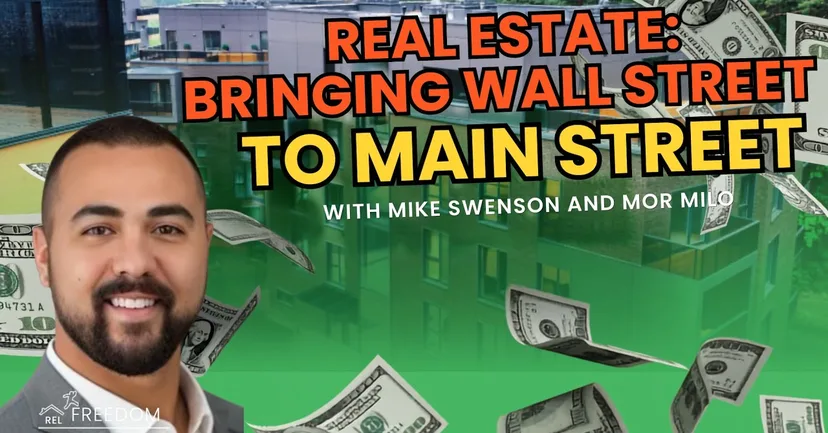
Relli co-founder and CEO Mor Milo joined Mike Swenson on the REL Freedom Podcast to talk about how private real estate is opening up to more investors and how Relli vets the sponsors on its platform. They cover what Mor learned watching his immigrant parents build a rental portfolio, why minimums and trust hold investors back, how SEC rules shape what can be offered, and Relli's sponsor due diligence. The episode, "Mor Milo - Real Estate: Bringing Wall Street To Main Street" (episode 351), was released September 10, 2026 and runs 30 minutes.
Editor's note: first published September 2026, so some details have changed. Today Relli is a marketplace where investors review offerings from reviewed sponsors, express interest and talk to each sponsor directly, and each offering page shows its own minimum. Plans described in the episode may have changed, and target returns mentioned are projections, not guarantees.
Watch on YouTube, or listen on Apple Podcasts or Spotify.
Key takeaways
- Mor's parents built wealth with about 10 rental properties, but he saw the cost up close: tenants, repairs and evictions. That pushed him toward passive ways to own real estate.
- Two hurdles keep even well-off investors on the sidelines: finding sponsors they trust, and minimums that often run $100,000 to $200,000.
- Private placements under Regulation D (506(b) and 506(c)) are relatively cheap to set up. Regulation A and crowdfunding offerings cost more but can be open to non-accredited investors.
- Relli underwrites each deal's numbers (replacement cost, rent growth, occupancy) and runs background checks on the sponsor before listing. Mor's reminder: investing has risk, and you can lose all your money.
Full transcript
Lightly edited for clarity. Section times match the YouTube video.
Welcome (0:00)
Mor Milo: The goal for us is really to not only help a person like the investor I just described find more opportunities and lower the barrier of entry so they can participate in more deals, but also figure out how we can get the average consumer involved, and give them a place where they can deploy $1,000, $10,000, $50,000 at a time, so they don't have to come up with a big chunk of down payment for a piece of property, go out and venture into real estate, buy land for the first time and have to figure it out on their own.
Mike Swenson: Welcome to The REL Freedom Show, where we inspire you to pursue your passion to gain time and financial freedom through opportunities in real estate. I'm your host, Mike Swenson. Let's get some REL freedom together.
Hello, everybody. Welcome to another episode of REL Freedom, where we help people build time and financial freedom through opportunities in real estate. I'm your host, Mike Swenson. If you want to get started on your real estate journey, check out our website, freedomthroughrealestate.com. It's where we put all of our episodes and all of our content, with the goal of inspiring you to pick something inside of real estate, get started and run with it. We want to see action takers out there, and we want to expose you to some great concepts and great things that are going to make you want to take action.
Today's episode is absolutely one of those things. It's a really exciting topic, something really cool and new out there, and I'm excited to see where it goes. We've got Mor Milo with Relli, founder and CEO of Relli, essentially looking to take the stock market type of impact and put it into real estate, and allow people to invest in real estate simply and easily. That's always something that's excited me: how do we make this as simple as possible for people? Remove as many barriers to entry as possible, so people can get in and invest in real estate. So I'm excited to hear your story, Mor. Welcome to the show.
Mor Milo: Thanks for having me, Mike. I appreciate being here.
How did Mor and Ross come to build Relli? (2:03)
Mike Swenson: Get us started. Take us back. I'd love to hear a little bit about your background and some of the stuff that led up to where you're at today with Relli.
Mor Milo: So I'm a founder. I guess I enjoy punishment and pain, so I've done it consistently for the last 10 years. But I have a wonderful business partner whose name is Ross, and he's one of my best friends. For the last 10 years, we've been trying to build things that help people, and we're now on our fourth startup together. Relli is the brainchild of the two of us going out into the world and building a stock market for real estate.
What got us here was really just a true thirst for knowledge and a desire to invest. We both have an affinity for investing in stocks and cryptocurrencies and all sorts of things we can get our hands on, and we've done pretty well. However, we don't qualify as accredited investors in the eyes of the SEC. For those who may not know, an accredited investor is essentially someone with over a million dollars in assets outside of their residence, or $200,000 in income as an individual, or $300,000 with a spouse. So we didn't qualify in that category just yet.
But we really loved the concept of real estate as an investment. My family had invested for the past 25 years in single-family residences and rented out those homes and apartments to individuals, and turned a profit that was greater than the W-2 income my father earned at his job. That was an incredible wealth-building tool for my family. But I also had a front-row seat to the pain of dealing with tenants and managing toilets, and just lots and lots of pain.
So after three previous startups, I looked at Ross one day and said, how do we get our hands on some of this real estate? And how do we do it like the super wealthy do it, where we don't have to participate in the nitty-gritty of ownership? We discovered there were very limited options for the average consumer. So we set a goal to create a stock market for real estate experience, similar to Fidelity, E-Trade, Charles Schwab or Robinhood, where anybody could come and invest as little as $100 into commercial real estate buildings, multifamily projects and industrial facilities managed by incredible operators with a long track record of delivering returns to investors for many, many years, giving the average consumer access through a digital marketplace.
What we discovered was that this market operates behind closed doors. It's all who you know and how you know them. Everyone is attempting to bring their business to the forefront in the digital revolution, but they're having a real struggle figuring out how to cross the divide between the old way of doing business and the new way of doing business with complete strangers in a digital format. So we started our journey by creating a marketplace that could connect the two parties in the ecosystem: the limited partners, the accredited investors, and the general partners, which are the sponsors of different real estate operations. We help them generate accredited investor leads on demand. And slowly but surely, our north star of building that stock market of real estate experience has not changed. In the next 12 to 18 months, we plan to roll out our first initiative to introduce the retail community to our platform.
What did Mor learn watching his parents be landlords? (5:51)
Mike Swenson: That's awesome. Before we dig deeper on that, because obviously there are so many cool things we'll talk about here, I want to go back to what you mentioned about the pain with your parents. For somebody listening to this episode who maybe hasn't invested in anything themselves, wants to get invested, listens to podcasts, does a bunch of research and gets started, what we find is, like you mentioned, pain. Not knowing how to find deals or what makes a good deal. The pain of taking those 2 AM phone calls, finding contractors, dealing with licenses and inspections and all that. And if you do have some success, you get another property and another property, and then it's figuring out how to scale, and more pain comes with that. Either you manage it yourself or you hire it out to somebody else.
For us, we're hoping to take away some of those pain points for our investors, investing in apartments through syndications, so they don't have to experience that. But I'd love to hear a little more, for people thinking about the different approaches (either I can be active and hands-on, or I can be passive and hands-off), about the experience you saw, or some of the challenges or difficulties your platform will hopefully take care of by offering passive opportunities.
Mor Milo: My parents came to this country with me in tow at three months old. Immigrants, no college graduates. My father was an engineer, very, very smart, and worked for Hewlett-Packard for many, many years, but never really decided to chase the corporate ladder. Real estate was their way of getting in and building some sort of wealth. They house hacked, just like a lot of people do. They bought a house, moved to the next one, kept the previous one and rented it out. They figured out how to be landlords, how to be business people, and they learned it very grassroots.
As I grew up, I watched them do it and participated. Obviously, as an immigrant child, you get wrangled into doing all the heavy lifting so we don't have to pay anybody else to do it, which, in fact, I was happy to do. But I watched and experienced the inspections and the demo days and the build-outs and the evictions and the pain. So I watched them learn firsthand what it was like to be business owners. Even to this day, they aren't particularly interested in the idea of being business owners. They like the concept of having the real estate. Had they put that hat on, they probably would have built an even larger portfolio and had more income, and everything would be fine and dandy. That's one path you could choose to go down. They chose not to. They chose to have a comfortable life and manage their 10 properties or so, and deal with the pain associated with those properties so they could generate that income.
Now, after four years of research trying to find an alternative... Because I watched them do that, I was going to go down that same path and buy my first property as well. But instead of buying that property, I decided to build our first startup with Ross. Ross, my business partner, had brought me into an automotive startup he had started, and we went down that journey. Instead of investing my money in property, I invested in that startup. Unfortunately, I lost my money. It didn't go the right direction, but we learned a boatload and all sorts of good stuff. Had I not gone that direction, I would have gone exactly the same path as my parents.
But now, after going that direction, learning what it's like to be a business owner, and now building a product that helps investors passively participate in real estate in a way where they don't have to get their hands dirty, even my parents, who were extremely old school in their methodology, are looking and saying, "All right, if I can put $100,000 here instead of using it as a down payment for a new property, and I can target a 9% return on my money every year from a loan that's being made by a fund I've invested in, and I don't have to do any headache, any homework, anything, because I've invested with a great sponsor, that's very attractive." That's very attractive. And that's where my curiosity has continued to boil around how we get this type of solution to the average consumer.
So if anything, watching my parents buy and manage property, and being involved in that process, has educated both me and them on the fact that there are so many different ways to do things. For an operator like yourself, who has the operational know-how and the desire to build and scale a portfolio, it makes all the sense in the world. For an individual who doesn't want the headache but wants the exposure, giving their money to someone like Mike might make a little more sense.
Who is passive investing for? (10:59)
Mike Swenson: And my exciting part has been hearing from the investors we've worked with. They say, "Mike, I've wanted to invest in real estate before, but I didn't know how. I don't know how to get started. I don't know how to find a property. I may not have enough money for an actual down payment on a multifamily, or maybe even a single-family if I'm not going to owner-occupy." So there's the financial constraint. There's the time constraint: they're probably working a W-2 job. And there's the knowledge constraint of "I don't really know."
The way we do it depends on the relationship. You have to have a preexisting relationship with these people. We've been able to help people, and they're thankful, because they say, "Hey, we now get to invest in real estate. I didn't know if I'd want to, and I don't want to be the one getting the 2 AM phone calls," which is maybe what prevents other people from doing it. So it's been exciting to hear that great feedback from the, quote unquote, average person who wants to invest in real estate and can't, or doesn't know how, or doesn't have the means and doesn't want to do it on their own. That's what keeps me going: knowing I'm helping those people accomplish some things on the real estate side they couldn't have done on their own. And that's obviously what you're working on too.
Mor Milo: That's absolutely true, and that's a great story. I just met a new investor who came to our platform. He found us online: he was searching on, I think it was Gemini, on Google, asking questions about passive investing, and he found our platform somehow and created an account. We reached out, scheduled the concierge meeting and talked to him about options. And lo and behold, the guy owns a 40-person law firm. He's always looking for new opportunities, and the two biggest constraints for him are usually finding a new deal with a sponsor he trusts, and the minimum investment for participating in that deal.
This is a person who has the means and has no issue writing a half-million-dollar check to an operator he trusts. However, he only has so many places to find new deals from new operators. He only has so many arbiters of truth when it comes to figuring out who's real and who's not, because he has to find his own way to vet each person and figure out whether they're high quality or not. And for many of these offerings, the minimums can be large: $200,000, $150,000, $100,000. So he's looking for opportunities where he can put a smaller stake in the pool, experience what it's actually like to work with that sponsor and whether they deliver returns, and then make a bigger bet after he feels more confident.
So the goal for us is really to not only help a person like the investor I just described find more opportunities and lower the barrier of entry so they can participate in more deals, but also figure out how we can get the average consumer involved, and give them a place where they can deploy $1,000, $10,000, $50,000 at a time, so they don't have to come up with a big chunk of down payment for a piece of property, go out and venture into real estate, buy land for the first time and have to figure it out on their own.
How do SEC rules shape what Relli can offer? (14:37)
Mike Swenson: Now, it's interesting, because with investing in real estate in that type of opportunity, the SEC, the Securities and Exchange Commission, has guidelines on what you can and can't do, and those are the guidelines we have to follow. I've heard people talk about being able to bet on sports: you can do that, lose money and not know anything about what you're betting on. How does that happen? But when it comes to real estate, the SEC is in there making sure you're following these guidelines.
It's interesting what's allowed and what's not allowed in our world. With things like cryptocurrency and the stock market, you can lose a bunch of money, or even investing in a startup business. Those are things where you can lose money. And yet in real estate, the SEC has all these guidelines about what you can and can't do, and monitors it. Since those rules are in place, you have to follow them. So walk us through some of the challenges, or some of the things you've done to be able to provide the offerings you're providing and play within the fences of the playground, so to speak.
Mor Milo: You're definitely right. There are definitely fences. There's a lot of red tape, and the difficulty is finding your way and slithering through the red tape to see what you can and can't do. It's been one of our biggest struggles as a startup building this system. What we've discovered is that most operators have private placement opportunities, 506(b) versus 506(c) for different reasons, which I know you've mentioned in the past, because you're an operator who uses those different syndication types. The beauty of those is that you can go out and advertise either to your direct community, where anybody can qualify, or to the wider community, where only a specific level of investor can qualify. And the beauty of those particular methods is that they're very affordable to build. The documentation and the requirements for reporting and auditing (should you need to audit, which in most cases you don't) are, for the most part, affordable: in the five digits, let's say.
Whereas if you look at a company like Apple or Google, or the QQQ index funds of the world, they're setting up systems that are very expensive not only to build but to maintain: millions and millions of dollars to build out a '40 Act and S-1 security, and then to maintain it with audits on a quarterly and annual basis and all that heavy lifting. There are exemptions in between those private placements and fully fledged public securities that allow for crowdfunding syndications, but they also require some digital nuance. You have to have certain systems in place that let you attract investors of a retail caliber and then deploy that capital into your investment opportunity with a trusted intermediary, a broker-dealer, in between to manage those transactions for the crowdfunding syndications. Those are the things we're going to take advantage of that the real estate market as a whole hasn't implemented, but that are starting to slowly trickle into the market.
As an example, there's a name everybody knows. Some people love him, some people don't love him. His name is Grant Cardone. Grant Cardone raises from everybody. He has over 20,000 investors. Why? Number one, he's an excellent salesperson. But number two, he also has what's called a Regulation A offering, and that Regulation A offering is what gives him the ability to go out to the retail consumer and offer and solicit an investment at a minimum of $5,000. Now, he's built an infrastructure that's cost millions of dollars to build. What we're attempting to build is a plug-and-play solution for sponsors to use that same Regulation A offering in a compliant and legal way, through a platform that consolidates all the functionality in one place. That way, the average syndicator or operator who might be really good at operating real estate, but doesn't have the technical background to build out all the infrastructure on a digital platform, can plug into a platform that's already set up for them.
Now, in addition to that, what we intend to do, because we still find ourselves a few years ahead of the community of sponsors building companies... And keep in mind, real estate is a very old business. It's one of the oldest businesses in the world. Real estate has always been around and always will be around. But the way most of these operators fund their deals and generate revenue is through their networks and communities. Now they're finally starting to feel the pressure of needing to go out to the wider market, and they're having to figure out how to implement these digital functions, but they're still figuring it out. They're not fully there.
So what we're going to do to bridge the gap is essentially be an asset manager that creates a type of asset that allows any average consumer to invest as little as $1,000 in the same private syndications you offer to your community, through a special purpose vehicle we've created that they can participate in. They get the benefit without the large minimum investment or the need to be accredited, all legal, all compliant, all operating beautifully, in a way where, for GPs like yourself, we write you a check: here's a check for all the money from all of our people, and we now hold you accountable to that check. And all the individual investors who gave us $1,000, $10,000, $20,000 or $50,000 at a time hold us accountable, and we show them what's happening in each one of the deals.
How does Relli vet sponsors and deals? (20:55)
Mike Swenson: In terms of vetting people, making sure you're providing great opportunities from experienced people, talk about that process. "Hey, I've got this great deal." Well, everybody's got a good deal, right? So it's determining what is actually a good deal. What's your experience level, that track record, that's really important, so that people who come to your platform and put their money in have it vetted, or have a better opportunity of success. It's still real estate, stuff happens, and you're doing your work to try to provide the best opportunities for people.
(A short advertisement for the host's own investment offering is omitted here.)
Mor Milo: Investing has risk. You can lose all your money. The secret is doing the due diligence up front, to make sure that at least when you've placed your money, you feel confident in it. What we've noticed is that investors as a whole don't really do due diligence. They'll work with people they know and feel comfortable with, but because of maybe a lack of knowledge, a lack of desire or a lack of time, they won't take the time to comb through the numbers. They won't take the time to do a background check. They won't take the time to go ask the difficult questions that are painful, because either they don't know or they don't want to. So the added layer at Relli is our due diligence layer.
With any sponsor that gets on our platform, that we deliver services to, we will not only underwrite the deal to see if things are within reason. Obviously, I can't determine whether a deal is going to be great or not great from a piece of paper, just like anybody else. But we can look at the numbers and say, okay, this replacement cost makes sense, this rental increase makes sense, this occupancy, depending on what we've learned about you, makes sense. We think you can fill the gap between where you're at today and what you're projecting. Fair. But if you come to me and tell me you're going to build in San Francisco for $300 a square foot, I'm going to tell you you're out of your mind. So that's the baseline we're able to do from a financial perspective.
In addition to that, we'll also go do background checks and due diligence on the sponsor and the operator behind the sponsor, so we know what other companies they're involved in. Have there been lawsuits in the past? Are there collections coming due? Are there issues in previous deals? Does the entity have multiple other entities connected to it? How are they doing? We'll actually take the time to spend a little money and a little time to make sure we have the bigger picture of this person. After we feel confident that we see a track record, that there are no skeletons in the closet that we can see from our preliminary checks, and that the deals look within reason and compliant from a legal standard, we'll then advertise those deals. So the added layer of compliance and due diligence we provide gives our investors added comfort, in the fact that we've done some background checks and we're not going to put any bad actors on our platform.
Mike Swenson: This is great. I love it. You're knocking down barriers. You're giving people an opportunity to get into a space that's tougher to get into, especially when you don't know people and don't have that preexisting relationship. And to your point about having a continual flow of deals: I know for us, we're doing about two a year, so that's all we've got. And we don't want to take on a deal we don't have confidence in just to do a deal. You want to hold that line on what you think is a good enough deal to take all of our time and effort to move forward with and purchase. So you're solving a lot of challenges in the meantime. And I know what you're building is no small feat, and probably a very expensive one. I know you've got a lot of uphill work you still have yet to do, and yet you've already done a lot of uphill work to get to where you're at.
Mor Milo: Thank you. There's quite a bit to do. There's a reason this hasn't come to market yet, and it's because it's very difficult to execute and not cheap. So our goal is really to take it one step at a time and try to meet our customers where they're at, whether it's the investor looking for a deal or the sponsor looking to get out in front of investors. Slowly but surely, we're adding to and bolstering the opportunity for everybody to participate.
What's next for Relli? (26:21)
Mike Swenson: That's wonderful. I know you mentioned 12 to 18 months, and you're continuing to work on this stuff. Numbers-wise, maybe what you've already accomplished, and some goals for the next year: what are you looking to see happen?
Mor Milo: Our biggest goal right now is getting a Regulation A offering so we can implement the "invest now" style button on our platform and allow the average consumer to participate in a way where they'll be able to manage their entire portfolio in one place. That's the number one focus. Currently, we've worked with over 15 different sponsors that have been underwritten and approved to be on our platform, and that we've helped get in front of investors, anywhere between $20 million and $3.3 billion in assets under management: private companies, publicly traded companies, annually audited companies. And every day we talk to new sponsors. Just in the last three or four days, I've probably talked to two handfuls of sponsors, with about 50% of them over a billion dollars in assets under management. Good track record, been around the block, gone through multiple exits, done things correctly for a long time, and looking to expand.
This conversation is very relevant for everybody across the board. Everyone wants to expand, and there are many great players out there with a strong track record of success that people should be able to see. So we're actively going out and finding those people. We probably talk to between eight and 15 of them a week, across all the channels they find their way to us through. And we're always underwriting deals. We're always looking at deals, always looking at opportunities to get people on the platform, always looking for people who qualify. But right now, the most important thing to us is how we bring in the average consumer at a $1,000 minimum. Eventually we'll get to $100, but today we want to get to $1,000, and give them resources to target north of 10% annual returns on syndications and funds that we're able to arbitrage from the private markets to the average consumer, in a way where they can participate without a big, massive check out of their bank account and still get the benefits.
How can listeners find Mor and Relli? (28:47)
Mike Swenson: That's awesome. Thank you so much for sharing what Relli is and what you're working on. I'm excited to see how it continues to develop and where it heads. For people who want to reach out and learn more about what you're doing, how can they best do so?
Mor Milo: The first thing you should do is go check us out at relli.co. As an investor, it's 100% free. Just go to www.relli.co and you can create an account. You can check out deals. You can even request a concierge meeting with me or one of my colleagues, mostly me, actually, and we'll walk you through all the deals on the platform. We'll connect you directly with sponsors we've vetted, and it's all totally free. If you'd like to meet with me, get to know me or check me out, I'm on LinkedIn very actively. Just look up my first and last name: Mor, M-O-R, Milo, M-I-L-O. You can find me there. And we're at @InvestWithRelli on all platforms: Instagram, Facebook, TikTok, you name it. We're there. So please come hang out with us.
Mike Swenson: Awesome. Well, thank you so much for coming on and sharing, and the best of luck to you guys in the future.
Listen to the full episode
The REL Freedom Podcast is hosted by Mike Swenson. Learn more about how Relli works or review current offerings.
