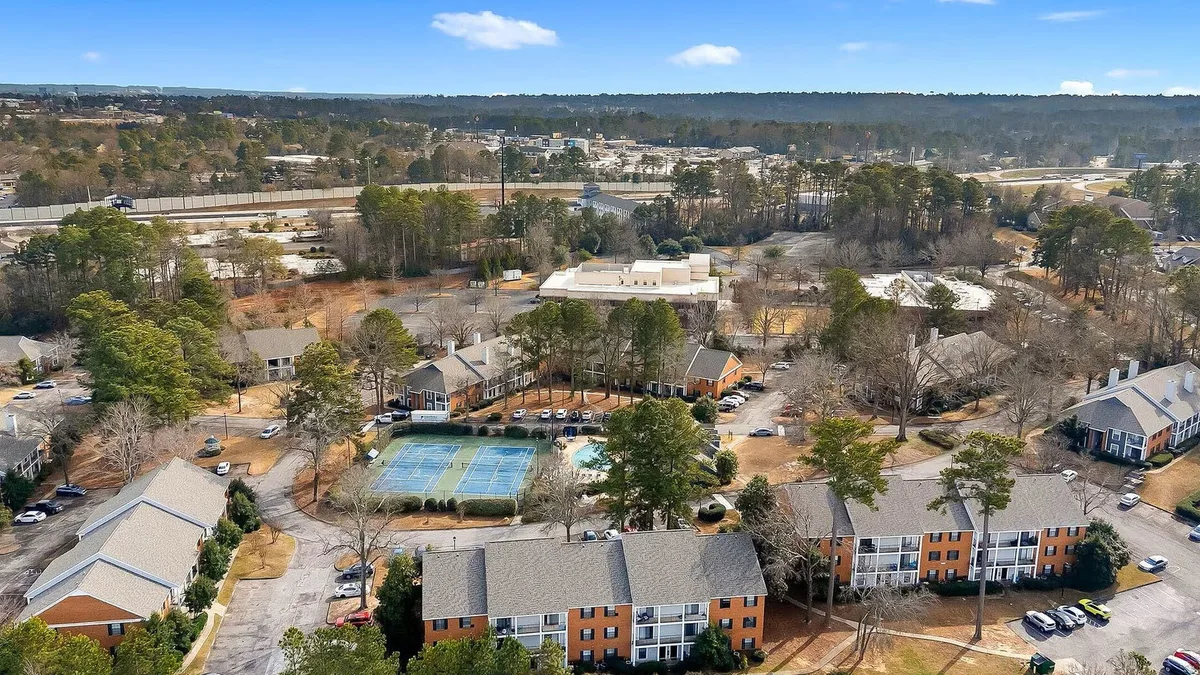
Deal terms and returns
Cap Rate Calculator: Value, NOI and Cap Rate
Cap rate formulas
- Cap rate
- NOI / price
- Value
- NOI / cap rate
- NOI
- Price x cap rate
- NOI build
- Rent - vacancy + other income - expenses
- NOI leaves out
- Debt, capex, depreciation, tax
- 2026 averages
- About 5.75% (apartments) to 7.7% (hotels)
NOI build as in MIT OpenCourseWare 11.431J. 2026 averages from Northmarq and HVS.
A cap rate calculator divides a property's net operating income (NOI) by its price to give the cap rate, or divides NOI by a cap rate to give the value.
Property value
$8,333,333
- NOI
- $500,000
- Cap rate
- 6.00%
- Value
- $8,333,333
Same NOI at nearby cap rates
- 5.00%
- $10,000,000
- 5.50%
- $9,090,909
- 6.00% (yours)
- $8,333,333
- 6.50%
- $7,692,308
- 7.00%
- $7,142,857
How this is calculated
Cap rate = NOI / price. Value = NOI / cap rate. NOI = price x cap rate. Write the cap rate as a decimal when you divide: 6% is 0.06.
NOI = gross rent minus vacancy and credit loss, plus other income, minus operating expenses. It leaves out loan payments, capital spending, depreciation and income tax.
Illustration only, not investment or tax advice; actual results depend on each offering's documents.
The short answer
A cap rate calculator divides a property's net operating income (NOI) by its price to give the cap rate, or divides NOI by a cap rate to give the value. Enter any two of NOI, price and cap rate and the third follows: $500,000 of NOI at a 6% cap rate is worth about $8,333,333.
Cap rate formulas
- Cap rate
- NOI / price
- Value
- NOI / cap rate
- NOI
- Price x cap rate
- NOI build
- Rent - vacancy + other income - expenses
- NOI leaves out
- Debt, capex, depreciation, tax
- 2026 averages
- About 5.75% (apartments) to 7.7% (hotels)
NOI build as in MIT OpenCourseWare 11.431J. 2026 averages from Northmarq and HVS.
- Any two numbers give the third. Cap rate = NOI / price, value = NOI / cap rate, NOI = price x cap rate.
- Small moves, big values. At $500,000 of NOI, going from a 6% to a 7% cap rate takes $1,190,476, or 14.3%, off the value.
- NOI comes first. Use income after operating expenses and before loan payments, never rent or cash flow after the loan.
- It prices, it does not forecast. A cap rate leaves out the loan, capital spending, growth, fees and the exit price.
In this guide · 7 sections
- How do you use this cap rate calculator?
- What are typical cap rates by property type?
- How do you value a property from its NOI?
- What does a cap rate tell you, and what does it leave out?
- What is NOI growth, and how do sponsors project it?
- How does the cap rate connect to your return as an investor?
- What else do people ask about calculating cap rates?
How to use it
How do you use this cap rate calculator?
Pick what you want to solve for, then enter the other two numbers. The calculator works from the three-way cap rate formula and updates as you type:
- Value = NOI / cap rate. Use it to price a property from its income.
- Cap rate = NOI / price. Use it to read the yield a buyer is paying for.
- NOI = price x cap rate. Use it to see what income a price and cap rate imply.
All amounts are a year. If you only have rents and expenses, tick "Build NOI from rent and expenses" and the calculator builds net operating income (NOI) the way MIT's real estate finance course does: potential gross rent, minus vacancy and credit loss, plus other income such as parking, minus operating expenses. The results card also values the same NOI at cap rates half a point and one point either side of yours, which is the quickest way to see how much a price depends on the cap rate.
For what makes a cap rate good for its risk, and how NOI is defined line by line, see the cap rate and NOI guide.
Typical cap rates
What are typical cap rates by property type?
In 2026, average U.S. cap rates ran from about 5.75% for apartments to about 7.7% for hotels. Industrial, self-storage, medical office and net lease averaged in the mid to high 6% range, and multi-tenant retail and office in the 7% range. Use them as a starting point for the calculator above, then check recent sales of similar properties in the same market.
| Property type | Average cap rate | Period | Source |
|---|---|---|---|
| Apartments (multifamily) | 5.75% | First half of 2026 | Northmarq, Sep 16, 2026 |
| Industrial, multi-tenant | 6.46% | Q3 2026 | Northmarq, Oct 28, 2026 |
| Self-storage | 6.59% | 2026 | Marcus & Millichap, Sep 2026 |
| Medical office | 6.8% | First half of 2026 | Cushman & Wakefield, Aug 18, 2026 |
| Net lease, single-tenant office, industrial and retail | 6.95% | Q3 2026 | Northmarq, Oct 28, 2026 |
| Retail, multi-tenant | 7.08% | Q3 2026 | Northmarq, Oct 28, 2026 |
| Office, multi-tenant | 7.58% | Q3 2026 | Northmarq, Oct 28, 2026 |
| Hotels | 7.7%; 8.0% to 8.5% for a stabilized hotel | Q2 2026 | HVS, Aug 27, 2026 |
These are national averages from broker and advisory research published from August to October 2026, each for the period shown. Cap rates vary by market, building class and age, tenant and deal, so a single property can trade well above or below its row. They describe the market, not offerings on Relli.
Worked example
How do you value a property from its NOI?
Divide the NOI by the cap rate that similar properties trade at. The example uses the default numbers in the NOI builder. For a net leased building, start with the triple net lease calculator.
Worked example
An apartment property is offered at $10,000,000. Rent at full occupancy would be $1,150,000 a year, vacancy and credit loss run 5%, parking and fees bring in $27,500 and operating expenses are $470,000. NOI is $1,150,000 - $57,500 + $27,500 - $470,000 = $650,000, so the asking price is a 6.5% cap rate.
| Cap rate | Math | Value | Vs $10M asking price |
|---|---|---|---|
| 6.0% | $650,000 / 0.060 | $10,833,333 | +8.3% |
| 6.5% | $650,000 / 0.065 | $10,000,000 | None |
| 7.0% | $650,000 / 0.070 | $9,285,714 | -7.1% |
Half a point of cap rate moves the value of the same income by about $700,000 to $830,000.
The swing is lopsided: half a point lower adds $833,333, half a point higher takes off $714,286. Cap rates sit in the denominator, so the lower they go, the faster value rises for each step down.
Reading the result
What does a cap rate tell you, and what does it leave out?
A cap rate tells you how much a buyer pays for each dollar of a property's yearly NOI, before any loan. It is a pricing measure, not a return forecast. MIT's course frames expected total return as roughly the cap rate plus expected growth in income, so a low cap rate can mean strong expected growth or low risk rather than an expensive building.
What it tells you
- The price per dollar of current or projected NOI.
- A first-year yield before debt, comparable across similar properties.
- How sensitive the price is to the market's cap rate.
What it leaves out
- The loan: NOI comes before debt payments.
- Capital spending, depreciation and income tax.
- Income growth, the exit price and the hold period.
- Sponsor fees, the promote and your share as an investor.
Two checks make the number useful. First, ask which NOI it uses: the last twelve months, next year's projection or a stabilized figure after a business plan. The same building can show very different cap rates on each. Second, ask what exit cap rate the sponsor assumes when the property sells, and rerun the value at half a point and one point higher.
What is NOI growth, and how do sponsors project it?
NOI growth is the yearly change in a property's net operating income, and sponsors project it by growing rents and other income at one rate and operating expenses at another. Because expenses are subtracted, a small gap between the two rates moves NOI more than either rate alone. Take $1,000,000 of income and $400,000 of expenses, so NOI is $600,000:
- Income and expenses both up 3%: NOI rises to $618,000, up 3%.
- Income up 2%, expenses up 4%: NOI rises to $604,000, up about 0.7%.
Check a projection against recent data before you put its NOI into the calculator. Same-store effective asking rents for U.S. apartments rose 1.7% in the year to October 2026 (RealPage, November 6, 2026). Consumer prices rose 3.7% in the year to September 2026, with rent of primary residence up 2.8% (Bureau of Labor Statistics, October 14, 2026). A plan that grows rents faster than those figures, or expenses slower than inflation, needs a stated reason, such as renovated units or below-market leases rolling over.
Next step
How does the cap rate connect to your return as an investor?
Only indirectly. In a syndication, the cap rate sets the price, then the loan, fees, business plan and sale price decide what investors receive. To go from property numbers to your own numbers:
- Use this calculator to test the going-in and exit cap rates.
- Put the sponsor's projected distributions and sale proceeds into the IRR and equity multiple calculator.
- Run the preferred return and split through the syndication returns calculator.
You can run all three on real offerings: each offering on Relli's investments page shows the sponsor's target terms, and you can ask the sponsor for the NOI and cap rate assumptions behind them.
Short answers
What else do people ask about calculating cap rates?
How do I calculate a cap rate from the purchase price?
Divide the property's yearly net operating income by the purchase price. $650,000 of NOI on a $10,000,000 price is $650,000 / $10,000,000 = 6.5%. Use NOI after operating expenses, not rent, and before any loan payments.
What cap rate should I use to value a property?
Use the cap rate at which similar properties, same type, market, age and tenant quality, have recently sold, from a dated broker or appraisal source. Then rerun the value half a point and a full point higher to see how much the price depends on that choice.
Does the cap rate include the mortgage?
No. NOI is measured before debt payments, so the cap rate is the same whether the buyer pays cash or borrows. The loan shows up in cash-on-cash return and levered IRR instead.
Can a cap rate be negative?
Yes. If operating expenses exceed income, NOI is negative and so is the cap rate. The calculator shows it when you solve for the cap rate, but it will not value a property from a negative NOI, because dividing a loss by a cap rate gives no meaningful price.
Is a higher cap rate better?
Only if the income is as safe and as likely to grow as at a lower cap rate. Buyers usually demand a higher cap rate for weaker tenants, shorter leases, tougher locations or buildings that need work, so a high number often prices in a risk.
Sources
- 11.431J Real Estate Finance and Investment: real estate cash flow pro formas and opportunity cost of capital (lecture slides), MIT OpenCourseWare (Fall 2006 | accessed Nov 12, 2026)
- Research Corner: Cap Rate, Please Explain!, NCREIF (Oct 2011)
- U.S. Cap Rate Survey H1 2026, CBRE (Aug 12, 2026)
- REIT Industry Tracker (T-Tracker), 2026 Q2, implied cap rates, Nareit (Aug 2026 | period Q2 2026)
- NCREIF Indices Review webinar slides, 2Q 2026, NCREIF (Sep 2026 | period ended Jun 30, 2026)
- The Nuts and Bolts of Private Commercial Real Estate (CRE) Investing, CFA Institute Enterprising Investor (Apr 7, 2023)
- MarketSnapshot: Multi-Tenant Overall Market, Q3 2026, Northmarq (Oct 28, 2026 | period Q3 2026 | accessed Nov 14, 2026)
- MarketSnapshot: Single-Tenant Overall Market, Q3 2026, Northmarq (Oct 28, 2026 | period Q3 2026 | accessed Nov 14, 2026)
- 2026 Midyear National Multifamily Report, Northmarq (Sep 16, 2026 | period H1 2026 | accessed Nov 14, 2026)
- U.S. Self-Storage Outlook 2026, Marcus & Millichap (Sep 2026 | accessed Nov 14, 2026)
- MOB Capital Markets 2026 Mid-Year Update, Cushman & Wakefield (Aug 18, 2026 | period H1 2026 | accessed Nov 14, 2026)
- HVS U.S. Market Pulse: August 2026, HVS (Aug 27, 2026 | period Q2 2026 | accessed Nov 14, 2026)
- October 2026 U.S. apartment data update, RealPage (Nov 6, 2026 | accessed Nov 14, 2026)
- Consumer Price Index, September 2026 (news release), U.S. Bureau of Labor Statistics (Oct 14, 2026 | accessed Nov 14, 2026)